

School Meal Programs By Total Beneficiaries 2026
A school meal is never just a plate of food.

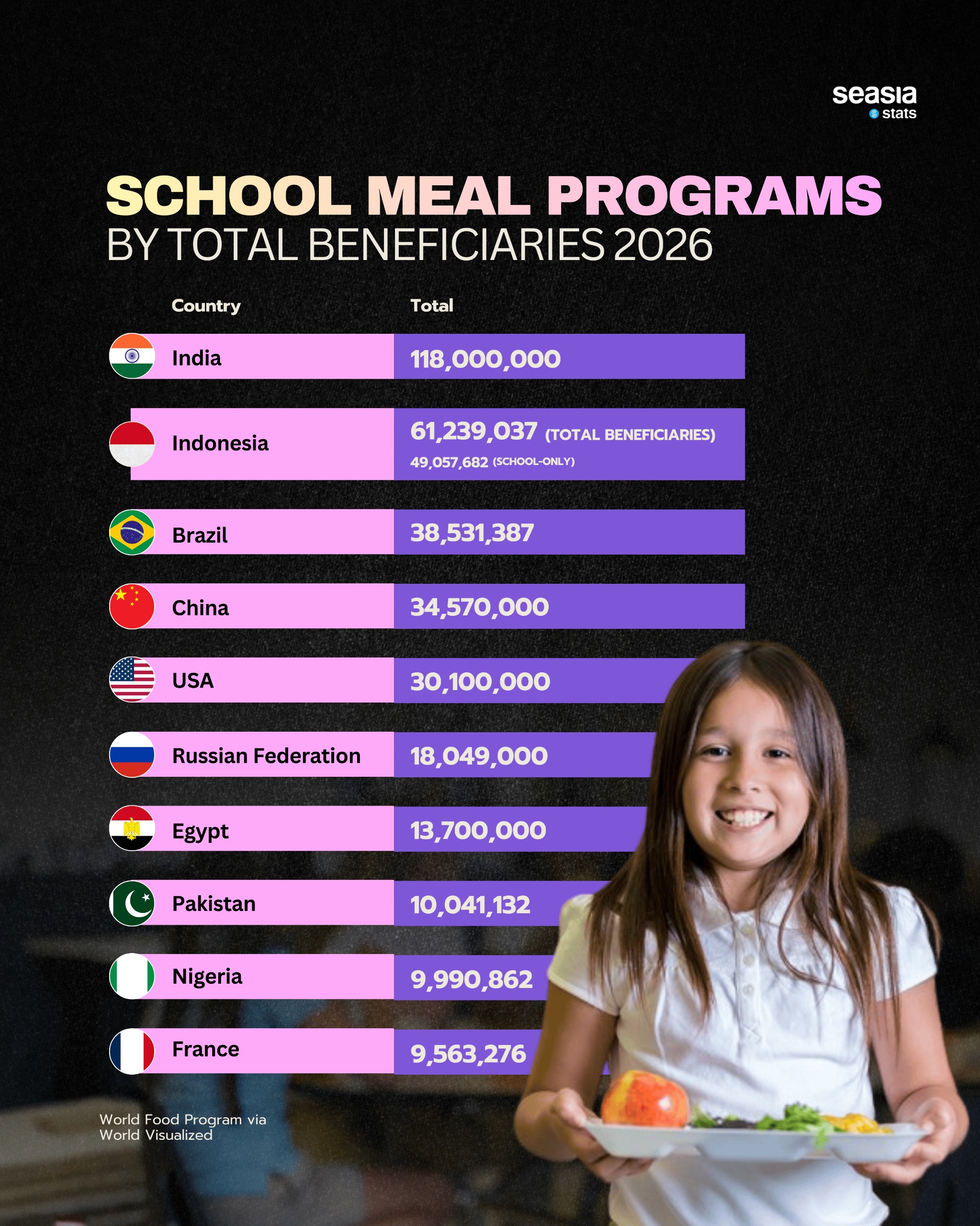
A school meal is never just a plate of food. In many countries, it is a quiet but powerful promise: that a child will not have to learn on an empty stomach. The latest figures highlighted by Seasia Stats show just how massive that promise has become, with some of the world’s largest nations now feeding tens of millions of children through public school meal systems.
Feeding at National Scale
At the top of the global list is India, whose school meal system reaches an extraordinary 118 million beneficiaries. That makes it one of the largest child nutrition programmes ever attempted anywhere in the world. India’s long-running PM POSHAN scheme—formerly known as the Mid-Day Meal Scheme—has for years been one of the country’s most important social protection tools, designed to keep children in school while improving nutrition and attendance. The Indian government says the programme provides hot cooked meals to children in government and aided schools, while recent official statements have emphasized its role in helping students “attend classes regularly, concentrate better, and thrive in class.”
Right behind India is Indonesia, with 61.2 million total beneficiaries, including about 49 million school-age children. That figure reflects the rapid expansion of the country’s Free Nutritious Meals programme, which has become one of the most ambitious social policy experiments in Southeast Asia. The initiative does not only target students; it also includes pregnant women, breastfeeding mothers, and toddlers, positioning nutrition as a national development priority rather than just a school policy. Recent Indonesian reporting has shown the programme continuing even during public holidays, underlining how central it has become to the government’s long-term human capital strategy.
Why School Meals Matter More Than Ever
Globally, school feeding is now far bigger than many people realize. The World Food Programme says that 466 million children benefit from school meal programmes worldwide, and that national governments—not aid agencies—now fund the overwhelming majority of these systems. WFP’s latest reporting also found that the number of children receiving school meals has risen sharply in recent years, making school feeding one of the fastest-growing forms of child social protection in the world.
The reason is simple: school meals do more than reduce hunger. They improve attendance, help children focus, support healthier growth, and often act as a financial cushion for low-income households. UNICEF has repeatedly stressed that nutrition and education are inseparable, noting that schools can become powerful platforms for healthier diets and better lifelong outcomes. During crises, they can even become a family’s most reliable source of daily food.
Southeast Asia’s Big Nutrition Bet
For Southeast Asia, Indonesia’s position near the very top of the list is especially significant. It signals that the region is no longer treating school feeding as a narrow welfare programme, but as an investment in future productivity, child development, and even national competitiveness.
This is important because Southeast Asia still faces a double burden of malnutrition: undernutrition remains a problem in poorer and rural communities, while childhood overweight and unhealthy processed food consumption are also rising in urban areas. In Indonesia, UNICEF has highlighted exactly this tension, warning that school-age nutrition now sits at the heart of the country’s broader development challenge. That makes school meal design—not just coverage—critically important.
Elsewhere in the region, countries like Thailand, Vietnam, and the Philippines may not yet appear near the very top of the global beneficiary rankings, but school nutrition has become increasingly central to public health and education planning. As ASEAN countries urbanize and household food habits change, school canteens and meal programmes are becoming more important than ever in shaping how the next generation eats.
Beyond Quantity: The Challenge of Quality
Of course, scale alone does not guarantee success. That is the hard truth behind every large school feeding system. The bigger the programme, the harder it becomes to ensure food safety, nutrition standards, local sourcing, and consistent delivery—especially across remote or poorer regions.
Indonesia’s rollout, for example, has also faced scrutiny over implementation, logistics, and food safety incidents, reminding policymakers that rapid expansion must be matched by strong oversight and kitchen infrastructure.
Still, the broader picture remains clear: from India to Indonesia, school meals are no longer a side policy. They are becoming one of the defining ways modern states invest in childhood itself.
And in a world where millions of children still arrive at school hungry, that may be one of the most meaningful public policies a government can offer.