

Share of Global Forest Area in 2025
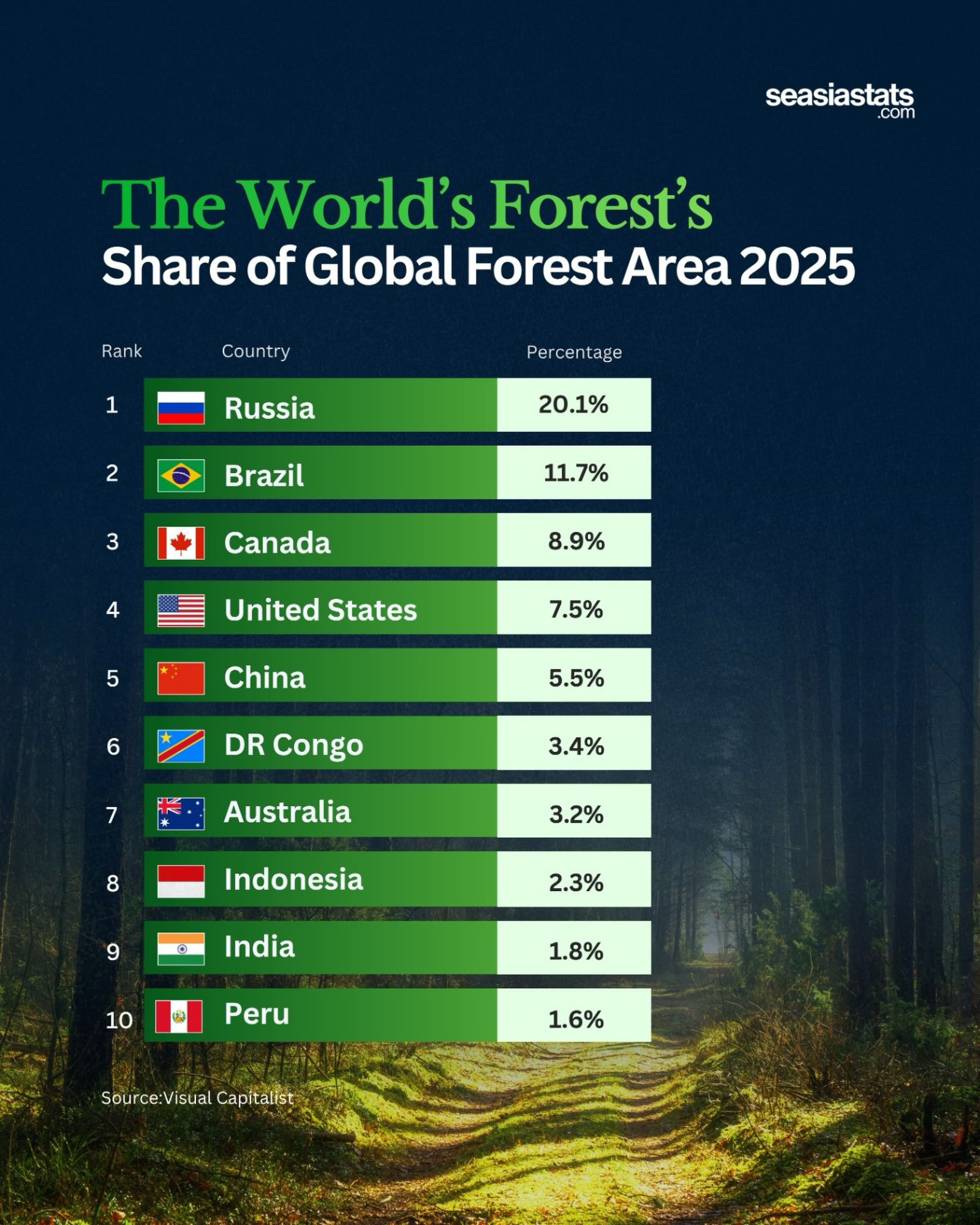
Russia has the largest share of the world's forest with 20.1%.

Forests are among the planet’s most important natural resources, supporting biodiversity, storing carbon, regulating water cycles, and providing livelihoods for millions of people. Yet the world’s forests are not distributed evenly.
According to Visual Capitalist, using data from the Food and Agriculture Organization of the United Nations (FAO) Global Forest Resources Assessment 2025, global forest area reached about 4.14 billion hectares, covering roughly 32% of the world’s land area.
Russia holds the largest share of the world’s forest area, accounting for 20.1%. Its enormous boreal forests stretch across much of the country, making Russia the clear global leader. Brazil ranks second with 11.7%, largely because of the vast Amazon rainforest within its borders. Together, Russia and Brazil contain nearly one-third of the world’s forests.
Canada comes third with 8.9%, followed by the United States with 7.5%. These two North American countries have extensive forests covering large areas, particularly across their northern and western regions.
China, meanwhile, accounts for 5.5% of global forest area and completes the top five. Visual Capitalist notes that these five countries together hold more than half of the world’s forests.
The Democratic Republic of the Congo (DR Congo) ranks sixth, contributing 3.4% of global forest area. Its forests form a major part of the Congo Basin, one of the world’s most important tropical forest regions. Australia follows with 3.2%, while Indonesia accounts for 2.3%, reflecting the importance of its tropical forests and ecosystems.
Rounding out the top 10 are India, with 1.8%, and Peru, with 1.6%. Peru’s forests are also strongly connected to the Amazon ecosystem, while India’s forests span a wide range of landscapes and ecological zones. The figures show how several of the world’s largest forest concentrations are found in countries with very different climates and geography.
Overall, the ranking highlights the highly concentrated nature of the world’s forests. Russia, Brazil, Canada, the United States, and China alone account for more than half of global forest area, while the top 10 countries represent a substantial majority.
These figures underscore why forest conservation in a relatively small group of countries can have global consequences for climate, biodiversity, and ecosystems.