

Singapore Leads IMD World Competitiveness Ranking
Singapore is the most economically competitive country in the world according to IMD World Competitiveness Center.

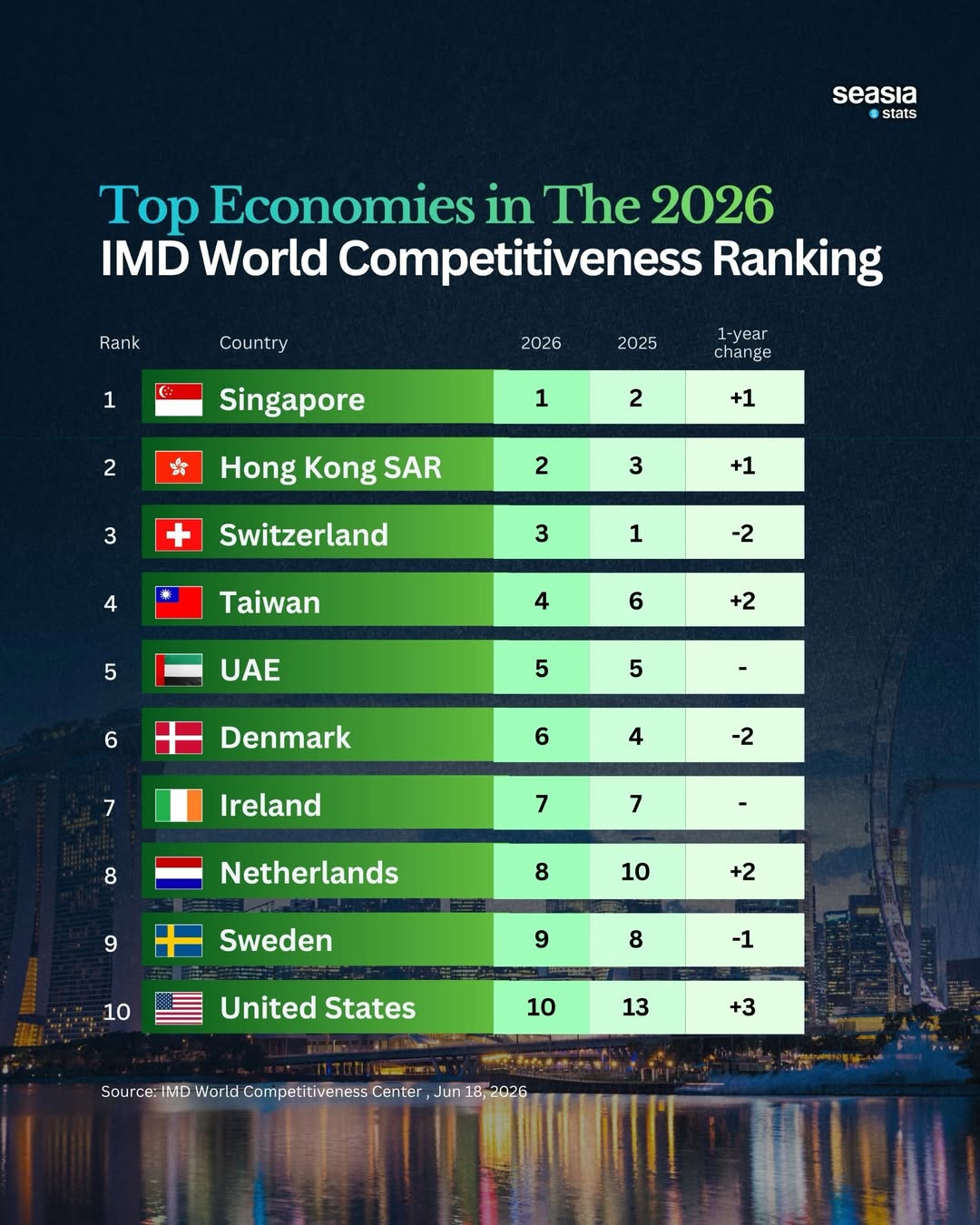
The 2026 IMD World Competitiveness Ranking highlights significant shifts among the world’s most competitive economies, reflecting changing strengths in governance, business efficiency, infrastructure, and economic performance. This year, Singapore reclaimed the top position, while several other economies experienced notable movements within the top ten.
Singapore rose from second place in 2025 to become the world’s most competitive economy in 2026. The city-state’s strong economic fundamentals, pro-business environment, world-class infrastructure, and commitment to innovation continue to make it a global benchmark for competitiveness. Its ability to attract investment and talent has reinforced its position at the top of the ranking.
Hong Kong also improved its standing, climbing from third place in 2025 to second in 2026. The economy benefited from its role as a major international financial center and its continued integration with regional and global markets. The improvement underscores Hong Kong’s resilience and its capacity to maintain competitiveness amid evolving economic conditions.
Switzerland, which held the top spot in 2025, slipped to third place in 2026. Despite the decline, Switzerland remains one of the world’s strongest performers, supported by its innovation ecosystem, highly skilled workforce, and stable institutional framework.
Taiwan emerged as one of the biggest movers in the top ten, advancing from sixth place in 2025 to fourth in 2026. Its rise reflects strong performance in technology-driven industries, advanced manufacturing capabilities, and sustained investment in innovation and research.
The United Arab Emirates maintained its fifth-place position for a second consecutive year. The UAE’s consistent ranking demonstrates the effectiveness of its diversification efforts, business-friendly policies, and investments in infrastructure and digital transformation.
Denmark fell from fourth place in 2025 to sixth in 2026, while Ireland retained seventh place in both years. Ireland’s stable ranking highlights its continued attractiveness for international business and investment, particularly in technology and pharmaceutical sectors.
The Netherlands moved up from tenth place in 2025 to eighth in 2026, benefiting from its strong logistics network, open economy, and innovation-focused business environment. Sweden, meanwhile, slipped from eighth to ninth place but remained among the world’s leading competitive economies.
Rounding out the top ten, the United States recorded a significant improvement, rising from thirteenth place in 2025 to tenth in 2026. The gain reflects the country’s economic dynamism, technological leadership, and strong business ecosystem.
Overall, the 2026 ranking demonstrates the importance of adaptability, innovation, and effective governance in maintaining global competitiveness in an increasingly complex economic landscape.