

Southeast Asian Cities That Are Getting Warmer the Most
The world is getting warmer. In Southeast Asia, six cities are warming the most.

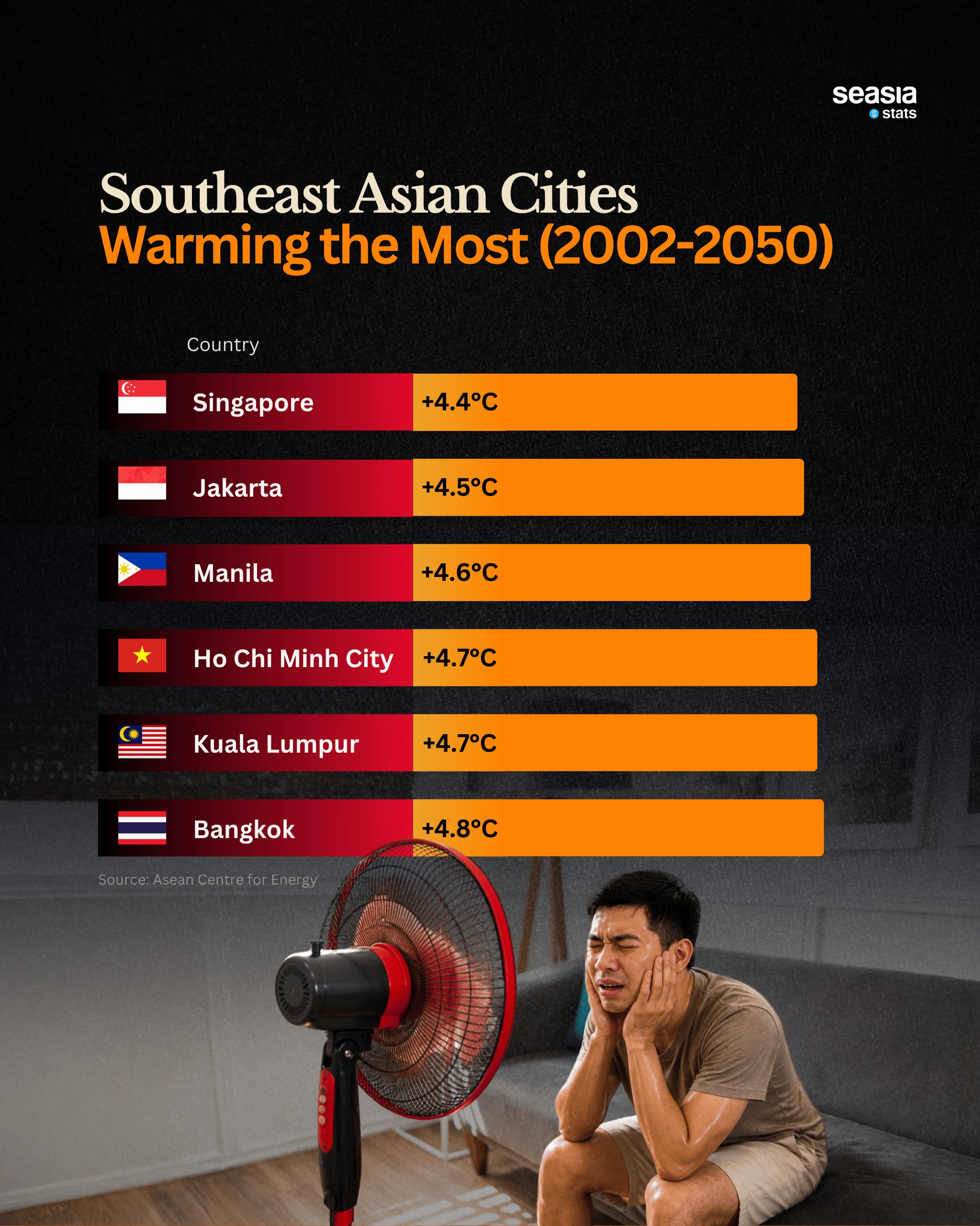
Southeast Asia’s rapidly growing cities are facing an intensifying climate challenge. According to research by the ASEAN Centre for Energy (ACE), urban areas across the region are projected to experience significant temperature increases between 2002 and 2050, driven by global climate change and amplified by local urban conditions.
These projections highlight a troubling trend: some of the region’s most important economic hubs are also among the fastest-warming.
Among the cities studied, Bangkok is expected to see the largest increase, with temperatures rising by approximately 4.8°C. Close behind are Ho Chi Minh City and Kuala Lumpur, each projected to warm by about 4.7°C.
Manila follows with an increase of around 4.6°C, while Jakarta is expected to warm by 4.5°C and Singapore by 4.4°C. Though the differences may seem small, even a fraction of a degree can significantly intensify heat stress, especially in already hot and humid tropical environments.
These warming trends are not occurring in isolation. Southeast Asia is already one of the world’s most climate-vulnerable regions, experiencing more frequent and intense heatwaves over recent decades.
ACE’s latest findings suggest that by 2050, many cities could endure between 85 and 120 days each year with temperatures exceeding 35°C, pushing urban systems to their limits. Bangkok, for example, could see average temperatures reaching over 38°C, making it the hottest major city in the region.
A key factor behind this rapid warming is the “urban heat island” effect. Dense concentrations of concrete, asphalt, and buildings trap heat, while limited green space reduces natural cooling.
In cities like Jakarta and Bangkok, temperatures in urban cores can already be several degrees higher than surrounding rural areas. As urban populations continue to grow—projected to account for two-thirds of the region’s population by mid-century—these effects are likely to intensify.
The consequences of rising urban temperatures are far-reaching. Public health risks, including heatstroke and respiratory stress, are expected to increase, particularly among vulnerable populations such as the elderly and low-income communities.
Economically, higher temperatures can reduce productivity, strain energy systems due to increased cooling demand, and raise household costs. This creates a feedback loop, where increased energy use contributes further to greenhouse gas emissions.
Addressing these challenges will require urgent and coordinated action. Strategies such as expanding urban green spaces, improving building design for passive cooling, and transitioning to cleaner energy sources are essential.
As Southeast Asian cities continue to grow, their ability to adapt to rising temperatures will play a crucial role in determining the region’s future resilience.