

Southeast Asian Countries and Their Forest Areas
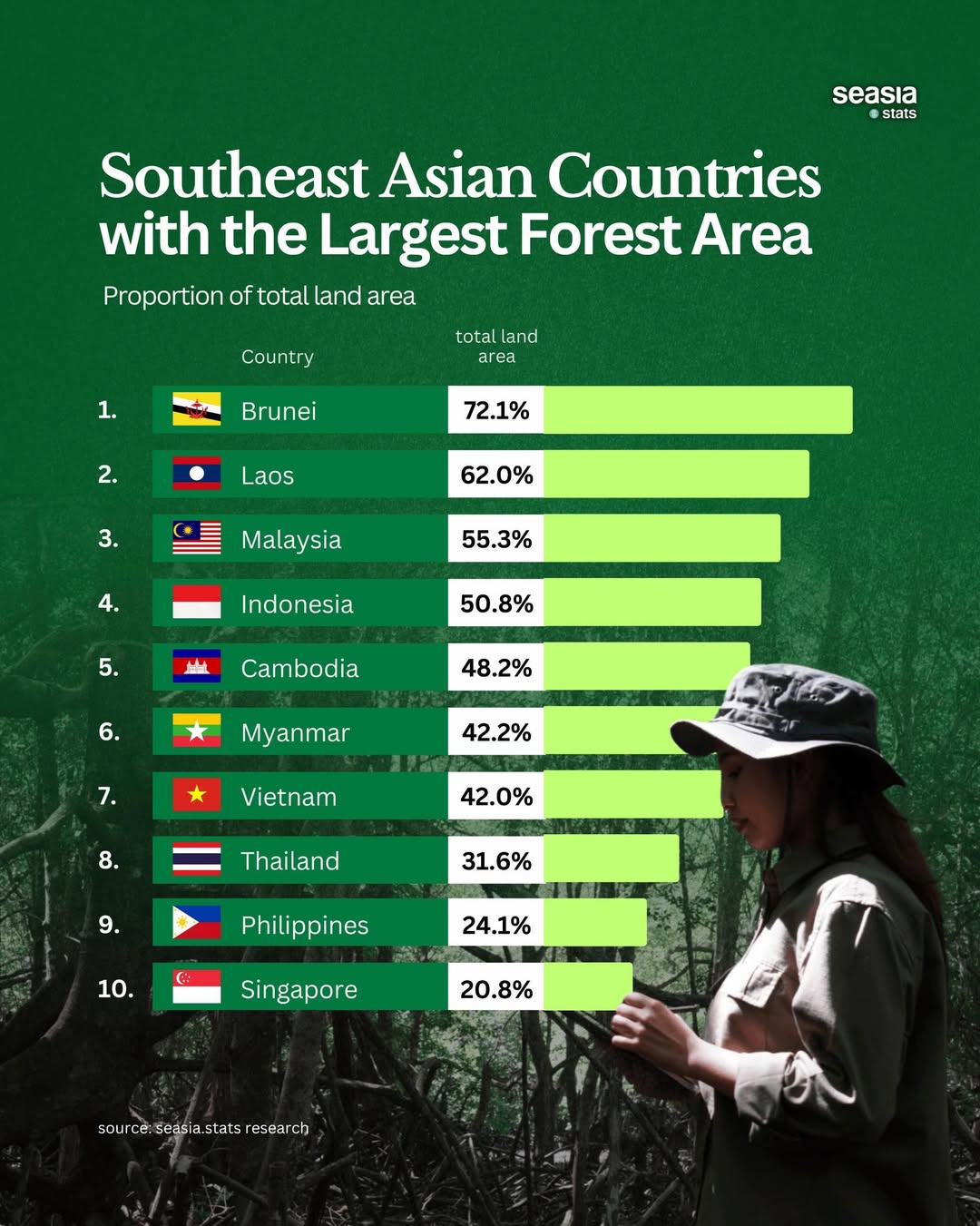
Brunei holds the record with the largest forest area in Southeast Asia.

Southeast Asia is one of the world’s richest regions in terms of biodiversity and tropical rainforest ecosystems. Forests in the region play a vital role in maintaining environmental balance, supporting wildlife habitats, regulating climate, and sustaining millions of people who depend on forest resources for their livelihoods.
However, the percentage of forest coverage differs greatly among Southeast Asian countries due to geography, urbanization, agriculture, and economic development.
Among all countries in the region, Brunei has the largest forest coverage, with forests covering 72.1% of its land area. Despite being a wealthy oil-producing nation, Brunei has managed to preserve much of its tropical rainforest. The country’s relatively small population and strong environmental protections have helped maintain its dense forest ecosystems.
Laos ranks second with 62.0% forest coverage. Much of Laos remains mountainous and sparsely populated, allowing extensive forest areas to survive. Forests are essential to the country’s biodiversity and rural economy, although illegal logging and land conversion remain challenges.
In Malaysia, forests cover 55.3% of the country’s territory. Malaysia is home to some of the oldest tropical rainforests in the world, particularly on the island of Borneo. These forests contain unique wildlife species such as orangutans, sun bears, and hornbills. However, palm oil plantation expansion has significantly affected forest conservation efforts over the years.
Indonesia follows with 50.8% forest coverage. As one of the world’s largest archipelagic nations, Indonesia possesses enormous rainforest areas spread across Sumatra, Kalimantan, Papua, and Sulawesi.
Indonesian forests are globally important because they store vast amounts of carbon and support extraordinary biodiversity. Nevertheless, deforestation caused by logging, mining, and plantation development remains a major environmental issue.
Other countries with substantial forest areas include Cambodia at 48.2%, Myanmar at 42.2%, and Viet Nam at 42.0%. Viet Nam has made significant progress in reforestation programs during recent decades, helping restore forest cover after years of war and agricultural expansion.
Meanwhile, Thailand records 31.6% forest coverage, while the Philippines has 24.1%. Rapid urban growth, farming, and infrastructure development have reduced forested land in both countries over time.
Finally, highly urbanized Singapore maintains 20.8% forest coverage despite its limited land area. Through careful urban planning and conservation policies, Singapore continues to protect green spaces within a modern city environment.
Overall, Southeast Asia’s forests remain essential for environmental sustainability, climate stability, and biodiversity conservation, making their protection increasingly important for future generations.