

Southeast Asian Countries by Water Area
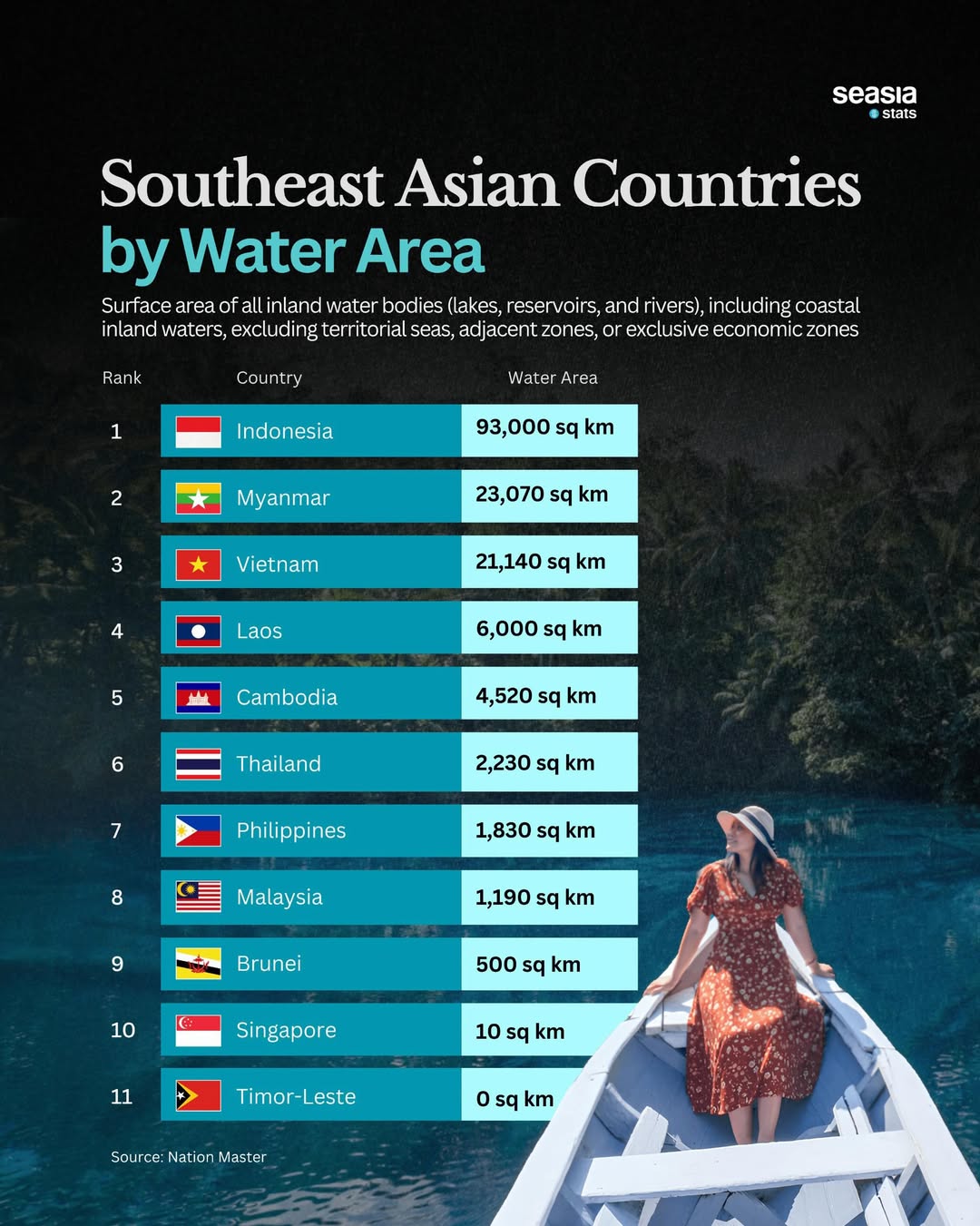
In Southeast Asia, Indonesia has the largest water area, followed by Myanmar and Vietnam.

Water resources play a vital role in shaping the geography, economies, and ecosystems of Southeast Asia.
When measuring water area—including inland water bodies such as lakes, rivers, reservoirs, wetlands, and coastal inland waters, while excluding territorial seas, adjacent zones, and exclusive economic zones—the countries of Southeast Asia display considerable variation in their aquatic landscapes.
Indonesia ranks first by a wide margin, with approximately 93,000 square kilometers of water area. As the world's largest archipelagic nation, Indonesia possesses countless rivers, lakes, swamps, and coastal lagoons spread across thousands of islands. These water resources support biodiversity, transportation, fisheries, agriculture, and hydroelectric development.
Myanmar holds second place with 23,070 square kilometers of water area. The country is traversed by major river systems such as the Ayeyarwady and Salween, along with extensive wetlands and inland waterways that are essential to both the environment and local livelihoods.
Vietnam follows closely with 21,140 square kilometers. Its extensive river networks, including the Red River and Mekong River deltas, contribute significantly to its large water area. These waterways are central to agriculture, aquaculture, and transportation.
Laos ranks fourth with 6,000 square kilometers of water area. Despite being landlocked, the country is rich in rivers and reservoirs, particularly along the Mekong River, which forms much of its western border. Cambodia follows with 4,520 square kilometers, largely due to the presence of the Tonlé Sap Lake, one of Southeast Asia's most important freshwater ecosystems.
Thailand possesses 2,230 square kilometers of water area, supported by numerous rivers, reservoirs, and inland lakes. The Philippines, despite being an island nation, has a comparatively modest inland water area of 1,830 square kilometers, consisting mainly of lakes, rivers, and freshwater wetlands.
Malaysia records 1,190 square kilometers of water area, while Brunei has approximately 500 square kilometers. Both countries benefit from extensive river systems that contribute to their environmental and economic development.
Singapore, one of the world's most urbanized nations, has just 10 square kilometers of water area. Nevertheless, its reservoirs and water management infrastructure play a crucial role in ensuring national water security.
Timor-Leste is listed with 0 square kilometers of water area under this classification, reflecting the limited extent of recognized inland water bodies within the measurement criteria.
These figures highlight the diverse hydrological characteristics of Southeast Asia. From Indonesia's vast network of inland waters to the smaller water resources of Singapore and Timor-Leste, water remains a defining feature of the region's geography, environmental sustainability, and economic activity.