

Southeast Asian Countries' First Skyscrapers
Malaysia is the first Southeast Asian country to have its very first skyscraper, with Laos being the latest.

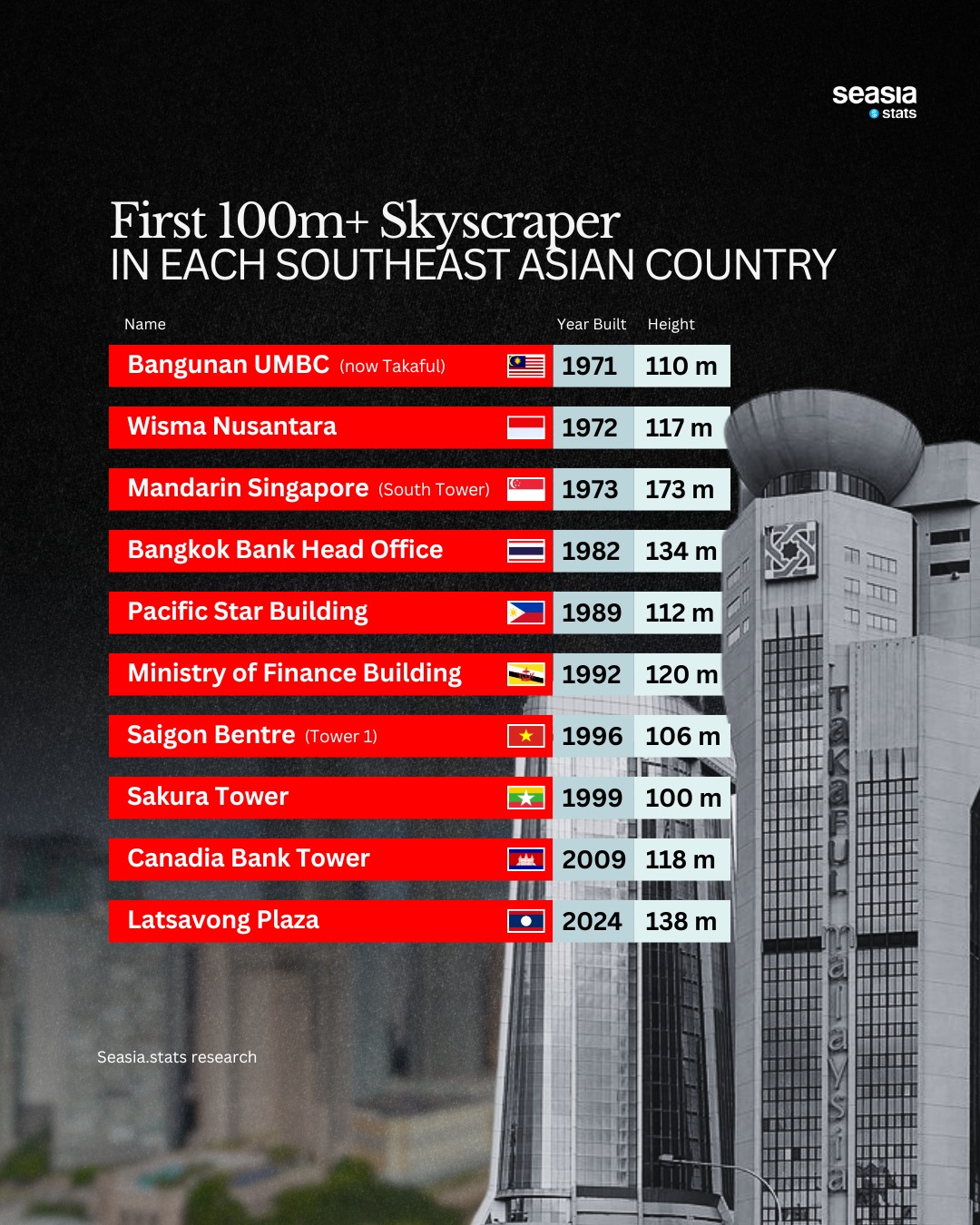
The rise of skyscrapers in Southeast Asia reflects the region’s rapid urbanization, economic growth, and modernization during the late twentieth and early twenty-first centuries. Across the region, the construction of the first buildings exceeding 100 meters symbolized national ambition and the emergence of modern city skylines.
Each Southeast Asian country reached this milestone at different moments in history, often tied to periods of economic transformation.
Malaysia became one of the earliest countries in the region to construct a 100-meter skyscraper with Bangunan UMBC. Completed in 1971 and standing 110 meters tall, the tower represented Kuala Lumpur’s growing status as a financial and commercial center.
Shortly afterward, Indonesia completed Wisma Nusantara in 1972. At 117 meters, it became Jakarta’s first modern skyscraper and symbolized Indonesia’s post-independence economic aspirations.
Singapore entered the skyscraper era with Mandarin Singapore in 1973. Rising to 173 meters, it was among the tallest buildings in Southeast Asia at the time and demonstrated Singapore’s emergence as a global business and tourism hub.
Thailand followed with the completion of Bangkok Bank Head Office in 1982. The 134-meter structure reflected Bangkok’s rapid commercial expansion during Thailand’s economic boom years.
In the Philippines, Pacific Star Building became the country’s first 100-meter-plus skyscraper in 1989, reaching 112 meters. Located in Makati, the nation’s financial center, it highlighted the growing importance of corporate development in Metro Manila.
Brunei achieved the milestone with the Ministry of Finance Building in 1992. Standing 120 meters tall, the building represented the oil-rich sultanate’s modernization and administrative development.
Viet Nam’s first skyscraper above 100 meters was Saigon Center, completed in 1996 at 106 meters. It marked the beginning of Ho Chi Minh City’s transformation into a major regional economic center following the country’s economic reforms.
Myanmar joined the list with Sakura Tower in 1999. Reaching exactly 100 meters, the tower became a landmark of Yangon’s modern business district.
Cambodia’s first modern skyscraper was Canadia Bank Tower, completed in 2009 with a height of 118 meters. It reflected Phnom Penh’s growing urban development after decades of instability.
Most recently, Laos entered the skyscraper era with Latsavong Plaza in 2024. Standing 138 meters tall, the complex symbolizes the country’s increasing integration into regional economic growth.
Together, these pioneering skyscrapers illustrate Southeast Asia’s journey toward modernization and the changing architectural identity of its major cities.