

Southeast Asian Countries from the Slimmest to the Heaviest
In Southeast Asia, Vietnamese are the slimmest while Bruneians are the heaviest.

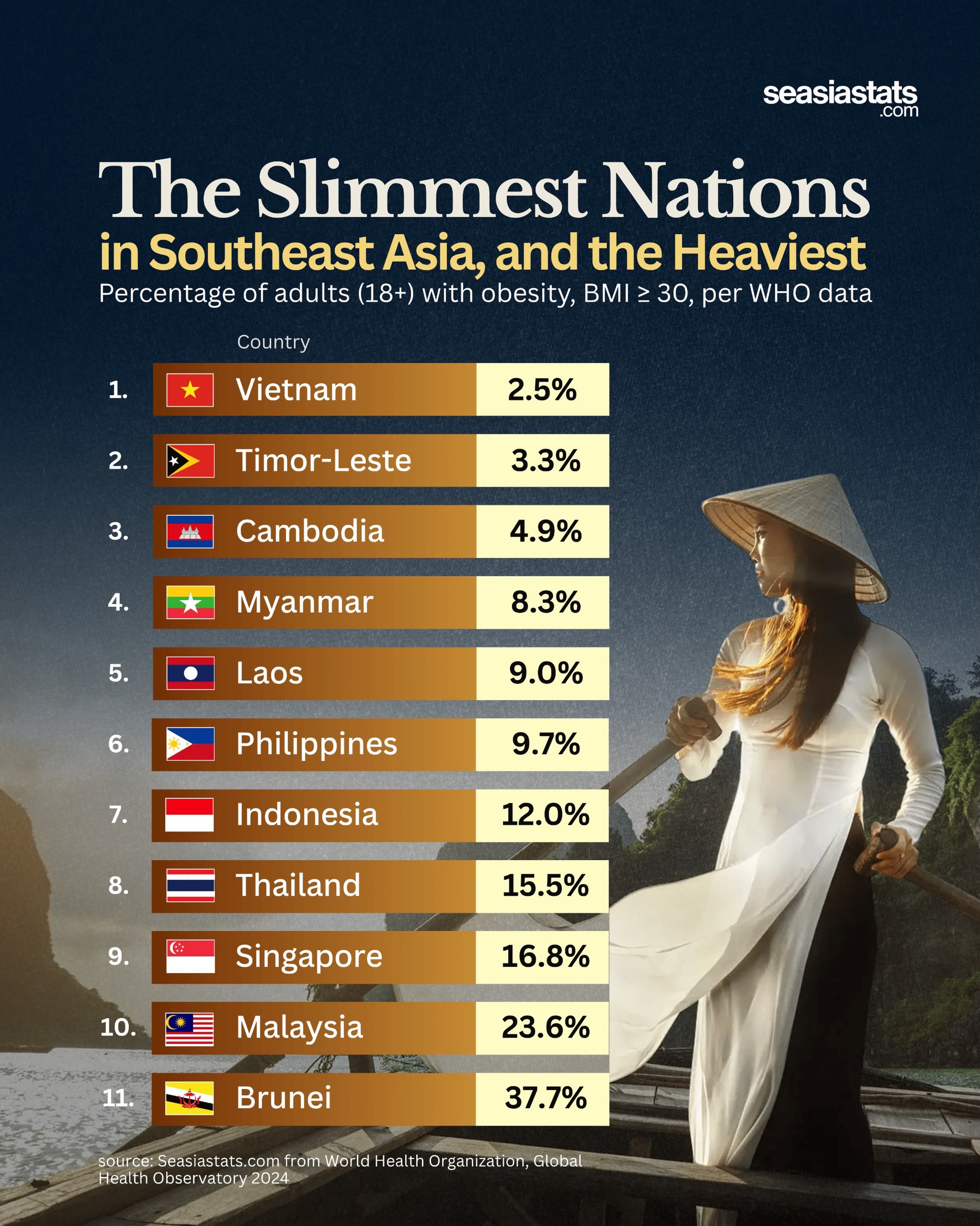
Southeast Asia is home to more than 680 million people and includes countries with remarkably different lifestyles, diets, economies, and patterns of health. One way to examine these differences is through adult obesity prevalence.
According to the figures provided from World Health Organization data, the countries of Southeast Asia can be arranged from the lowest to the highest percentage of adults living with obesity.
At the lowest end of the list is Vietnam, with an adult obesity rate of 2.5%. Vietnam is followed by Timor-Leste, at 3.3%, and Cambodia, at 4.9%. These relatively low figures place the three countries at the bottom of the regional ranking.
Next comes Myanmar, where the adult obesity rate is listed at 8.3%, followed by Laos at 9.0%. The Philippines has a rate of 9.7%, making it the sixth country in this ranking. Although these percentages are considerably higher than those of Vietnam, Timor-Leste, and Cambodia, they remain below the rates reported for several other Southeast Asian countries.
Indonesia comes next, with an adult obesity rate of 12.0% in the figures provided. As Southeast Asia's most populous country, Indonesia has experienced major changes in urbanization, food consumption, and lifestyles.
The World Health Organization has identified changing diets, urbanization, and insufficient physical activity as important factors in the region's growing burden of overweight and obesity.
The next countries are Thailand, at 15.5%, and Singapore, at 16.8%. Both countries have experienced substantial economic and urban development, alongside changes in diet and daily physical activity.
Higher on the list are Malaysia, with 23.6%, and finally Brunei, with 37.7%. Based on the figures supplied, Brunei has the highest adult obesity percentage among the 11 Southeast Asian countries listed.
It is important to remember that obesity statistics are estimates rather than measurements of every individual in a country. WHO defines adult obesity using a BMI of 30 kg/m² or higher, and its estimates are age-standardized to make comparisons between populations more meaningful.
Overall, the figures illustrate substantial differences across Southeast Asia, from Vietnam's 2.5% to Brunei's 37.7%. They also highlight how obesity has become an increasingly important public-health issue in a region traditionally associated with lower obesity prevalence.
WHO notes that Southeast Asia is experiencing a nutrition transition in which economic development, urbanization, changing diets, and physical inactivity are contributing to rising levels of overweight and obesity.