

Southeast Asian Countries with the Largest Chinese-Speaking Populations
Malaysia has the largest Chinese-speaking population in all of Southeast Asia.

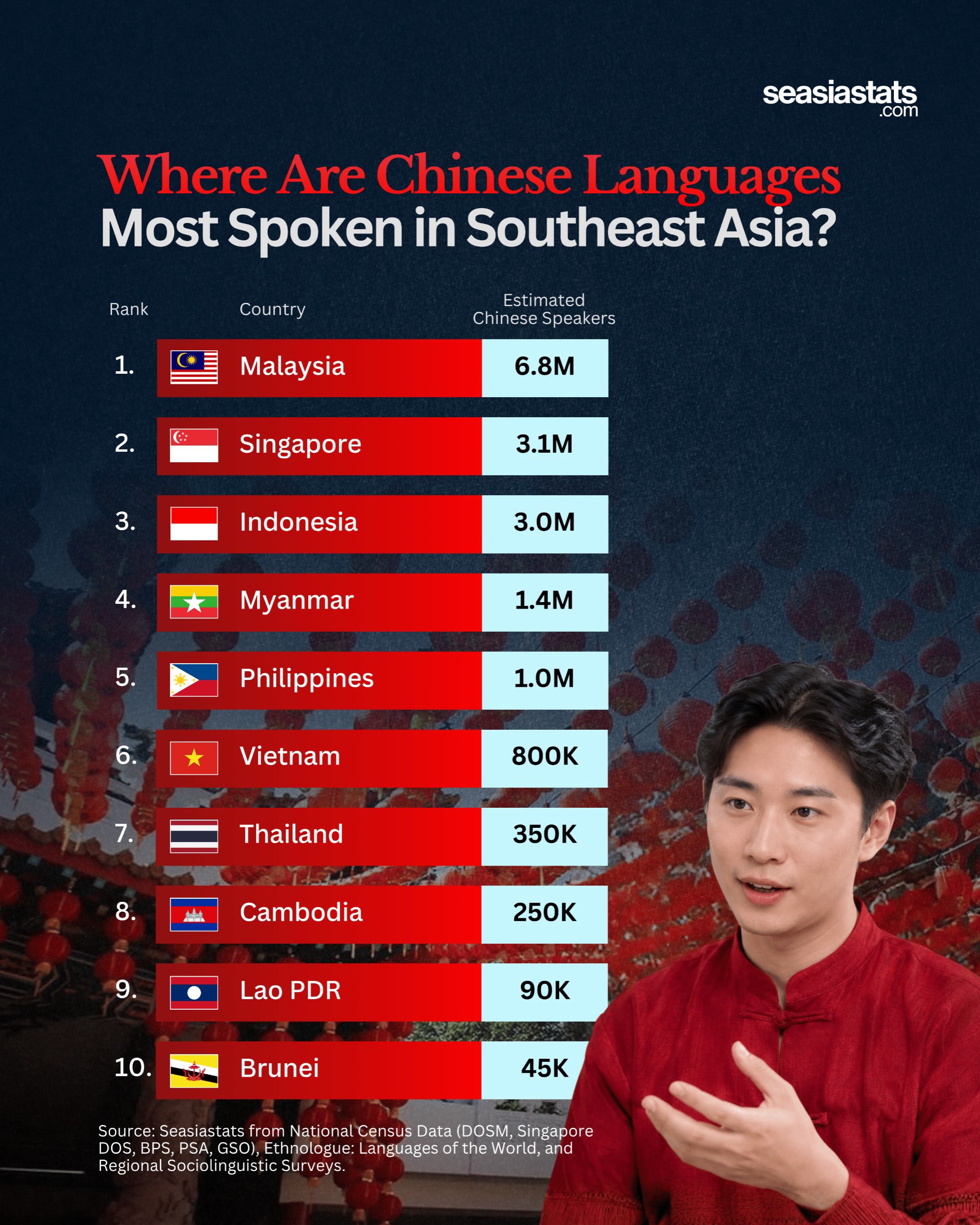
Chinese-speaking communities have a significant presence across Southeast Asia, reflecting centuries of migration, trade, cultural exchange, and historical connections with China. Today, several countries in the region have millions of people who speak Chinese, making the language an important part of Southeast Asia's cultural and linguistic diversity.
Malaysia ranks first among Southeast Asian countries with the largest Chinese-speaking population, with approximately 6.8 million speakers.
The Chinese language, particularly Mandarin and various Chinese dialects, plays an important role in the country's multicultural society. Chinese-language education, media, and cultural institutions also contribute to maintaining the language across generations.
Singapore comes second with around 3.1 million Chinese speakers. As a country with a Chinese-majority population, Mandarin is one of its four official languages and an important part of its education system, public communication, and cultural identity.
Indonesia ranks third, with approximately 3.0 million Chinese speakers. The language is maintained through Chinese-Indonesian communities, educational institutions, cultural activities, and growing interest in learning Mandarin for business and international communication.
Myanmar occupies fourth place with an estimated 1.4 million Chinese speakers. Its Chinese-speaking population is concentrated particularly in areas with historical connections to China, including communities involved in cross-border trade and commerce.
The Philippines follows in fifth place with approximately 1.0 million speakers. Chinese is spoken within Filipino-Chinese communities, where it remains connected to family traditions, cultural heritage, and business activities.
Vietnam ranks sixth with around 800,000 Chinese speakers, reflecting the presence of ethnic Chinese communities and historical linguistic connections. Thailand takes seventh place with approximately 350,000 speakers, while Cambodia ranks eighth with an estimated 250,000.
Laos occupies ninth position with around 90,000 Chinese speakers. The language has gained additional importance through expanding economic relations, investment, tourism, and trade connections with China.
Brunei completes the list with approximately 45,000 Chinese speakers. Despite having a relatively small population, its Chinese-speaking community contributes to the country's multicultural environment and maintains important cultural and commercial connections.
Overall, these figures highlight the widespread influence of the Chinese language throughout Southeast Asia. Malaysia and Singapore stand out with the largest Chinese-speaking populations, while Indonesia, Myanmar, and the Philippines also have substantial communities.
Beyond its cultural significance, Chinese continues to play an important role in regional business, education, tourism, and international relations, particularly as economic connections between Southeast Asian countries and China continue to develop.