

Southeast Asian Countries with the Largest Economic Growth in Q3 2026
Vietnam leads Southeast Asia's economic growth in Q3 2026.

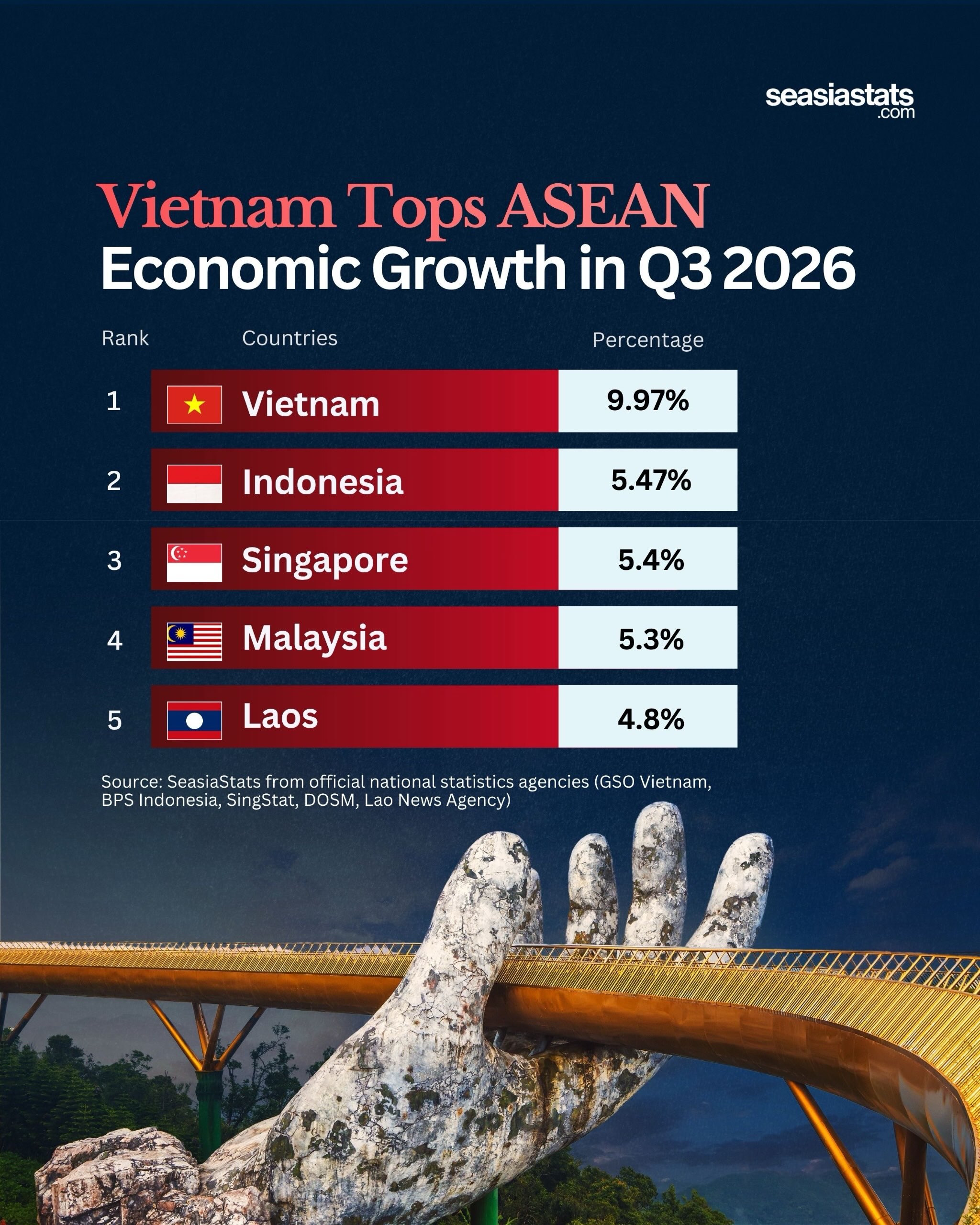
Southeast Asia continued to demonstrate strong economic performance in the third quarter of 2026, with several countries recording solid growth amid an evolving global economic environment.
Vietnam emerged as the region's fastest-growing economy, followed by Indonesia, Singapore, Malaysia, and Laos. Their performances highlight the region's economic resilience, supported by domestic consumption, industrial expansion, investment, and international trade.
Vietnam secured first place with an impressive economic growth rate of 9.97%, making it the strongest performer among the five countries.
Its rapid expansion reflects the country's growing industrial capabilities, manufacturing activities, export performance, and increasing foreign investment. Strong activity across the industrial, construction, and services sectors has also contributed to its economic momentum.
Indonesia ranked second, recording economic growth of 5.47% in Q3 2026. Household consumption and manufacturing were among the major contributors to its performance.
Rising domestic economic activity, government spending, and investment also supported the country's expansion. Indonesia's large domestic market continues to provide an important foundation for maintaining economic growth.
Singapore occupied third place with a growth rate of 5.4%. As one of Southeast Asia's major financial and commercial centers, Singapore benefited from manufacturing activities, particularly in electronics, precision engineering, and transport engineering.
Its strong international connectivity and established services sector also remain important drivers of economic development.
Malaysia followed closely in fourth place, recording economic growth of 5.3%. Its performance reflects continued economic activity across manufacturing, services, domestic consumption, and investment.
The country's integration into regional and international supply chains also supports its position as an important manufacturing and trading center in Southeast Asia.
Meanwhile, Laos completed the top five with economic growth of 4.8%. Its economy benefited from several important sectors, including manufacturing, private investment, electricity production, wholesale and retail trade, and tourism. The expansion of infrastructure and regional economic connectivity also provides opportunities for further development.
Overall, the Q3 2026 rankings demonstrate that Southeast Asia remains an important center of economic growth in the global economy. Although Vietnam recorded a considerably higher growth rate than its regional counterparts, Indonesia, Singapore, Malaysia, and Laos also maintained positive economic momentum.
Their performances illustrate the diverse economic strengths of Southeast Asian countries and the importance of industrial development, investment, consumption, and international cooperation in supporting long-term regional prosperity.