

Southeast Asia's Best-Governed Countries
To no one's surprise, Singapore is the best governed country in Southeast Asia.

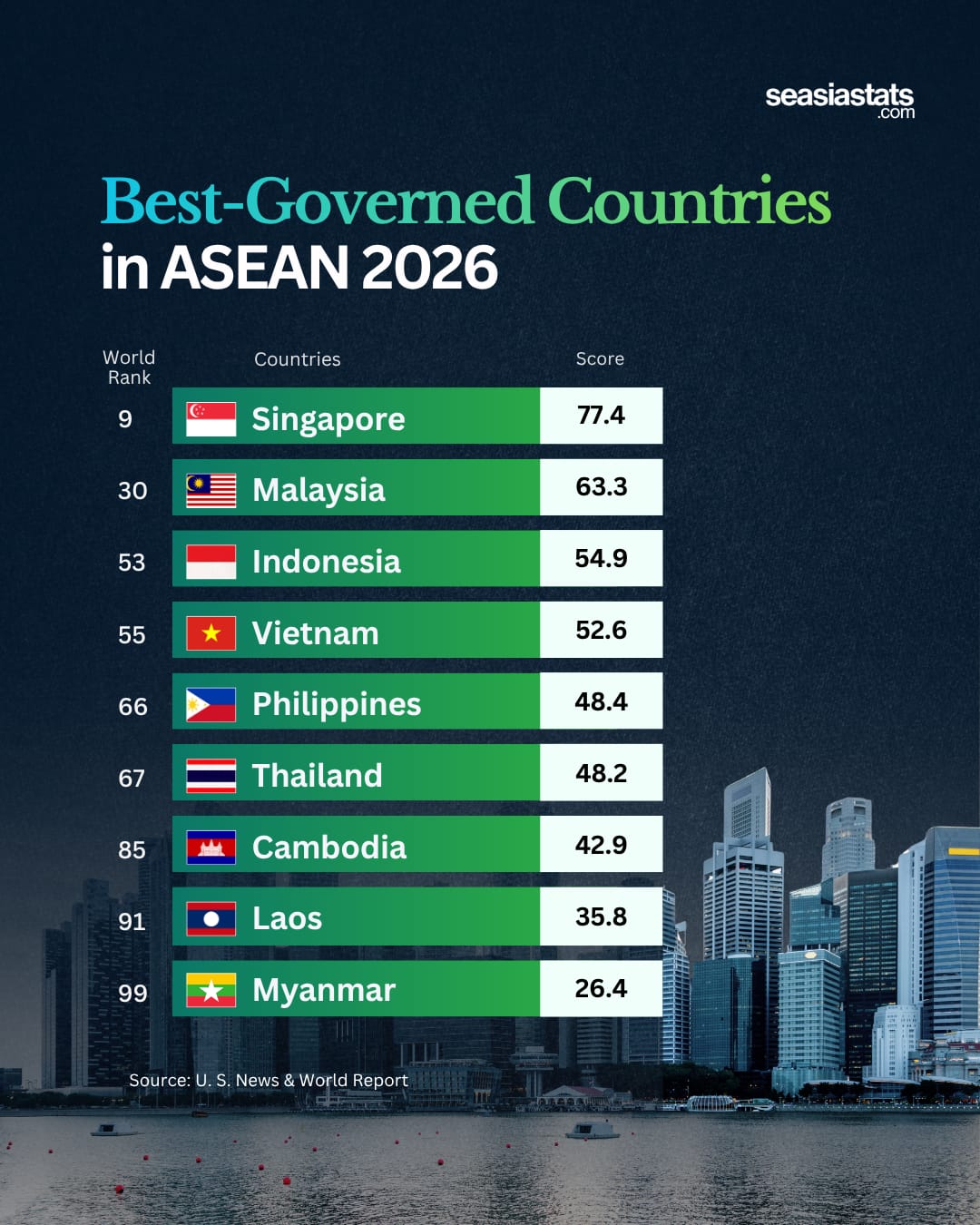
Good governance is an important foundation for a country’s stability, economic development, public services, and quality of life. In Southeast Asia, countries differ considerably in how effectively their governments operate and deliver services to their citizens.
According to the U.S. News & World Report scores provided, Singapore ranks first among the selected countries with a score of 77.4, followed by Malaysia at 63.3 and Indonesia at 54.9.
Singapore stands clearly at the top of the list. Its high score reflects its reputation for efficient public institutions, effective administration, strong infrastructure, and a well-organized government. Singapore’s broader performance is also notable in the 2026 U.S. News Best Countries report, where it ranks first globally for infrastructure.
Malaysia ranks second with 63.3 points. Its relatively strong performance demonstrates the country’s established institutions and growing administrative capacity. Malaysia has also gained regional recognition for its leadership role, particularly during its 2025 ASEAN chairmanship.
Indonesia follows with 54.9 points, reflecting its progress as one of Southeast Asia’s largest and most influential countries. Its size and diversity make effective governance particularly important, as the government must manage a large population spread across thousands of islands.
Vietnam receives 52.6 points, while the Philippines scores 48.4. Thailand follows closely at 48.2. These scores suggest moderate governance performance, although each country continues to face challenges involving institutional effectiveness, political stability, and public administration.
The Philippines, for example, has also been assessed by other governance indexes, where it ranks behind several Southeast Asian neighbors.
Further down the list are Cambodia, with 42.9 points, and Laos, with 35.8 points. Both countries have made progress in economic and social development, but their governance systems continue to face institutional challenges.
Myanmar records the lowest score among the countries listed, at 26.4, reflecting significant difficulties in political stability and effective government.
Overall, these scores highlight considerable differences in governance across Southeast Asia. Singapore’s leading position demonstrates the benefits of strong institutions and efficient administration, while the lower scores indicate areas where governments could improve transparency, stability, public services, and institutional capacity.
Nevertheless, governance is complex and cannot be fully represented by a single number. Rankings should therefore be viewed as useful comparative indicators rather than complete judgments of a country’s government.