

Southeast Asia's Busiest Airports
Theses ten airports are the busiest in Southeast Asia in 2025.

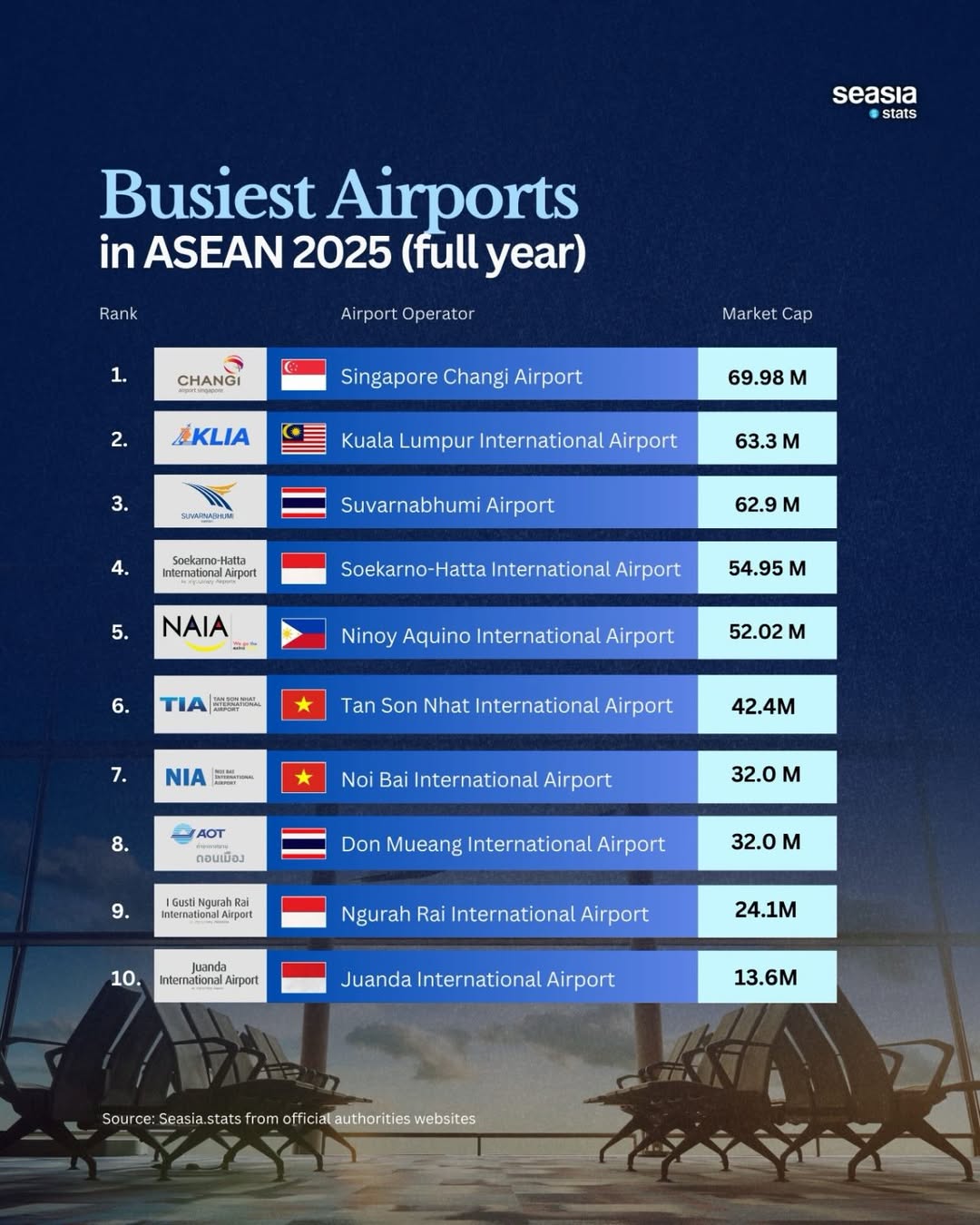
In 2025, Southeast Asia reaffirmed its position as one of the world’s fastest-growing aviation markets, with millions of travelers moving through the region’s major airports every month. The continued recovery of tourism, the expansion of low-cost carriers, and stronger regional connectivity have all contributed to record-breaking passenger traffic across ASEAN countries.
Leading the region is Changi International Airport in Singapore, which handled approximately 69.98 million passengers in 2025. Widely recognized for its world-class facilities, efficiency, and global connectivity, Changi remains the premier aviation hub in Southeast Asia.
Its strategic role as a transit gateway between Asia, Europe, and Australia continues to strengthen Singapore’s position in international air travel.
In second place is Kuala Lumpur International Airport with 63.3 million passengers. The airport has experienced rapid growth thanks to Malaysia’s tourism recovery and the expansion of airlines such as AirAsia and Malaysia Airlines. Kuala Lumpur’s strong role as a low-cost travel hub has also helped attract millions of regional travelers.
Thailand’s Suvarnabhumi Airport ranked third with 62.9 million passengers. As Bangkok’s primary international gateway, the airport benefits from Thailand’s booming tourism industry and its central geographic position within Southeast Asia.
Meanwhile, Indonesia’s Soekarno-Hatta International Airport recorded 54.95 million passengers, reflecting the country’s massive domestic and international travel demand.
The Philippines’ Ninoy Aquino International Airport followed closely with 52.02 million passengers despite ongoing congestion challenges. In Vietnam, Tan Son Nhat International Airport welcomed 42.4 million passengers, while Noi Bai International Airport handled around 32 million passengers, highlighting Vietnam’s rapidly expanding aviation sector.
Thailand also placed another airport in the top ten with Don Mueang International Airport, which served 32 million passengers, mainly through low-cost carriers.
Indonesia’s tourism gateway, Ngurah Rai International Airport, processed 24.1 million passengers as Bali remained one of Asia’s most popular tourist destinations. Finally, Juanda International Airport completed the list with 13.6 million passengers.
These figures demonstrate how Southeast Asia’s aviation industry has entered a new era of growth, supported by rising tourism, stronger economies, and increasing regional mobility.