

Southeast Asia's Busiest Airports in September 2026
With 3.45 million seats, Singapore Changi Airport is the busiest in Southeast Asia in September.

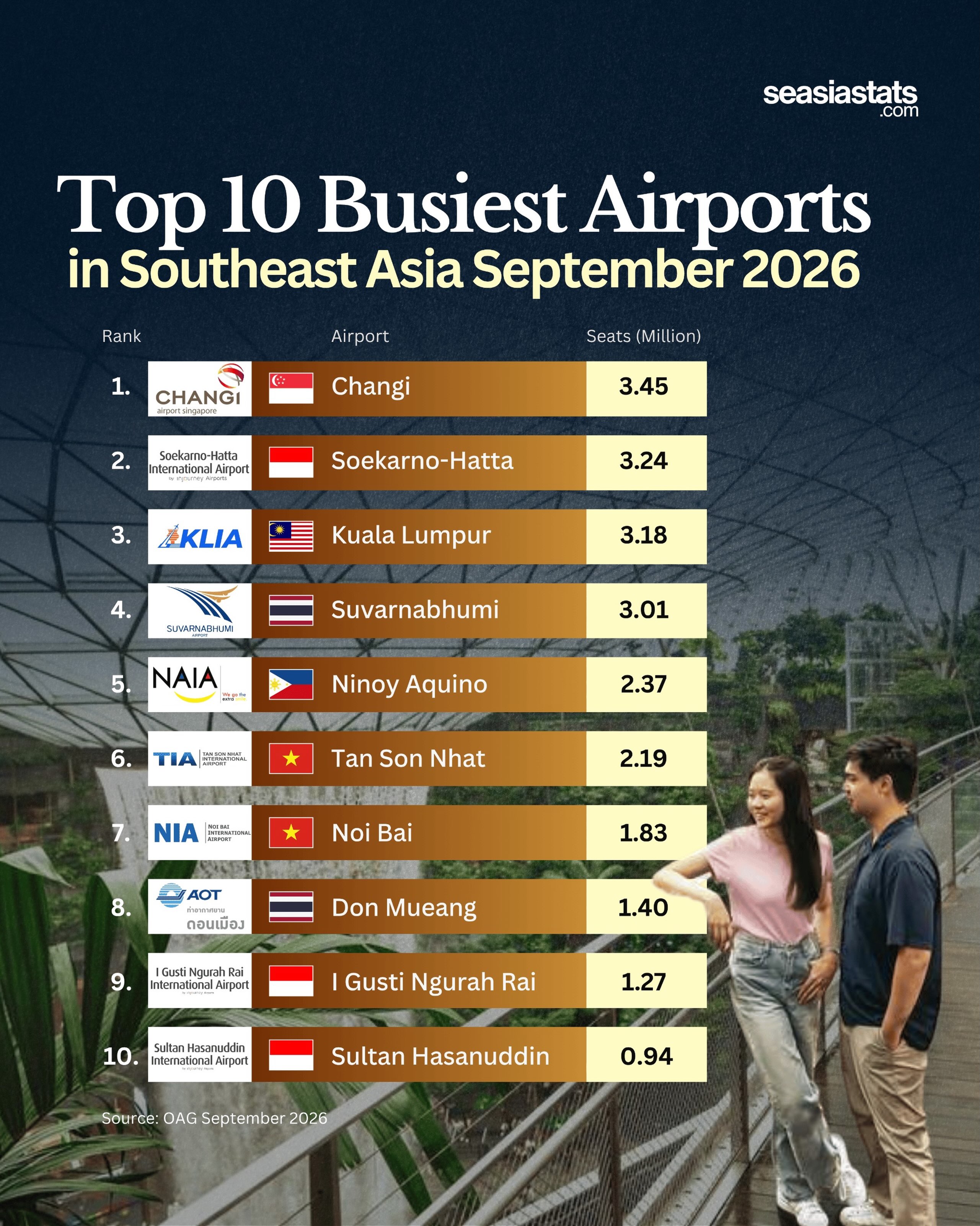
Singapore’s Changi Airport leads Southeast Asia’s aviation landscape in September 2026, according to OAG data measuring scheduled seats in millions. The ranking underscores the region’s robust air travel demand, driven by tourism recovery, business connectivity, and expanding low-cost carrier networks.
Singapore Changi Airport tops the list with 3.45 million seats, reinforcing its status as a premier global hub. Its extensive long-haul and regional connections continue to attract passengers transferring across Asia, Europe, and beyond.
Close behind is Jakarta’s Soekarno-Hatta International Airport at 3.24 million seats. As Indonesia’s primary gateway, it handles heavy domestic traffic alongside growing international routes, reflecting the archipelago’s large population and economic activity.
Kuala Lumpur International Airport ranks third with 3.18 million seats. Malaysia’s main airport benefits from strong links to the Middle East, Australia, and intra-ASEAN destinations, supported by both full-service and budget airlines.
Bangkok’s Suvarnabhumi Airport follows at 3.01 million seats, serving as Thailand’s principal international facility and a key node for tourism to the kingdom and neighboring countries.
Fifth place goes to Manila’s Ninoy Aquino International Airport with 2.37 million seats. The Philippine capital’s main airport remains vital for overseas Filipino workers and inbound leisure travel.
Ho Chi Minh City’s Tan Son Nhat International Airport records 2.19 million seats, highlighting Vietnam’s rapid aviation growth fueled by rising middle-class demand and foreign investment. Hanoi’s Noi Bai International Airport, at 1.83 million seats, further illustrates Vietnam’s dual-hub strength, with the northern capital supporting business and tourism links.
Bangkok’s secondary facility, Don Mueang International Airport, secures eighth position with 1.40 million seats, primarily catering to low-cost carriers and domestic Thai routes. Bali’s I Gusti Ngurah Rai International Airport follows with 1.27 million seats, driven by the island’s enduring appeal as a global leisure destination.
Completing the top ten is Makassar’s Sultan Hasanuddin International Airport at 0.94 million seats. This eastern Indonesian gateway plays an important role in connecting Sulawesi and supporting regional tourism and commerce.
Collectively, these ten airports account for the bulk of Southeast Asia’s scheduled capacity in September 2026.
The concentration of seats in Singapore, Indonesia, Malaysia, Thailand, the Philippines, and Vietnam points to the region’s integrated aviation market and its importance as a driver of economic and tourism growth. Continued infrastructure investments and airline expansion are expected to sustain this momentum in the months ahead.