

Southeast Asia's Daily Workplace Stress
Workers in the Philippines are the most stressful in Southeast Asia, followed by Singapore.

Workplace stress remains a significant challenge across Southeast Asia, although the experience varies considerably from one country to another.
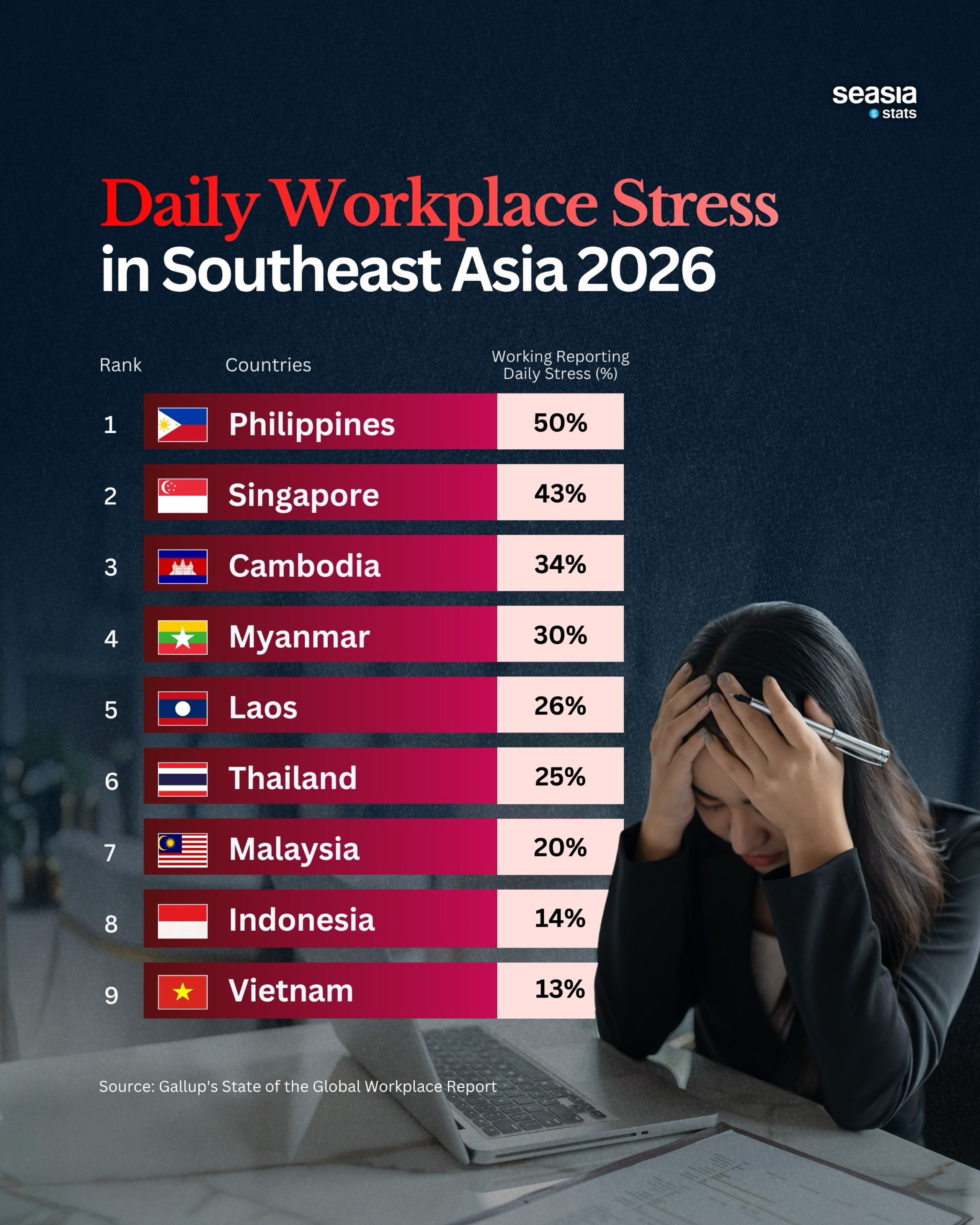
According to Gallup's State of the Global Workplace Report, the share of employees who report experiencing daily stress ranges from as high as 50% in the Philippines to just 13% in Vietnam. These differences highlight the diverse working environments and economic conditions across the region.
The Philippines records the highest level of daily workplace stress in Southeast Asia, with 50% of workers saying they experience stress every day. This suggests that one in every two employees faces regular workplace pressure, underscoring the importance of mental health support and effective work-life balance initiatives.
Singapore ranks second, with 43% of employees reporting daily stress. As one of Asia's leading financial and business hubs, Singapore's fast-paced and highly competitive work culture may contribute to elevated stress levels among workers. Despite its strong economy, many employees continue to face demanding workloads and high performance expectations.
Cambodia follows with 34%, while Myanmar reports 30% of workers experiencing daily stress. These figures indicate that nearly one-third of employees in both countries regularly deal with workplace pressures, reflecting the challenges associated with developing labor markets and changing economic conditions.
Laos records a daily stress rate of 26%, followed closely by Thailand at 25%. These countries sit near the middle of the regional rankings, with about one in four workers experiencing stress on a daily basis.
Although lower than the figures seen in the Philippines and Singapore, these rates still point to the need for supportive workplace policies and employee well-being programs.
Malaysia reports that 20% of workers experience daily stress, placing it among the lower-stress countries in Southeast Asia. Indonesia follows with 14%, while Vietnam records the region's lowest reported level at 13%.
These comparatively lower percentages may reflect differences in workplace culture, employee expectations, or perceptions of stress, although many factors can influence survey responses.
Daily workplace stress has important implications for employee health, productivity, and organizational performance. High stress levels can contribute to burnout, lower job satisfaction, and reduced engagement, while healthier work environments can improve both employee well-being and business outcomes.
Although Southeast Asian countries differ in the proportion of workers experiencing daily stress, the Gallup findings emphasize that workplace well-being remains an important issue throughout the region.
Investing in supportive leadership, flexible work practices, mental health resources, and positive organizational cultures can help create healthier workplaces and improve the overall employee experience.