

Southeast Asia's FDI Leaders in 2025
Singapore is uncatchable in its FDI ranking in Southeast Asia.

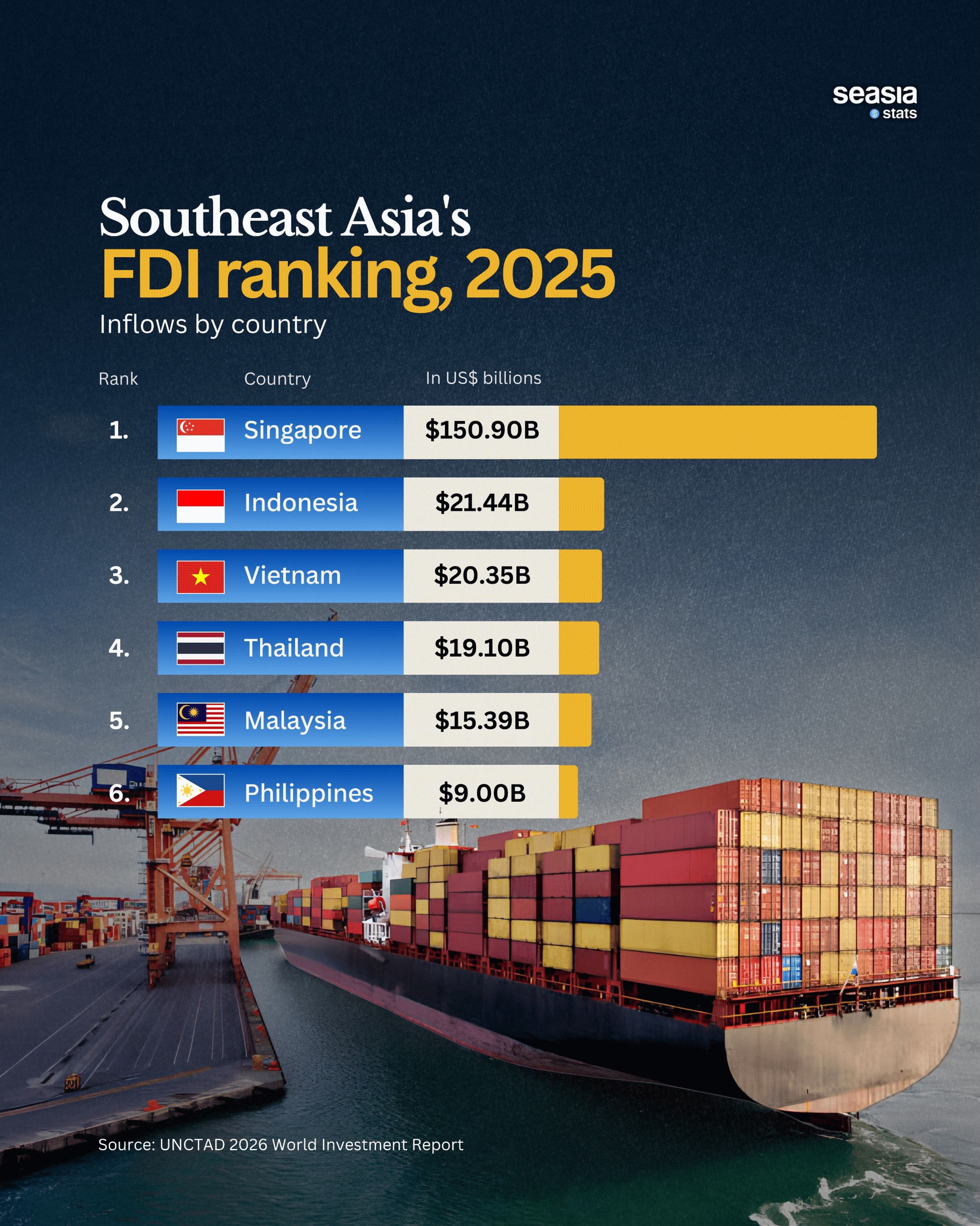
Southeast Asia continued to strengthen its position as one of the world's most attractive investment destinations in 2025, with Foreign Direct Investment (FDI) inflows rising across the region.
According to the United Nations Conference on Trade and Development (UNCTAD) World Investment Report 2026, Southeast Asia received a record level of investment, highlighting its growing importance in global supply chains, manufacturing, digital industries, and green energy.
The region attracted approximately US$244 billion in FDI during the year, making it the largest recipient subregion among developing economies.
Singapore remained the region's undisputed leader, attracting US$150.90 billion in FDI. The city-state continues to serve as Southeast Asia's premier financial and business hub, supported by its stable regulatory environment, world-class infrastructure, and strong presence of multinational corporations.
Its strategic role in finance, technology, logistics, and advanced manufacturing has enabled Singapore to maintain a significant lead over its regional peers.
Indonesia ranked second with US$21.44 billion in FDI inflows. Southeast Asia's largest economy continued to attract investors through its abundant natural resources, expanding downstream industries, infrastructure development, and growing domestic consumer market.
Government efforts to improve the investment climate have also contributed to its strong performance.
Close behind was Vietnam, which secured US$20.35 billion in FDI. The country has become a preferred destination for global manufacturers seeking to diversify supply chains, particularly in electronics, textiles, and high-tech industries. Competitive labor costs and an expanding network of free trade agreements continue to enhance Vietnam's appeal.
Thailand followed with US$19.10 billion, supported by investments in automotive manufacturing, electronics, tourism, and renewable energy. Meanwhile, Malaysia attracted US$15.39 billion, benefiting from its strengths in semiconductors, digital services, and industrial manufacturing.
Rounding out the top six was the Philippines, which recorded US$9.00 billion in FDI inflows. Continued investments in infrastructure, information technology-business process management (IT-BPM), renewable energy, and manufacturing contributed to the country's performance, although competition for global capital remains intense.
The 2025 rankings demonstrate Southeast Asia's resilience amid an evolving global investment landscape. As companies diversify production networks and seek new growth opportunities, the region remains an increasingly attractive destination for international investors.
Continued policy reforms, infrastructure improvements, and regional economic integration are expected to further strengthen Southeast Asia's competitiveness in the years ahead.