

Southeast Asia's FDI Rankings 2025, Singapore Is Still Far Ahead
Singapore leads the FDI ranking in all of Southeast Asia with an enormous margin.

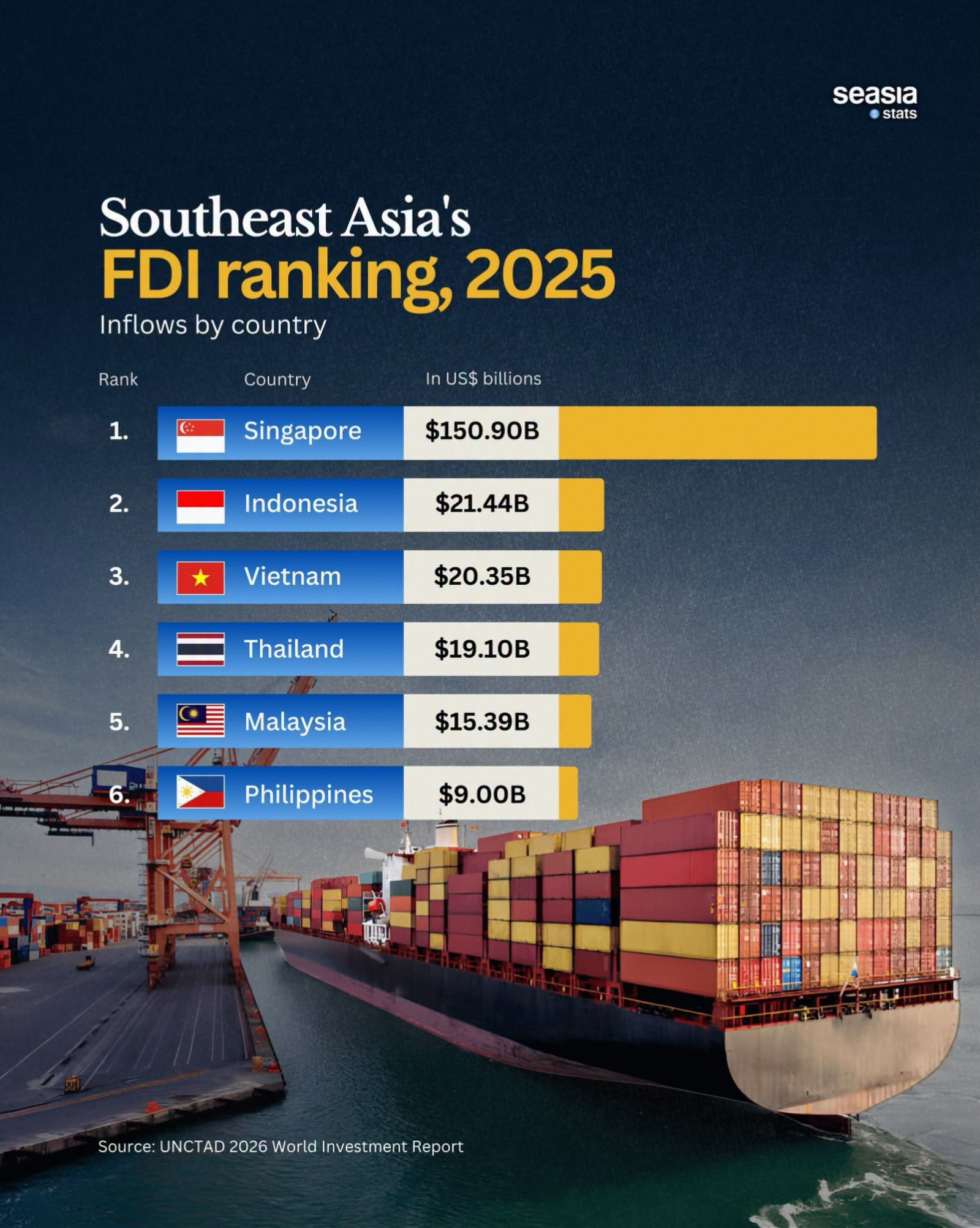
Foreign direct investment (FDI) remained a major driver of economic development in Southeast Asia in 2025, highlighting the region’s growing importance in global supply chains, manufacturing, digital industries, and strategic infrastructure.
According to the UNCTAD World Investment Report 2026, Southeast Asian economies continued to attract significant foreign capital, with Singapore maintaining its dominant position, followed by Indonesia, Vietnam, Thailand, Malaysia, and the Philippines.
Singapore ranked first in Southeast Asia with FDI inflows of US$150.90 billion in 2025. The city-state’s leading position reflects its role as a global financial centre, regional headquarters hub, and gateway for multinational corporations operating across Asia.
Its strong legal framework, advanced infrastructure, skilled workforce, and business-friendly environment have continued to make it one of the world’s most attractive destinations for international investment.
Indonesia placed second with US$21.44 billion in FDI, supported by its large domestic market, abundant natural resources, and growing role in electric vehicle (EV) supply chains.
The country’s policies encouraging downstream processing of minerals, especially nickel, have helped attract investment into battery production, manufacturing, and industrial development. Indonesia’s economic scale and strategic location continue to strengthen its position as a major investment destination in ASEAN.
Vietnam followed closely in third place with US$20.35 billion. The country has become a key manufacturing base for global companies seeking diversified supply chains.
Its competitive labour force, export-oriented industrial policies, and participation in major trade agreements have supported strong foreign investment, particularly in electronics, technology, and manufacturing sectors.
Thailand ranked fourth with US$19.10 billion, benefiting from its established automotive industry, infrastructure networks, and efforts to expand investments in electric vehicles and advanced manufacturing.
Malaysia recorded US$15.39 billion, attracting investors through its semiconductor sector, digital economy initiatives, and industrial capabilities. The Philippines received US$9.00 billion, with opportunities in services, business process outsourcing, renewable energy, and manufacturing.
The rankings demonstrate both the strength and diversity of Southeast Asia’s investment environment. While Singapore’s FDI volume remains far ahead due to its role as a financial and corporate hub, other ASEAN economies are attracting capital through manufacturing expansion, resource industries, technology development, and domestic market growth.
UNCTAD’s reports emphasize that FDI is increasingly concentrated in strategic sectors and that countries must ensure investment contributes to productivity, employment, skills development, and technology transfer.
Overall, the 2025 FDI rankings show Southeast Asia’s continued rise as a critical destination for global investors. Competition among ASEAN members is intensifying, but the region as a whole remains well-positioned to benefit from shifting supply chains, digital transformation, and the global search for resilient production networks.