

Southeast Asia's Governmental Systems
Diversity in Southeast Asia includes the various governmental systems with republic still dominating.

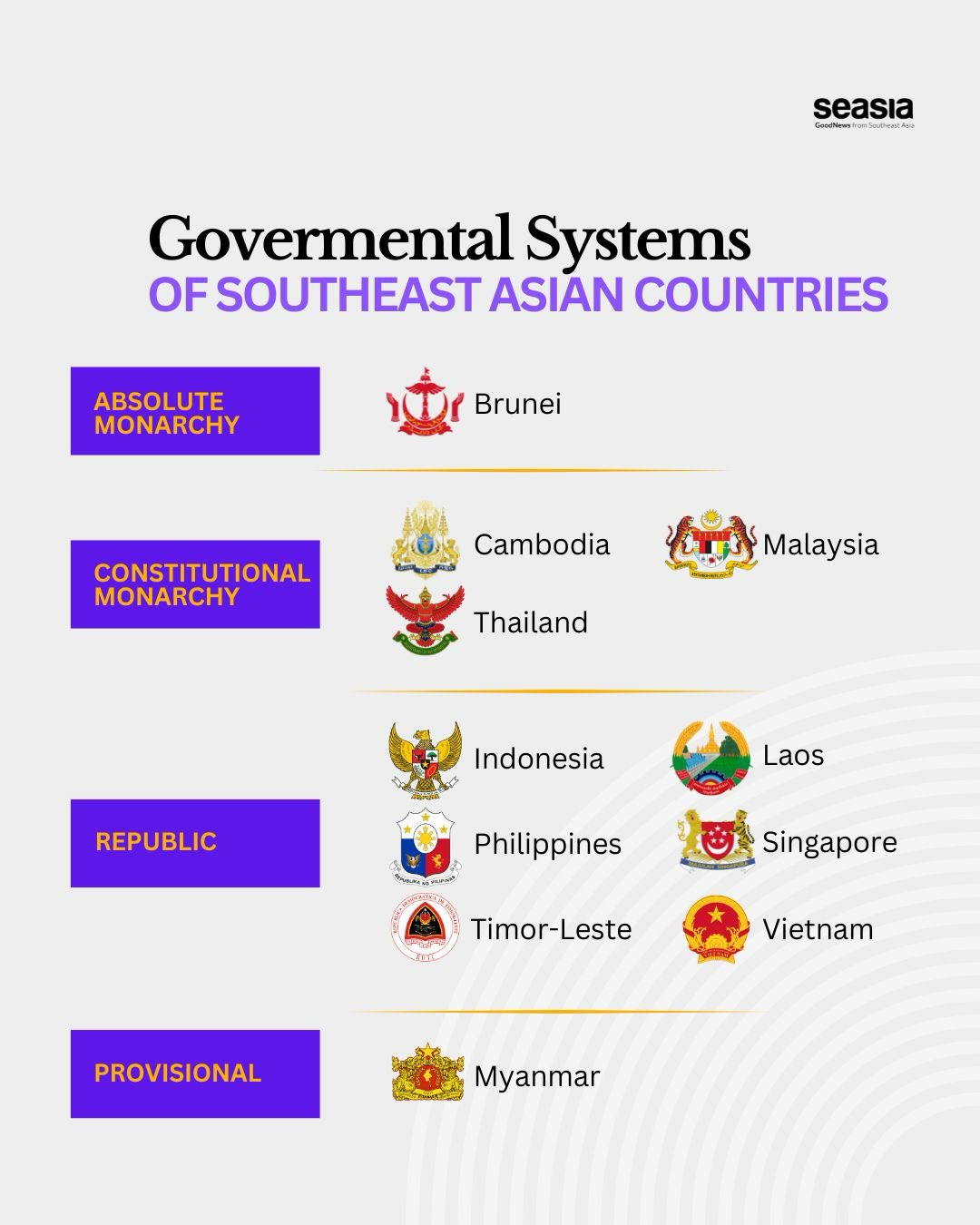
Southeast Asia is a diverse region not only in culture and religion, but also in governmental systems. Each country has developed its own political structure based on historical experiences, colonial influence, and national identity. The region includes monarchies, republics, and provisional governments that reflect different approaches to leadership and governance.
Brunei practices an absolute monarchy. In this system, the Sultan holds supreme executive authority and plays a central role in politics, religion, and national administration. The Sultan of Brunei is both the head of state and head of government, and political power is concentrated in the monarchy. This system emphasizes stability, tradition, and strong royal leadership.
Several Southeast Asian countries use constitutional monarchy. Cambodia, Malaysia, and Thailand all maintain monarchs whose powers are limited by constitutions and democratic institutions. In these countries, elected governments manage daily administration while kings serve as symbolic national leaders and cultural figures.
Malaysia has a unique rotating monarchy in which rulers from different states take turns becoming king every five years. Thailand’s monarchy remains highly respected and influential in society, while Cambodia’s king mainly serves ceremonial functions.
Most Southeast Asian nations are republics. Indonesia, Philippines, and Timor-Leste are democratic republics where presidents are elected by citizens. These governments are based on constitutions that separate powers among executive, legislative, and judicial branches. Elections play an important role in determining leadership and public representation.
Other republics in the region include Laos, Singapore, and Vietnam. Laos and Vietnam are socialist republics led by single communist parties, where political authority is centralized and opposition parties are not permitted.
Singapore, meanwhile, is a parliamentary republic known for its strong governance, economic development, and political stability. Although elections are held regularly, one political party has dominated the country for decades.
Myanmar currently operates under a provisional system due to ongoing political instability. Following the military takeover in 2021, the country has faced conflict and uncertainty. The military government exercises control while opposition groups continue to challenge its authority. As a result, Myanmar’s political future remains uncertain.
Overall, Southeast Asia demonstrates a wide variety of governmental systems. These systems reflect the region’s complex history and show how countries adapt governance to their social, cultural, and political conditions.