

Southeast Asia's Largest Airports by Departing Seats
These ten airports are the largest in Southeast Asia, based on departing seats.

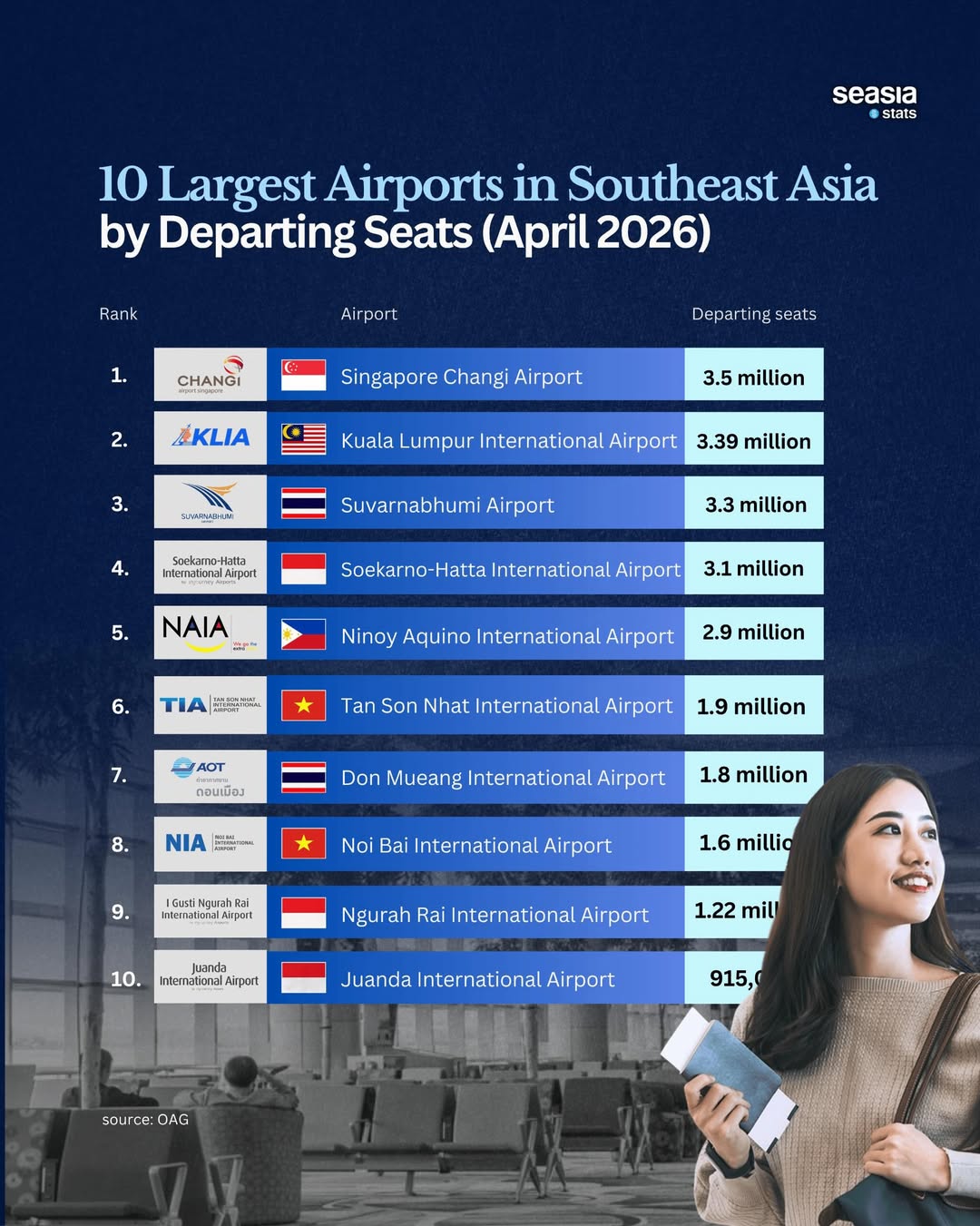
Southeast Asia’s aviation sector continues to experience strong growth in 2026, driven by tourism recovery, expanding middle-class travel demand, and increased regional connectivity. The region’s largest airports now handle millions of departing airline seats every month, reflecting their importance as international and domestic transportation hubs.
Leading the region is Singapore Changi Airport with 3.5 million departing seats in April 2026. Changi remains one of the world’s most respected aviation hubs because of its efficiency, connectivity, and award-winning passenger facilities. Singapore’s strategic geographic position also makes the airport a key transit point between Asia, Europe, and Oceania.
Close behind is Kuala Lumpur International Airport with 3.39 million departing seats. KLIA has strengthened its role as a major regional hub, especially through the rapid expansion of low-cost carriers and long-haul Asian routes. The airport serves as one of Southeast Asia’s most important gateways for international tourism and business travel.
Thailand’s Suvarnabhumi Airport ranks third with 3.3 million seats. As Thailand’s primary international airport, Suvarnabhumi supports the country’s massive tourism industry and extensive global flight network. Meanwhile, Don Mueang International Airport recorded 1.8 million departing seats, remaining one of the world’s busiest low-cost carrier airports.
Indonesia’s Soekarno-Hatta International Airport handled 3.1 million departing seats, making it the fourth-largest airport in the region. As the main gateway to Jakarta and Indonesia’s largest metropolitan area, the airport plays a central role in domestic and international travel.
Indonesia also placed two additional airports in the top ten: Ngurah Rai International Airport with 1.22 million seats and Juanda International Airport with 915,000 seats.
The Ninoy Aquino International Airport ranked fifth with 2.9 million seats, highlighting the Philippines’ growing aviation demand. Viet Nam also showed strong performance, with Tan Son Nhat International Airport recording 1.9 million seats and Noi Bai International Airport reaching 1.6 million.
Overall, these airports demonstrate Southeast Asia’s rising importance in global aviation, supported by economic growth, tourism expansion, and increasing regional mobility.