

Southeast Asia's Largest Forests
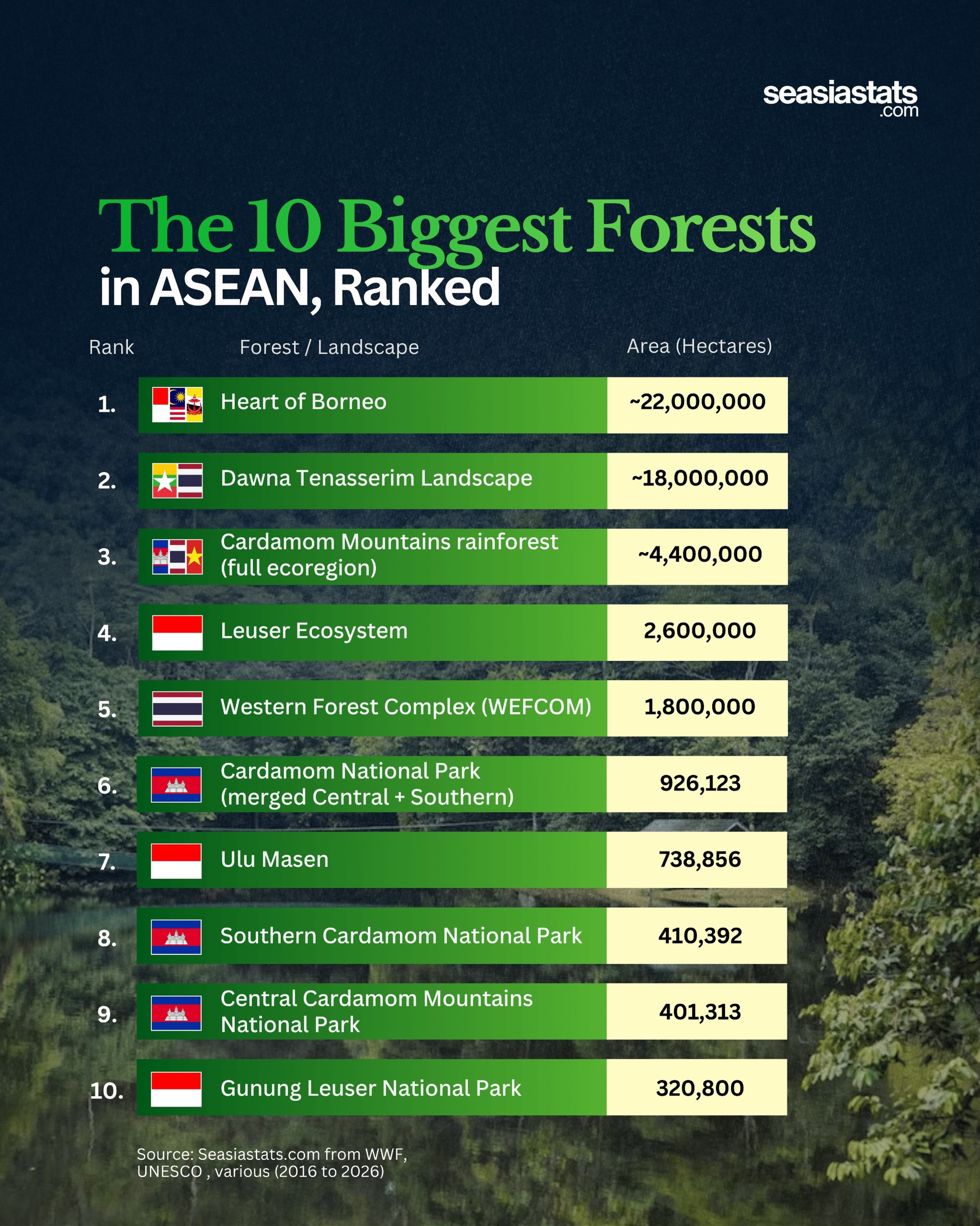
The Heart of Borneo is the largest forest in Southeast Asia, it belongs to Indonesia, Malaysia, and Brunei.

Southeast Asia is home to some of the world's most extensive and biologically diverse tropical forests. These landscapes support thousands of plant and animal species, regulate regional climates, store vast amounts of carbon, and provide livelihoods for millions of people.
From the island of Borneo to the mountain ranges of mainland Southeast Asia, these forests are among the region's most valuable natural treasures.
The largest forest landscape in Southeast Asia is the Heart of Borneo, covering around 22 million hectares across Brunei, Indonesia, and Malaysia. This vast transboundary forest contains one of the world's richest concentrations of biodiversity, including orangutans, clouded leopards, pygmy elephants, and thousands of endemic plant species.
Second is the Dawna Tenasserim Landscape, spanning approximately 18 million hectares across Myanmar and Thailand. This immense forest complex forms one of mainland Southeast Asia's most important wildlife corridors, supporting tigers, Asian elephants, gaur, and numerous threatened bird species.
The Cardamom Mountains Rainforest ranks third with about 4.4 million hectares. Stretching across southwestern Cambodia and parts of eastern Thailand, this ecoregion is one of Southeast Asia's largest remaining blocks of intact rainforest and is renowned for its exceptional biodiversity.
Indonesia's Leuser Ecosystem covers around 2.6 million hectares in northern Sumatra. It is the only place on Earth where Sumatran orangutans, elephants, rhinos, and tigers coexist in the wild, making it one of the planet's most significant conservation landscapes.
Thailand's Western Forest Complex (WEFCOM) occupies approximately 1.8 million hectares, forming the country's largest protected forest network. It plays a vital role in conserving Southeast Asia's remaining populations of large mammals.
Within Cambodia, the combined Cardamom National Park—formed by the Central and Southern Cardamom National Parks—covers around 926,123 hectares. This protected area safeguards extensive evergreen forests, rivers, and wildlife habitats.
Other major forests include Ulu Masen in Aceh, Indonesia, with approximately 738,856 hectares, followed by Southern Cardamom National Park with around 410,392 hectares and Central Cardamom Mountains National Park with about 401,313 hectares.
These forests are internationally recognized for their ecological importance and ongoing conservation efforts.
Completing the top ten is Gunung Leuser National Park, covering approximately 320,800 hectares. As part of the larger Leuser Ecosystem and a UNESCO World Heritage Site, it protects some of Sumatra's most valuable tropical rainforest.
Together, these forests represent the ecological heart of Southeast Asia. Conserving them is essential not only for protecting wildlife but also for maintaining climate stability, preserving freshwater resources, and ensuring sustainable livelihoods for future generations.