

Southeast Asia's Largest Minimarket Chains
Indonesia's Alfamart and Indomaret have the most stores in Southeast Asia.

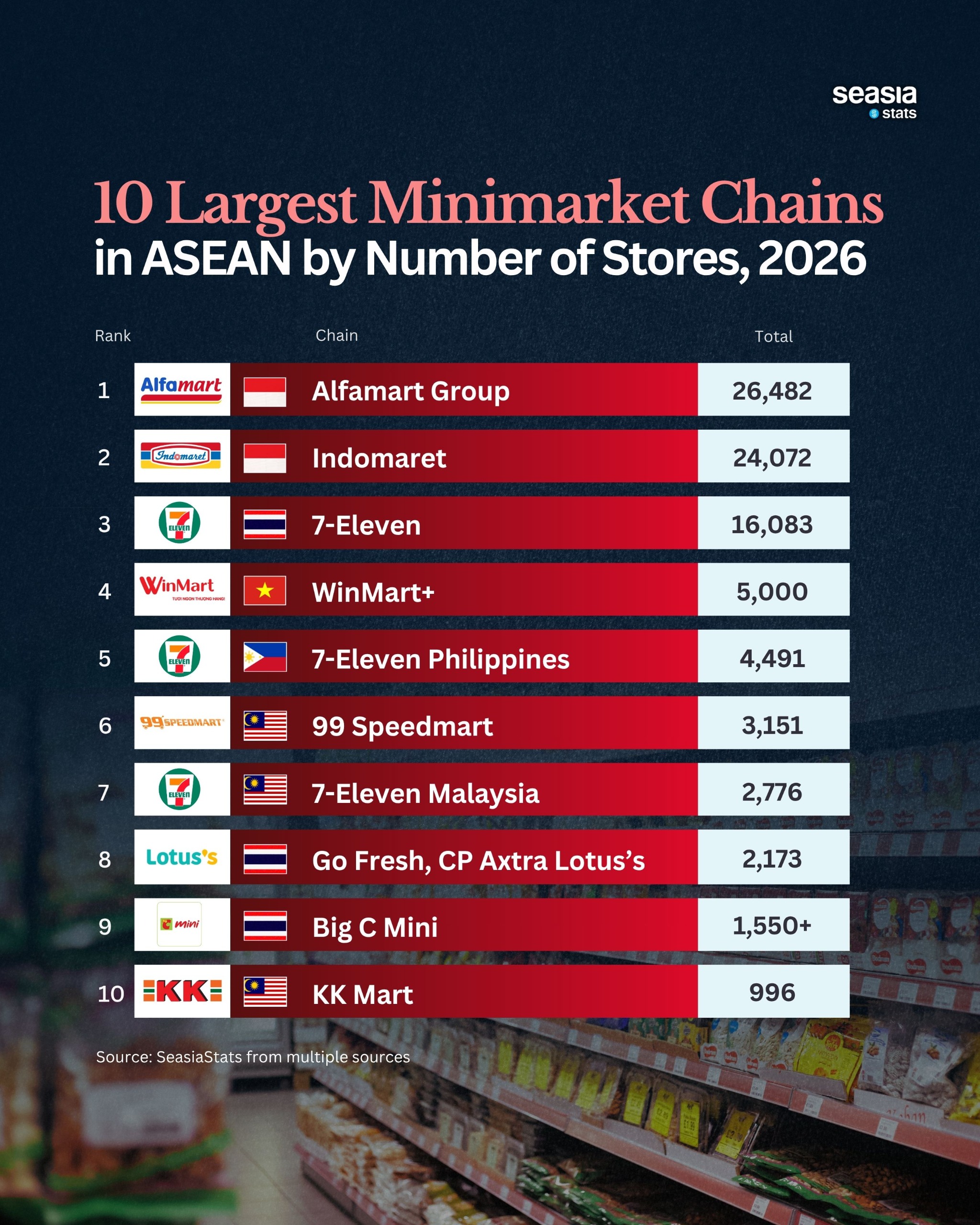
Southeast Asia has become one of the world's most dynamic retail markets, driven by rapid urbanization, population growth, rising consumer spending, and changing shopping habits. Among the region's most prominent retail businesses are minimarket and convenience store chains, which have expanded aggressively to serve consumers seeking affordable products, convenient locations, and quick shopping experiences.
Alfamart Group ranks as Southeast Asia's largest minimarket operator, with an impressive 26,482 outlets. Indonesia-based Alfamart has established an extensive retail network, making its stores a familiar sight in urban neighborhoods and smaller communities. Its closest competitor is Indomaret, another Indonesian retail giant, with 24,072 stores. Together, these two companies demonstrate Indonesia's dominant position in the region's minimarket industry.
Thailand also has a significant presence in the convenience retail sector. 7-Eleven Thailand ranks third with 16,083 stores, reflecting the brand's extraordinary popularity and extensive nationwide coverage. Meanwhile, Vietnam's WinMart+ occupies fourth place with approximately 5,000 outlets, highlighting the rapid development of modern grocery retail in the country.
The Philippines is another important market, with 7-Eleven Philippines operating 4,491 stores. Malaysia also has several major players, led by 99 Speedmart with 3,151 outlets, followed by 7-Eleven Malaysia with 2,776 stores. These chains have strengthened their positions through convenient locations, competitive pricing, and broad selections of everyday necessities.
Other notable competitors include Go Fresh and CP Axtra's Lotus's, with a combined reported figure of 2,173 stores, followed by Big C Mini in Thailand with approximately 1,550 outlets. Malaysia's KK Mart completes the top ten with 996 stores.
The figures illustrate the competitive landscape of Southeast Asia's minimarket industry, where local champions and international brands compete for consumers. Indonesia leads the ranking, while Thailand, Malaysia, Vietnam, and the Philippines also contribute significantly to the region's retail expansion.
Looking ahead, the industry is likely to experience further growth through digital payments, e-commerce integration, loyalty programs, ready-to-eat food offerings, and improvements in supply chain management. As consumer lifestyles continue to evolve, minimarket chains will remain an essential part of Southeast Asia's retail economy.
With thousands of outlets across multiple countries, these ten retail groups demonstrate the scale, competitiveness, and enormous potential of Southeast Asia's modern convenience retail market.