

Southeast Asia's Largest Transportation Companies
Here are the largest transportation companies in Southeast Asia, based on their assets.

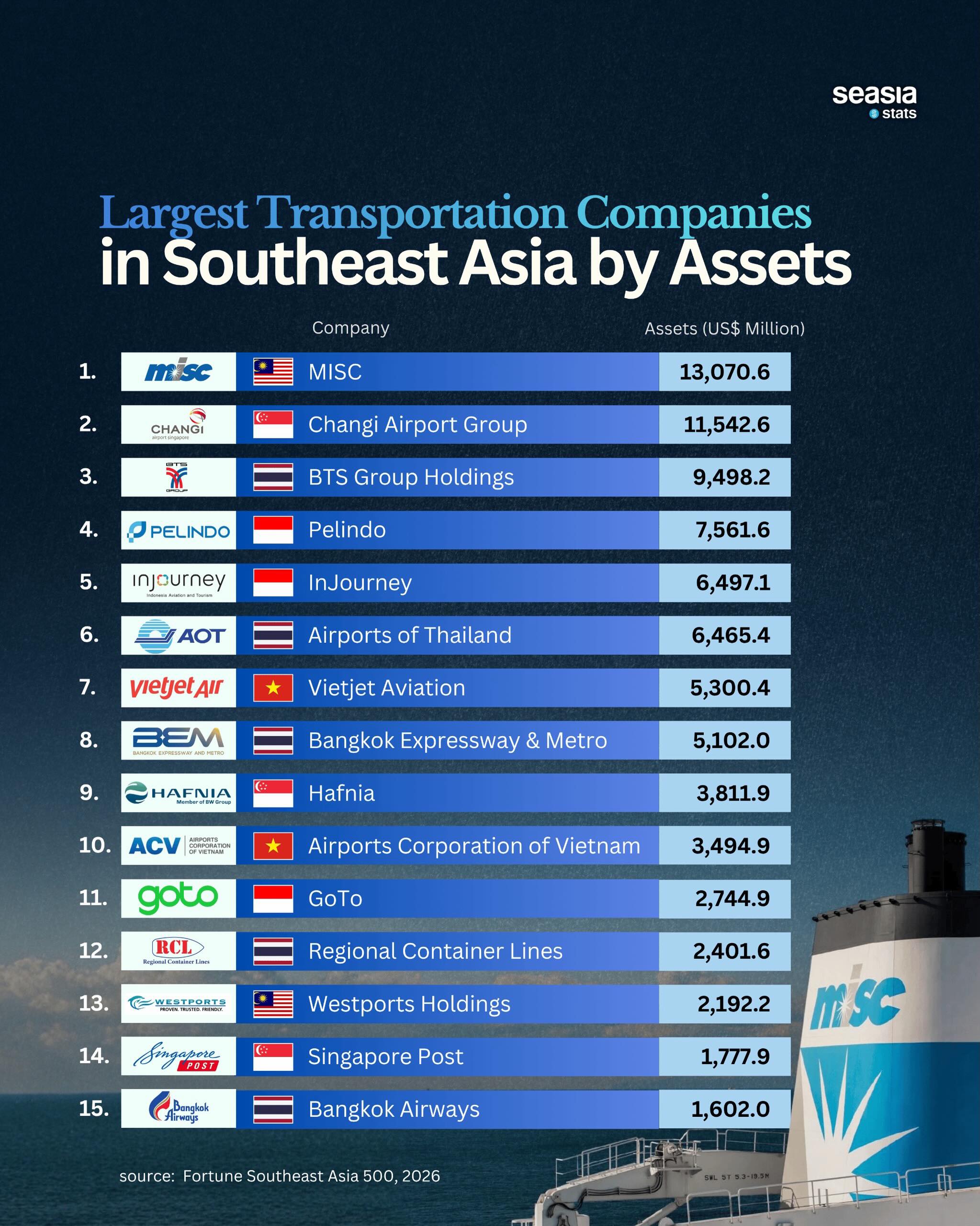
Transportation plays a vital role in Southeast Asia's economic growth, connecting millions of people and facilitating trade across one of the world's most dynamic regions.
The Fortune Southeast Asia 500 (2026) ranking highlights the region's largest transportation companies by total assets, demonstrating the importance of aviation, shipping, logistics, rail transit, ports, and digital mobility.
Leading the list is Malaysia's MISC, with total assets of US$13,070.6 million. As one of the region's largest shipping and energy transportation companies, MISC operates a global fleet serving the maritime and offshore energy industries.
Singapore's Changi Airport Group ranks second with US$11,542.6 million in assets. Operator of the internationally acclaimed Changi Airport, the company continues to be a major aviation hub connecting Southeast Asia with the rest of the world.
Thailand's BTS Group Holdings occupies third place with US$9,498.2 million, reflecting its leadership in urban mass transit and infrastructure development. Indonesia's state-owned port operator Pelindo follows with US$7,561.6 million, while Indonesia's tourism and aviation holding company InJourney ranks fifth with US$6,497.1 million.
Thailand's Airports of Thailand closely follows with assets totaling US$6,465.4 million, managing several of the country's busiest international airports. Vietnam's low-cost carrier Vietjet Aviation ranks seventh with US$5,300.4 million, ahead of Thailand's Bangkok Expressway and Metro, which reports US$5,102.0 million in assets.
Singapore-based tanker operator Hafnia holds ninth place with US$3,811.9 million, while Airports Corporation of Vietnam rounds out the top ten with US$3,494.9 million, reflecting Vietnam's rapidly expanding aviation sector.
Indonesia's technology and mobility company GoTo ranks eleventh with US$2,744.9 million. Although widely recognized for digital services and ride-hailing, transportation remains one of its core business segments.
Thailand's Regional Container Lines follows with US$2,401.6 million, while Malaysia's Westports Holdings records US$2,192.2 million, highlighting the country's role in international maritime trade.
Completing the list are Singapore Post, with assets of US$1,777.9 million, reflecting its logistics and parcel delivery operations, and Thailand's Bangkok Airways, which reports US$1,602.0 million in assets.
Together, these companies illustrate the diversity of Southeast Asia's transportation industry. From airports and seaports to rail systems, airlines, shipping firms, logistics providers, and digital mobility platforms, they form the backbone of regional connectivity and economic integration.
Their substantial asset bases underscore the continuing importance of transportation infrastructure in supporting Southeast Asia's long-term development and competitiveness.