

Southeast Asia's Largest Universities by Land Area
The UPLB in the Philippines is the largest university in Southeast Asia with a staggering size of 15,000 hectares.

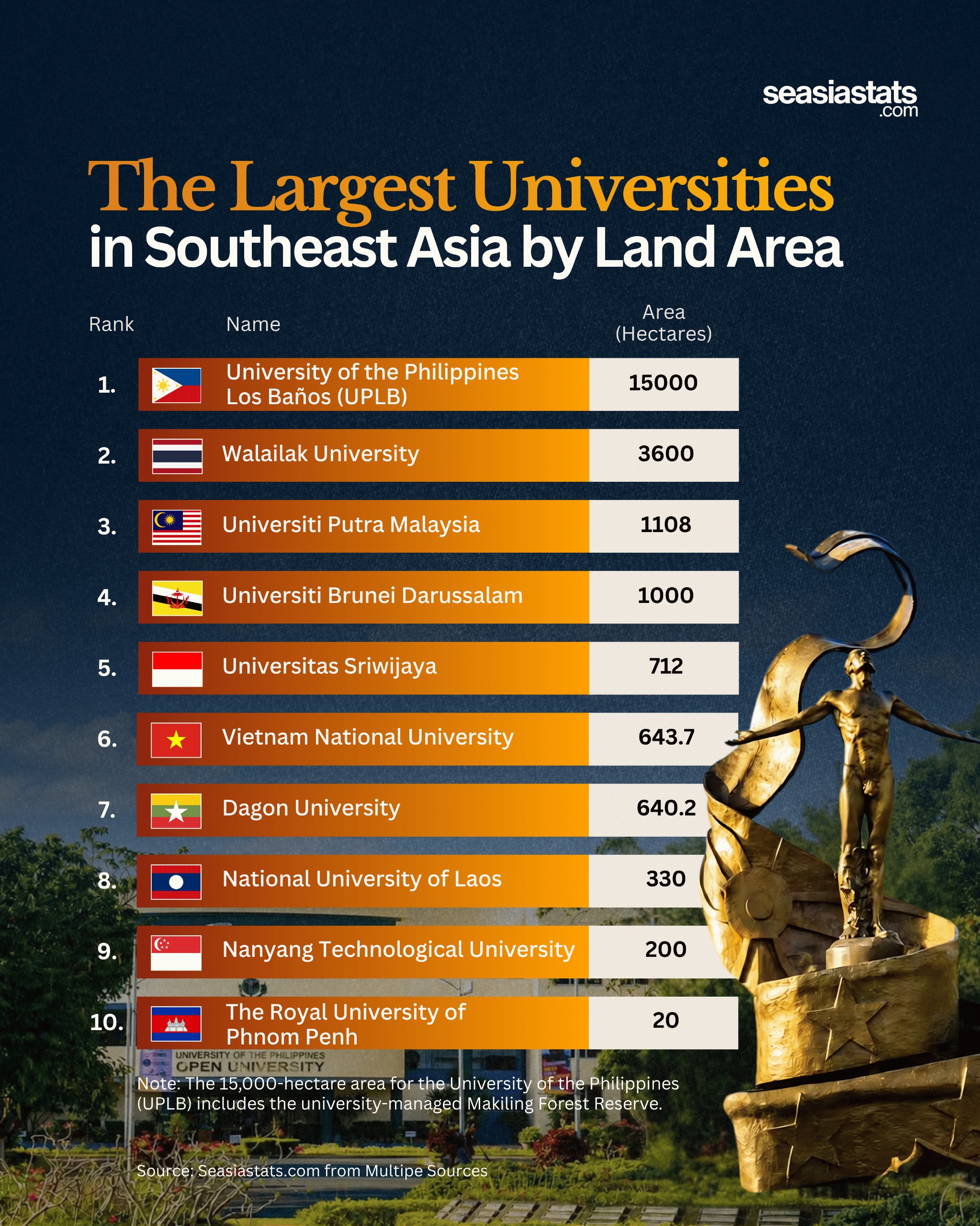
Southeast Asia is home to several universities with expansive campuses that support education, scientific research, environmental conservation, and agricultural development. Measured by land area, these institutions rank among the region's largest and demonstrate how vast campuses can contribute to academic excellence and innovation.
The University of the Philippines Los Baños (UPLB) in the Philippines is the largest university in Southeast Asia by land area, covering approximately 15,000 hectares.
Located at the foot of Mount Makiling, UPLB is internationally recognized for its leadership in agriculture, forestry, environmental science, and biotechnology. Much of its land consists of forests, research farms, and protected natural areas.
Thailand's Walailak University ranks second with a campus spanning 3,600 hectares. Its spacious grounds accommodate modern academic facilities, research centers, residential colleges, and green spaces that support both education and sustainable development.
In Malaysia, Universiti Putra Malaysia (UPM) occupies 1,108 hectares, making it one of the country's largest universities. Originally established as an agricultural institution, UPM has expanded into a comprehensive research university while maintaining its strong focus on agriculture, veterinary medicine, and environmental sciences.
University Brunei Darussalam (UBD) covers approximately 1,000 hectares, providing ample room for academic buildings, student housing, research institutes, and recreational facilities. Its campus reflects Brunei's commitment to higher education and environmental sustainability.
Indonesia's Universitas Sriwijaya (Unsri) has a campus area of 712 hectares, primarily located in Indralaya, South Sumatra. The university continues to grow as a leading center for education and research in Indonesia.
Vietnam's Vietnam National University occupies approximately 643.7 hectares, followed closely by Dagon University in Myanmar with 640.2 hectares. Both institutions serve large student populations while supporting expanding academic and research programs.
The National University of Laos has a campus covering 330 hectares, making it the country's largest higher education institution.
Meanwhile, Singapore's Nanyang Technological University (NTU) spans 200 hectares, demonstrating that a relatively smaller campus can still support world-class research and academic excellence through efficient planning and advanced infrastructure.
Completing the list is The Royal University of Phnom Penh in Cambodia, which occupies 20 hectares. Despite its comparatively compact size, it remains Cambodia's oldest and most prestigious public university, playing a vital role in the nation's higher education system.
Together, these universities showcase the diversity of Southeast Asia's higher education landscape. While campus size varies considerably, each institution contributes significantly to teaching, research, and national development, illustrating that both expansive and compact campuses can foster academic achievement and societal progress.