

Southeast Asia’s Leading Cities in the 2026 Global Cities Index
Singapore leads Southeast Asia according to The Oxford Economics Global Cities Index 2026.

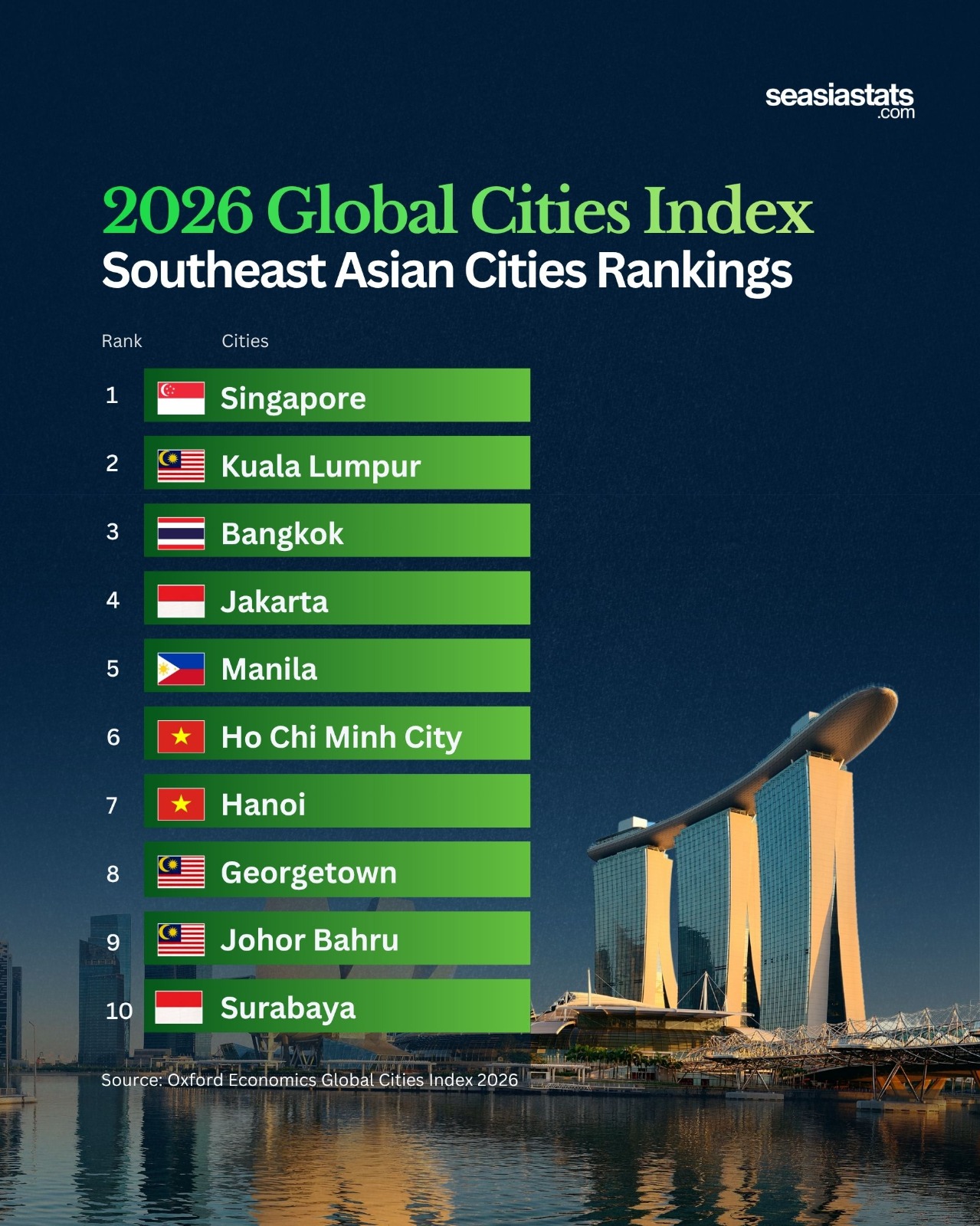
Southeast Asia continues to strengthen its position as one of the world’s most dynamic urban regions, with major cities playing an increasingly important role in the global economy.
The Oxford Economics Global Cities Index 2026 provides a broad comparison of cities around the world, assessing their performance across economics, human capital, quality of life, environment and governance.
Among the Southeast Asian cities featured in the 2026 index, Singapore stands out as the region’s leading city. Its position reflects the city-state’s strong international economic connections, highly developed infrastructure, skilled workforce and established role as a global business and transportation hub.
Oxford Economics has previously highlighted Singapore as Southeast Asia’s highest-ranked city overall, noting its strong performance in quality of life as well as its international corporate and educational connections.
Kuala Lumpur is another prominent Southeast Asian city in the 2026 rankings. Oxford Economics identifies Kuala Lumpur as one of its global “Cities to Watch,” giving it an overall score of 75.4.
The Malaysian capital recorded particularly strong results in human capital and governance, while its economic performance also contributed to its position as a city with significant future potential.
The list also includes several of the region’s largest metropolitan centers. Bangkok, Thailand’s capital, remains an important regional center for business, tourism and services. Jakarta, Indonesia’s largest urban economy, is another major city in the index, supported by the scale of its population and economic activity.
The Philippines is represented by Manila, while Vietnam has two cities on the list: Ho Chi Minh City and Hanoi. Ho Chi Minh City is particularly notable in the 2026 index because Oxford Economics places it among its “Cities to Watch,” with an overall score of 62.6. The organization highlights the rapid growth of Asian cities, including Ho Chi Minh City, as part of the broader shift in global economic activity toward Asia.
Other Southeast Asian cities featured are George Town, Johor Bahru and Surabaya. Their inclusion demonstrates that Southeast Asia's urban development extends beyond its largest capital cities, with secondary metropolitan areas also contributing to the region's economic and social landscape.
Together, these ten cities illustrate the diversity of Southeast Asia's urban economies. From Singapore's established global role to the rapid development of cities such as Ho Chi Minh City and Kuala Lumpur, the 2026 Global Cities Index highlights the region's growing importance within the changing global urban economy.