

Southeast Asia’s Manufacturing Powerhouses in 2024
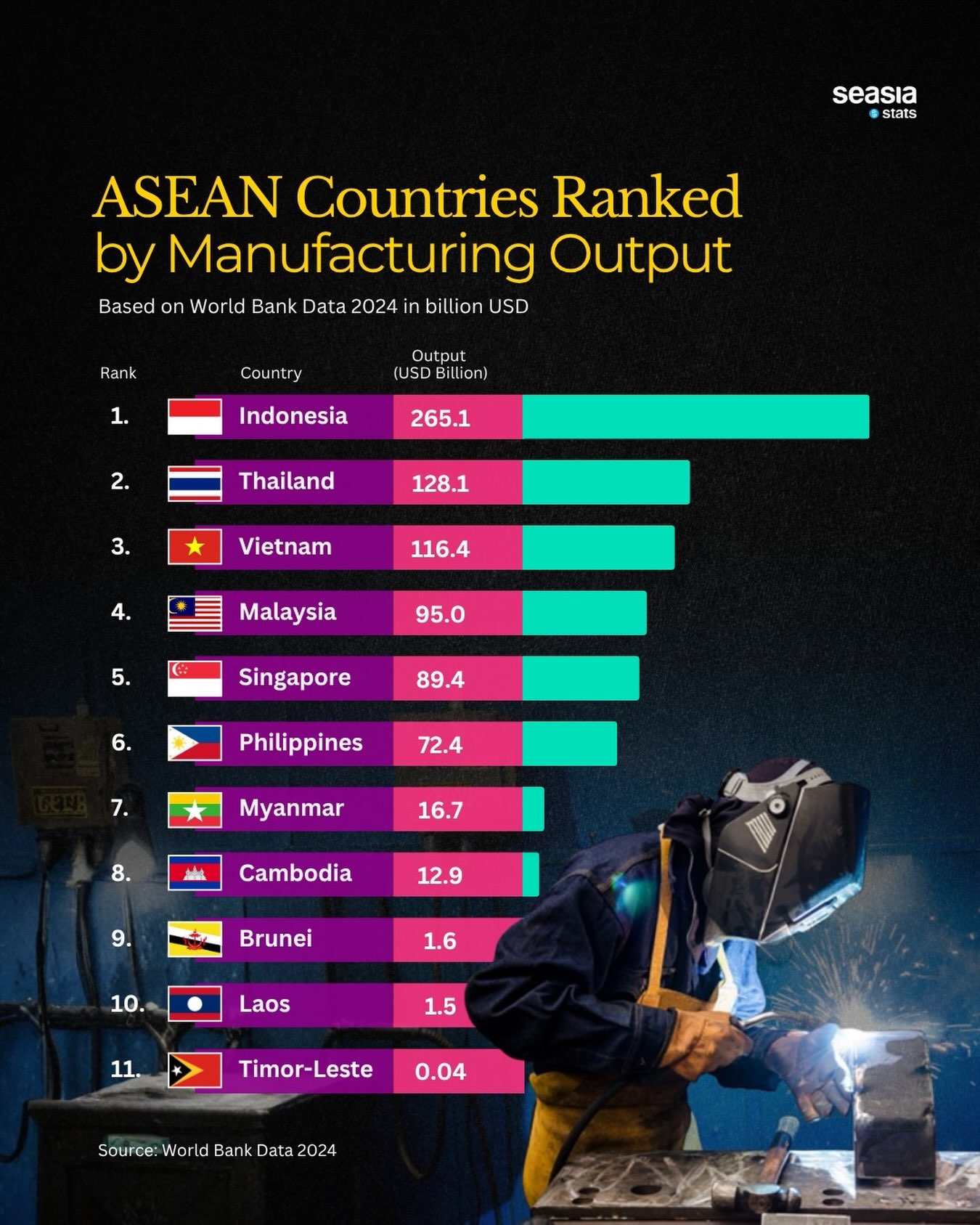
Indonesia is Southeast Asia's largest manufacturing economy in 2024 with approximately $265.1 billion.

Manufacturing remains one of the most important pillars of Southeast Asia’s economy, supporting exports, employment, investment and integration into global supply chains.
According to World Bank World Development Indicators, manufacturing value added measures the contribution of the manufacturing sector to an economy and is reported in current U.S. dollars. The World Bank compiles the indicator from national statistical agencies, central banks and other official sources.
Indonesia is by far Southeast Asia’s largest manufacturing economy, with manufacturing output of approximately $265.1 billion in 2024.
Its enormous domestic market, extensive industrial base and production of food products, chemicals, machinery, vehicles and other manufactured goods have helped establish the country as the region’s leading manufacturing powerhouse.
Thailand ranks second with $128.1 billion, supported by a highly developed industrial sector. The country is particularly well known for automotive production, electronics, food processing and machinery.
Vietnam follows closely with $116.4 billion, reflecting its rapid transformation into a major manufacturing and export center. Electronics, textiles, footwear and machinery have become increasingly important to Vietnam’s industrial economy.
Malaysia, with $95.0 billion, occupies fourth place. Its manufacturing strengths include electronics and electrical products, chemicals, petroleum-related products and machinery.
Singapore follows with $89.4 billion. Although its population and land area are much smaller than those of its neighbors, Singapore has developed a high-value manufacturing sector focused on semiconductors, pharmaceuticals, chemicals, aerospace and advanced engineering.
The Philippines ranks sixth with $72.4 billion in manufacturing output. Its industrial base includes electronics, food processing, chemicals and other consumer and intermediate goods. Together, these six economies account for the overwhelming majority of manufacturing activity among the Southeast Asian countries in this ranking.
The remaining economies have smaller manufacturing sectors but are gradually expanding their industrial capabilities. Myanmar records $16.7 billion, followed by Cambodia at $12.9 billion. Cambodia’s manufacturing industry is strongly associated with garments, footwear and travel goods.
Brunei records $1.6 billion, while Laos contributes $1.5 billion. At the bottom of the ranking, Timor-Leste records approximately $0.04 billion, or $40 million.
Overall, the figures reveal a striking concentration of manufacturing capacity in Southeast Asia. Indonesia, Thailand, Vietnam, Malaysia, Singapore and the Philippines form the region’s principal industrial core, while Cambodia, Myanmar, Brunei, Laos and Timor-Leste represent smaller but potentially evolving manufacturing markets.
The World Bank's data underline the enormous diversity of Southeast Asia's industrial landscape and the region's continuing importance to global production and supply chains.