

Southeast Asia's Most and Least Peaceful Countries in 2026
Singapore is the most peaceful country in Southeast Asia, while Myanmar is the least.

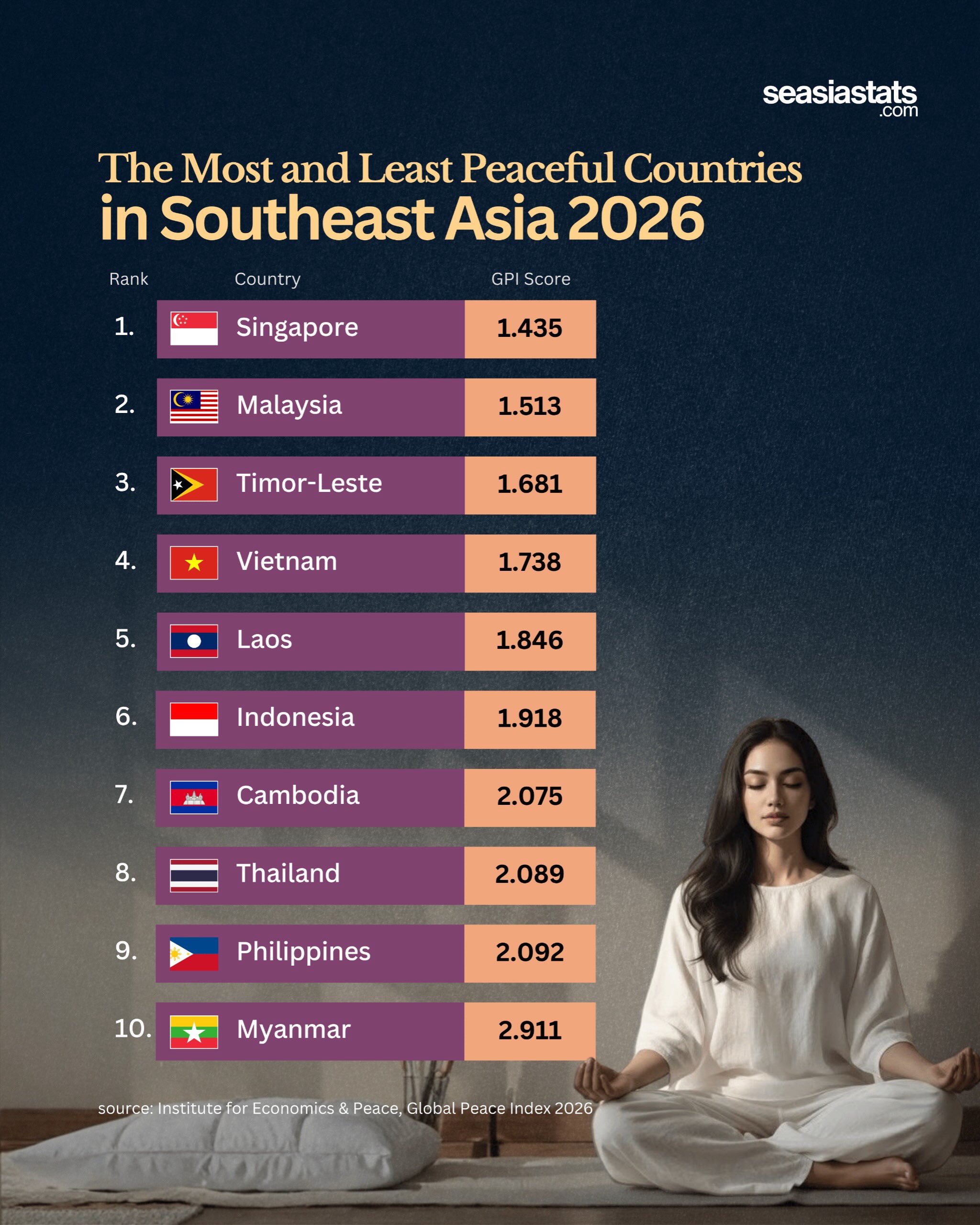
Southeast Asia presents a diverse picture of peace and security in 2026, with countries recording different levels of peacefulness according to their Global Peace Index (GPI) scores. The rankings highlight differences in stability, safety, and conflict-related challenges across the ten Southeast Asian nations.
The Global Peace Index, published by the Institute for Economics & Peace (IEP), evaluates peacefulness using indicators related to societal safety and security, ongoing domestic and international conflicts, and militarization. Generally, a lower GPI score indicates a higher level of peacefulness.
Singapore leads Southeast Asia with a GPI score of 1.435, making it the region’s most peaceful country in 2026. Its strong public security, political stability, and effective institutions contribute to its reputation as a safe and orderly nation. Malaysia follows in second place with a score of 1.513, reflecting its comparatively peaceful environment.
Timor-Leste ranks third with a score of 1.681, followed by Vietnam at 1.738. Laos occupies fifth place with 1.846, while Indonesia ranks sixth with 1.918. These countries demonstrate varying levels of peacefulness, shaped by their domestic conditions, governance, and security environments.
Further down the regional ranking, Cambodia records a score of 2.075, placing it seventh. Thailand follows in eighth place with 2.089, narrowly ahead of the Philippines, which ranks ninth with 2.092. Although their scores are relatively close, each country faces distinct challenges involving public security, political tensions, or internal conflict.
At the other end of the ranking, Myanmar has the highest GPI score in Southeast Asia at 2.911, making it the region’s least peaceful country according to the supplied figures.
The country has experienced prolonged armed conflict and political instability, creating serious humanitarian and security challenges. These conditions have contributed to its position at the bottom of the regional ranking.
Overall, the 2026 figures show a considerable gap between Singapore and Myanmar. Singapore’s score is 1.476 points lower than Myanmar’s, illustrating the contrasting levels of peacefulness represented in the ranking.
In conclusion, Southeast Asia’s peace landscape in 2026 ranges from Singapore’s comparatively high stability to Myanmar’s severe conflict-related challenges. While the GPI provides a useful framework for comparing countries, its scores should be understood alongside each nation’s political, social, and security circumstances.
Continued efforts to strengthen institutions, resolve conflicts, and promote regional cooperation remain important for improving peace throughout Southeast Asia.