

Southeast Asia’s Most Innovative Economies in 2026
Ranked 5th globally, Singapore leads Southeast Asia in innovative economy.

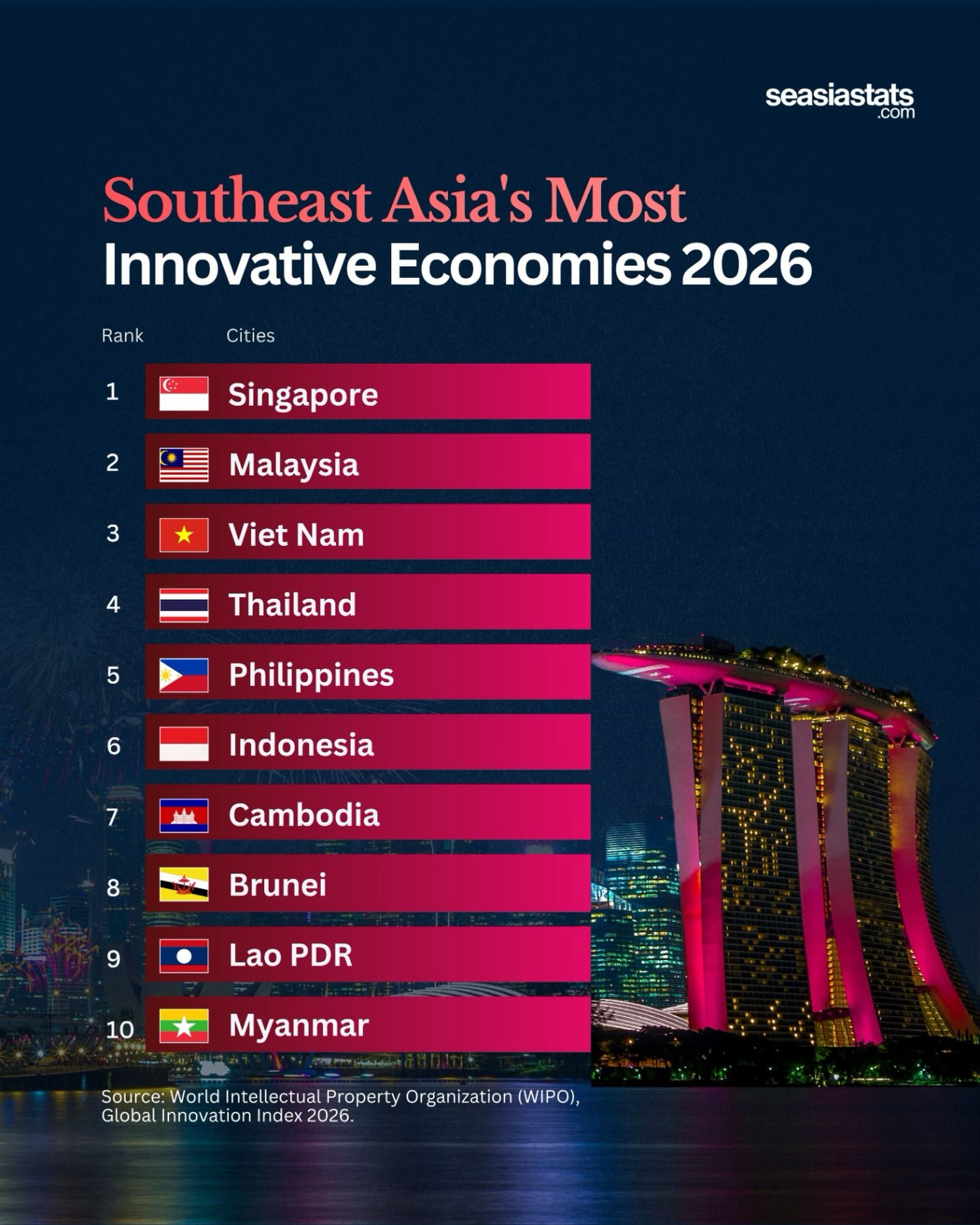
Southeast Asia is emerging as one of the world’s most dynamic innovation regions, with several economies strengthening their capabilities in technology, research, manufacturing, digital services and intellectual property.
According to the World Intellectual Property Organization (WIPO) Global Innovation Index (GII) 2026, the region combines established innovation leaders with fast-rising middle-income economies.
Singapore remains the clear regional leader, ranking 5th globally and second in the wider Southeast Asia, East Asia and Oceania region. Its strength comes from sophisticated infrastructure, research, business innovation and a highly developed technology ecosystem.
Malaysia, ranked 34th globally, follows as Southeast Asia’s second-highest economy and continues to benefit from high-tech manufacturing, international trade and strong business research and development.
Vietnam, ranked 43rd, is one of the region’s most notable innovation success stories. WIPO identifies Vietnam as a long-standing innovation overperformer and highlights its strength in high-tech and creative-goods exports, mobile-app creation and integration into global manufacturing networks.
Thailand, ranked 44th, also performs strongly, particularly in business-funded research and development; it is another economy that has repeatedly performed above expectations for its level of development.
The Philippines, ranked 52nd, has built considerable strength in high-tech trade and ICT services, while Indonesia, ranked 55th, benefits from a growing startup ecosystem and strong late-stage venture-capital activity.
Both countries are among the middle-income economies that have made significant long-term progress in the GII.
Further down the ranking, Cambodia stands at 93rd, with market sophistication as one of its principal innovation strengths. Brunei Darussalam ranks 98th, followed by Laos at 108th and Myanmar at 125th. Although these economies currently trail their regional peers, their inclusion illustrates the diverse stages of innovation development across Southeast Asia.
Overall, the GII 2026 shows that Southeast Asia is not relying on a single innovation model. Singapore leads through advanced knowledge and technology while Malaysia with its sophisticated manufacturing.
Vietnam and Thailand with their rapidly developing industrial capabilities, and the Philippines and Indonesia through digital services, entrepreneurship and global value chains. Together, these economies demonstrate Southeast Asia’s growing importance in the global innovation landscape.