

Southeast Asia's Most Legendary Spirits
These are the most legendary spirits from Southeast Asian countries. You don't want to encounter them.

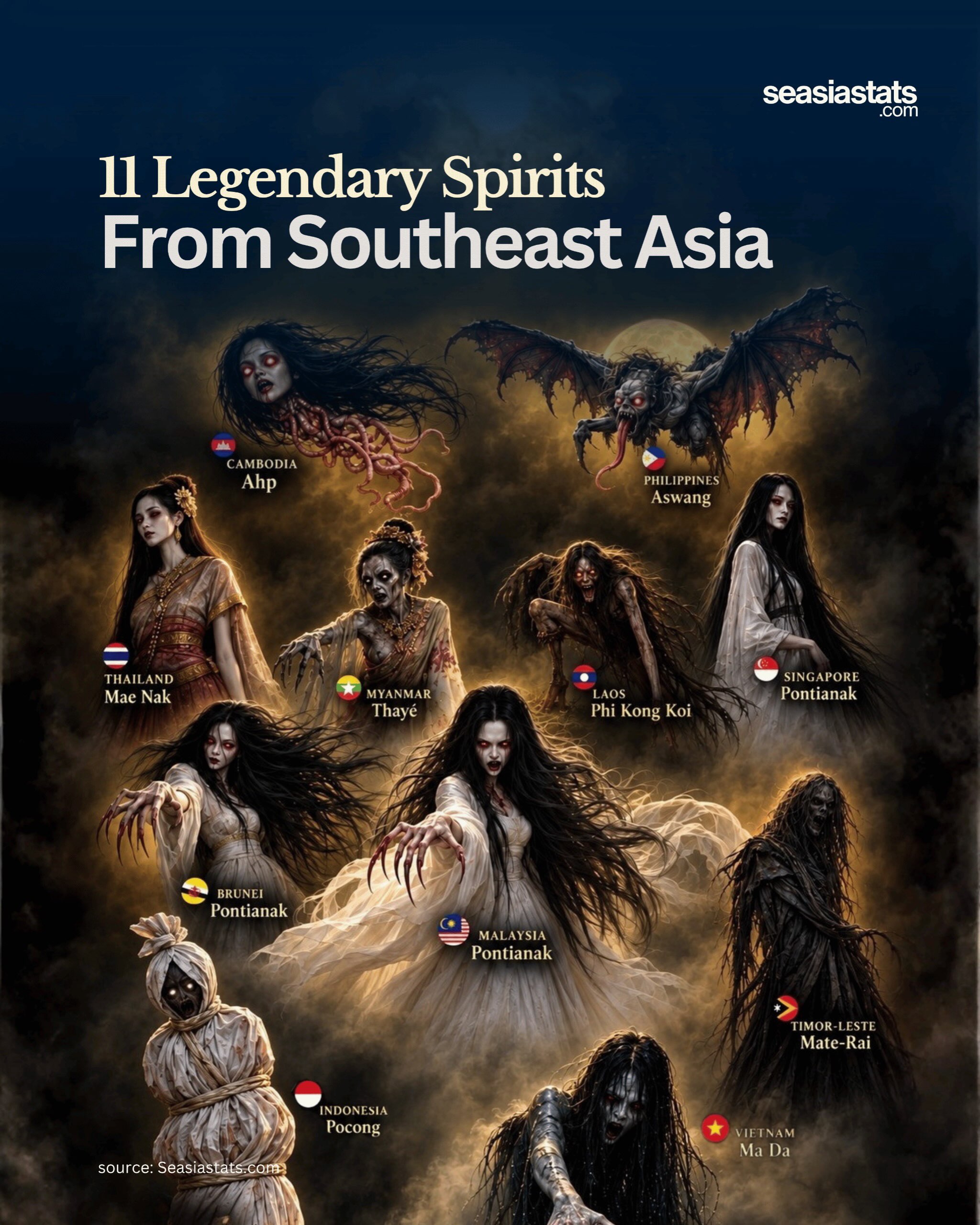
Southeast Asia is a region rich in culture, folklore, and supernatural legends. Passed down through generations, stories of ghosts and mysterious spirits reflect the beliefs, fears, and traditions of different communities.
From vengeful female spirits to wandering souls and shape-shifting monsters, these legendary beings continue to fascinate people across the region.
In Malaysia, Brunei, and Singapore, the Pontianak is one of the most famous supernatural figures. Often depicted as the ghost of a woman who died during pregnancy or childbirth, she is believed to appear as a beautiful woman before revealing her terrifying nature. Her eerie cries and association with banana trees make her a frightening figure in local folklore.
In Indonesia, the Pocong is a ghost wrapped tightly in a white burial shroud, symbolizing a deceased person's soul that remains bound to the earthly world. Its hopping movements and pale appearance have made it a popular figure in Indonesian horror stories and films.
Thailand's Mae Nak is a tragic ghost associated with a famous love legend. According to folklore, she died during childbirth while her husband was away at war. Unaware of her death, he returned home to live with her spirit. Her story explores love, grief, and the difficulty of accepting loss.
In Cambodia, the Ahp is commonly described as a frightening female spirit whose head separates from its body at night, accompanied by its internal organs. It is believed to wander in search of blood or other sources of nourishment.
The Philippines is home to the Aswang, a terrifying supernatural creature known for its ability to shapeshift. Depending on the regional tradition, it may resemble a vampire, ghoul, or predatory monster that hunts at night.
In Laos, Phi Kong Koi is often portrayed as a small, one-legged forest spirit associated with eerie nighttime sounds. In Myanmar, the Thaye is generally described in some traditions as a large, frightening ghost connected with death and restless spirits.
Vietnamese folklore features Ma Da, a water ghost believed to haunt rivers, ponds, and other bodies of water, sometimes dragging unsuspecting people underwater. In Timor-Leste, Mate-Rai, a term associated with the dead or spirits of the deceased, reflects traditional beliefs about the continuing presence of ancestral spirits.
Although these legends differ in appearance and origin, they share a common theme: the mysterious boundary between life and death. These supernatural stories preserve cultural traditions, teach moral lessons, and explain the unknown.
Today, they remain an important part of Southeast Asia's cultural identity, inspiring books, films, festivals, and countless chilling tales told after dark.