

Southeast Asia's Most Powerful Passports
Singapore's passport is still holding the crown as the strongest passport in Southeast Asia.

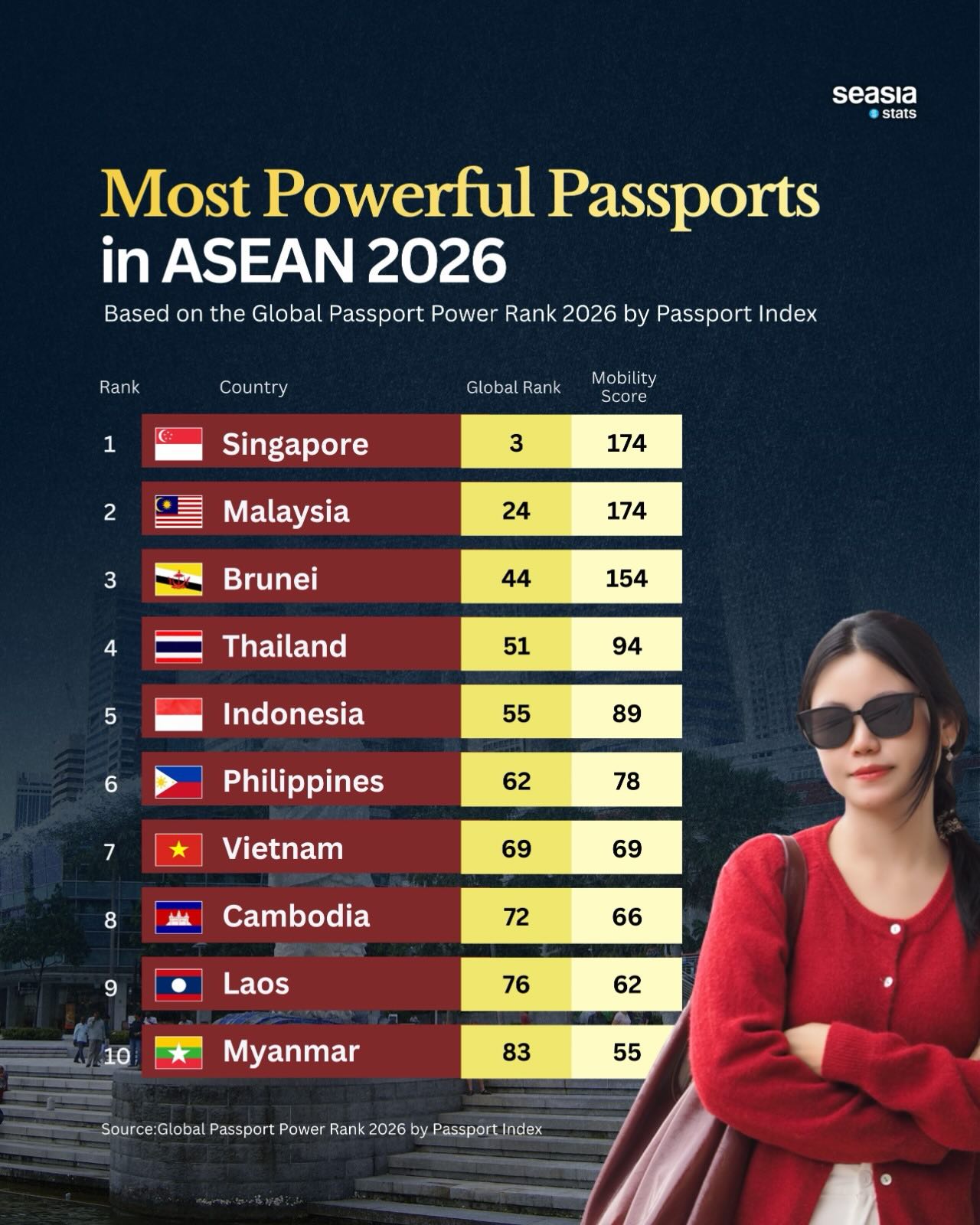
The strength of a passport is measured by the travel freedom it provides, allowing citizens to enter foreign destinations without obtaining a traditional visa in advance. According to the Passport Index 2026, Southeast Asian countries continue to display a wide range of global mobility, with Singapore maintaining its position as the region's strongest passport.
Singapore ranks 3rd globally with a mobility score of 174, making it the most powerful passport in Southeast Asia. Singaporean passport holders enjoy visa-free, visa-on-arrival, electronic travel authorization (eTA), or simplified entry to 174 destinations worldwide.
The country's strong diplomatic relations, stable economy, and extensive international partnerships continue to support its exceptional level of travel freedom.
Malaysia follows as the region's second-strongest passport, ranking 24th globally with a mobility score of 174. Although sharing the same mobility score, Malaysia is placed lower in the overall ranking because the Passport Index also considers additional passport power indicators beyond mobility alone.
Brunei ranks 44th with a mobility score of 154, reflecting its broad visa-free access despite its relatively small population. Thailand occupies 51st place with a mobility score of 94, while Indonesia ranks 55th with a mobility score of 89, demonstrating continued improvements in international travel access over recent years.
The Philippines is positioned 62nd globally with a mobility score of 78, followed by Vietnam in 69th place with a mobility score of 69.
Cambodia ranks 72nd with a mobility score of 66, while Laos is 76th with 62 mobility score. Myanmar rounds out the ASEAN rankings in this comparison, placing 83rd globally with a mobility score of 55.
The rankings highlight the significant differences in passport strength across Southeast Asia. Higher mobility scores generally reflect stronger diplomatic ties, reciprocal visa agreements, and greater international trust between governments.
Citizens holding more powerful passports benefit from easier travel for tourism, business, education, and investment opportunities, reducing both travel costs and administrative requirements.
As global mobility continues to evolve, governments across the region are seeking to expand visa-waiver agreements and strengthen international cooperation. While Singapore and Malaysia remain regional leaders in passport power, other ASEAN members are also working to improve travel access through enhanced diplomatic engagement and bilateral agreements.
The 2026 Passport Index demonstrates that passport strength is more than a measure of convenience—it also reflects a country's international relationships, economic standing, and global influence, making it an important indicator of worldwide connectivity in an increasingly interconnected world.