

Southeast Asia's National Animals
These are the official and unofficial national animals of Southeast Asian countries.

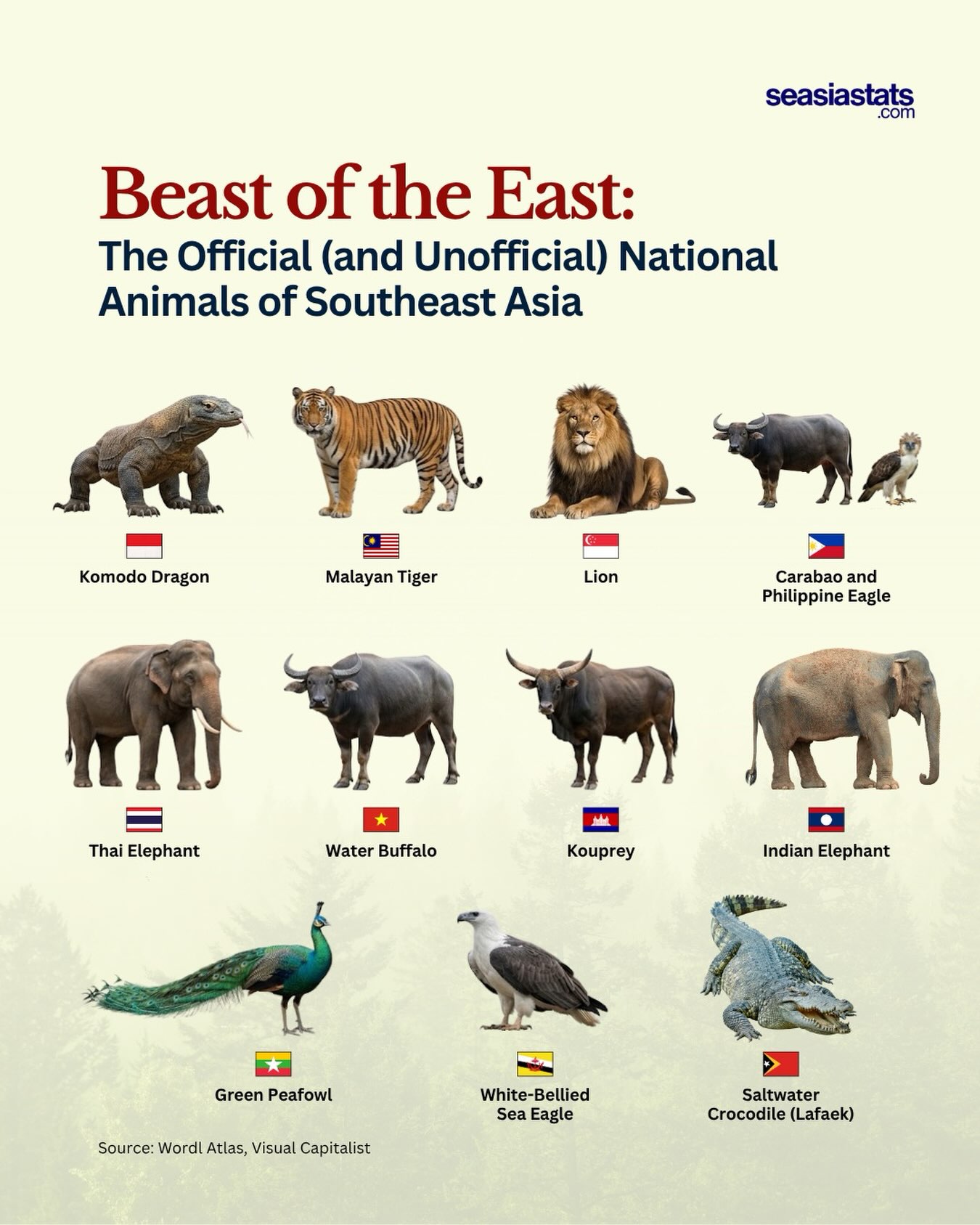
Southeast Asia is renowned for its remarkable variety of wildlife, with many countries being closely linked to particular animals. While some species have been officially declared national animals, others are considered unofficial national symbols because of their cultural significance, historical connections, or strong association with the nation.
In Indonesia, the Komodo dragon serves as a powerful national symbol. Found naturally on several Indonesian islands, this prehistoric-looking reptile is well known for its impressive size and unique physical features. Malaysia is symbolized by the Malayan tiger, an endangered species valued for its power, bravery, and deep significance in Malay culture.
Singapore’s national animal is the lion. Despite the fact that wild lions have never naturally inhabited Singapore, the animal has a strong connection to the country through its name and historical origins.
The carabao, or water buffalo, is widely recognized as a national animal of the Philippines. It represents strength, perseverance, hard work, and the importance of farming and rural communities. The Philippine eagle is also a major national symbol, serving as the country’s national bird and reflecting the Philippines’ exceptional natural biodiversity.
In Thailand, the Thai elephant holds a special place as one of the country’s most recognizable symbols. Throughout Thai history, elephants have been closely connected with religion, transportation, warfare, and important cultural traditions.
Vietnam has a long-standing association with the water buffalo, which has traditionally been essential to farming and village communities. The animal is often seen as a representation of endurance, strength, patience, and the hardworking nature of Vietnamese farmers.
Cambodia traditionally identifies the kouprey as its national animal. This uncommon wild cattle species is an important part of Cambodia’s natural heritage, although it is considered critically endangered and may possibly have disappeared from the wild.
In Laos, the Indian elephant is an important national symbol, reflecting the country’s long and significant cultural and historical relationship with elephants.
Myanmar is associated with the green peafowl, a bird admired for its striking appearance as well as its cultural importance. In Brunei, the white-bellied sea eagle symbolizes the nation’s diverse tropical environment, including its forests, waterways, and coastal regions.
Timor-Leste, meanwhile, is commonly linked with the saltwater crocodile. This powerful reptile is an important part of the country’s natural environment and also has significance within local traditions and beliefs.
Taken together, these animals highlight the extraordinary wildlife diversity found throughout Southeast Asia. Whether they have official national status or are simply honored as important symbols, they embody the region’s history, traditions, landscapes, and natural wealth.
Protecting these species and the environments they depend on is therefore essential to preserving the cultural and natural identity of Southeast Asia for generations to come.