

Southeast Asia’s Performance in PISA 2025
As expected, Singaporean youths performed the best in PISA 2025 among Southeast Asian countries

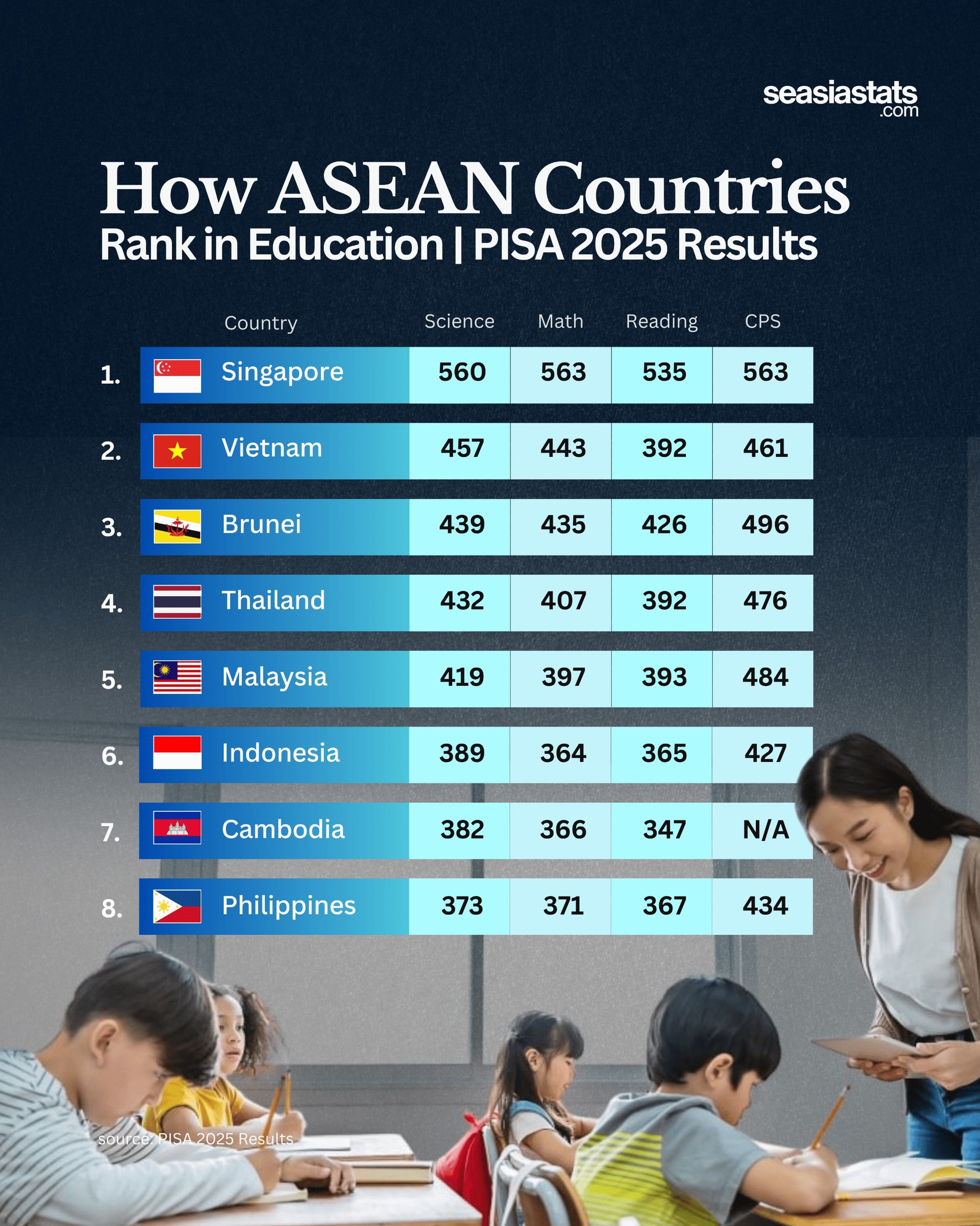
The results of the Programme for International Student Assessment (PISA) 2025 highlight significant differences in educational performance across Southeast Asia.
The assessment, conducted by the OECD, measured the abilities of 15-year-old students in science, mathematics, reading, and computational problem solving (CPS). More than 760,000 students from 91 countries and economies participated worldwide.
Singapore was by far Southeast Asia’s strongest performer and one of the world's leading education systems. Its students scored 560 in science, 563 in mathematics, 535 in reading, and 563 in computational problem solving.
Singapore achieved the highest reading score internationally and was also second globally in both science and mathematics. Its CPS score was among the world's highest as well.
Vietnam ranked second among the Southeast Asian countries listed, recording 457 in science, 443 in mathematics, 392 in reading, and 461 in CPS.
Brunei Darussalam followed with 439 in science, 435 in mathematics, 426 in reading, and 496 in CPS. Brunei's results placed it among ASEAN's top three in science and mathematics and second in reading. Ministry of Education Brunei
Thailand recorded 432 in science, 407 in mathematics, 392 in reading, and 476 in CPS, while Malaysia achieved 419, 397, 393, and 484, respectively. Notably, Malaysia's CPS result was considerably stronger relative to its performance in the traditional academic subjects.
The OECD also identified Malaysia as one of the systems performing more than 30 points above expectations in computational problem solving based on science performance.
Further down the ranking, Indonesia scored 389 in science, 364 in mathematics, 365 in reading, and 427 in CPS. Cambodia recorded 382 in science, 366 in mathematics, and 347 in reading, while its CPS result was unavailable. The Philippines scored 373 in science, 371 in mathematics, 367 in reading, and 434 in CPS.
Overall, the results reveal a substantial educational gap within Southeast Asia. Singapore stands clearly apart from its regional neighbors, particularly in science, mathematics, and reading.
At the same time, the comparatively strong CPS performances of countries such as Brunei, Malaysia, Thailand, and the Philippines suggest that traditional academic scores do not tell the entire story of students' abilities in an increasingly digital world.
The 2025 results therefore provide Southeast Asian governments with both challenges and opportunities as they seek to strengthen education systems and prepare students for the future.