

Southeast Asia's Pork Consumption
Pork consumption in Southeast Asia varies greatly, with Vietnamese eating it the most, and Indonesians the least.

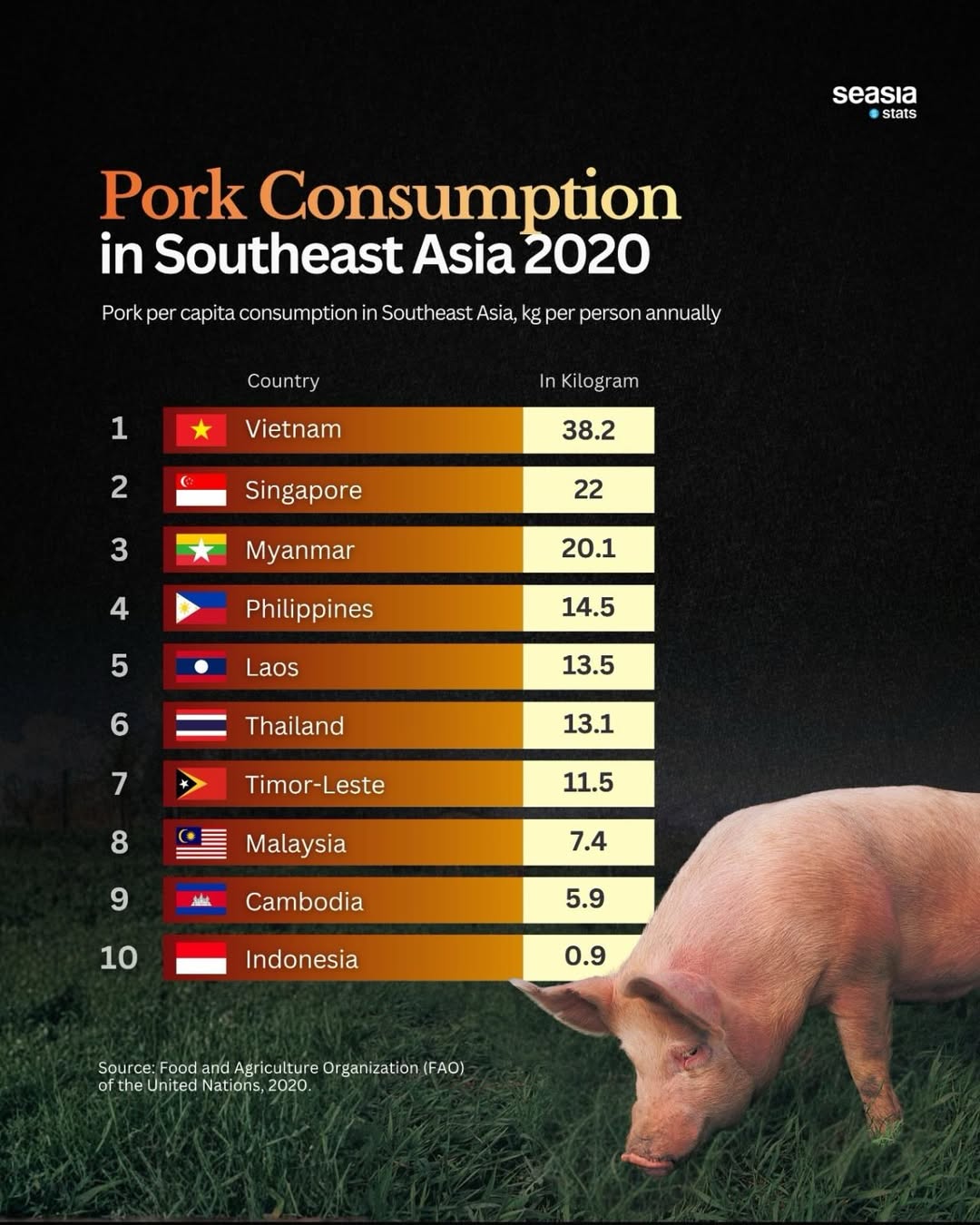
Pork consumption across Southeast Asia varies widely, reflecting the region’s cultural, religious, and economic diversity. Annual pork consumption per person ranges from very high levels in Viet Nam to extremely low levels in Indonesia, showing how food habits are closely connected to local traditions and demographics.
Among Southeast Asian countries, Viet Nam records the highest pork consumption at 38.2 kilograms per person annually.
Pork plays a central role in Vietnamese cuisine and daily meals, appearing in popular dishes such as pho, banh mi, and grilled pork specialties. The country’s strong agricultural sector and long-standing culinary traditions have helped maintain high demand for pork products.
Singapore follows with 22 kilograms per person annually. Despite its relatively small population, Singapore has a strong demand for pork due to its multicultural food culture and high purchasing power. Pork is commonly used in Chinese, Western, and local hawker dishes across the city-state.
In Myanmar, annual pork consumption reaches 20.1 kilograms per person. Pork remains an important protein source for many communities, particularly among non-Muslim populations. Similarly, the Philippines consumes 14.5 kilograms per person each year, where pork is widely featured in traditional meals such as lechon and adobo.
Other mainland Southeast Asian countries show moderate levels of pork consumption. Laos records 13.5 kilograms per person annually, while Thailand follows closely at 13.1 kilograms. Pork is frequently used in local street food and regional cuisine in both countries. Meanwhile, Timor-Leste consumes 11.5 kilograms per person each year.
In contrast, pork consumption is significantly lower in countries with large Muslim populations. Malaysia records 7.4 kilograms per person annually, while Cambodia stands at 5.9 kilograms.
The lowest figure in the region belongs to Indonesia at only 0.9 kilograms per person annually. As the world’s largest Muslim-majority country, Indonesia’s dietary patterns are heavily influenced by Islamic halal principles, which prohibit pork consumption for most of the population.
Overall, pork consumption in Southeast Asia demonstrates how religion, culture, income levels, and food traditions shape eating habits across the region.