

Southeast Asia's Public Libraries
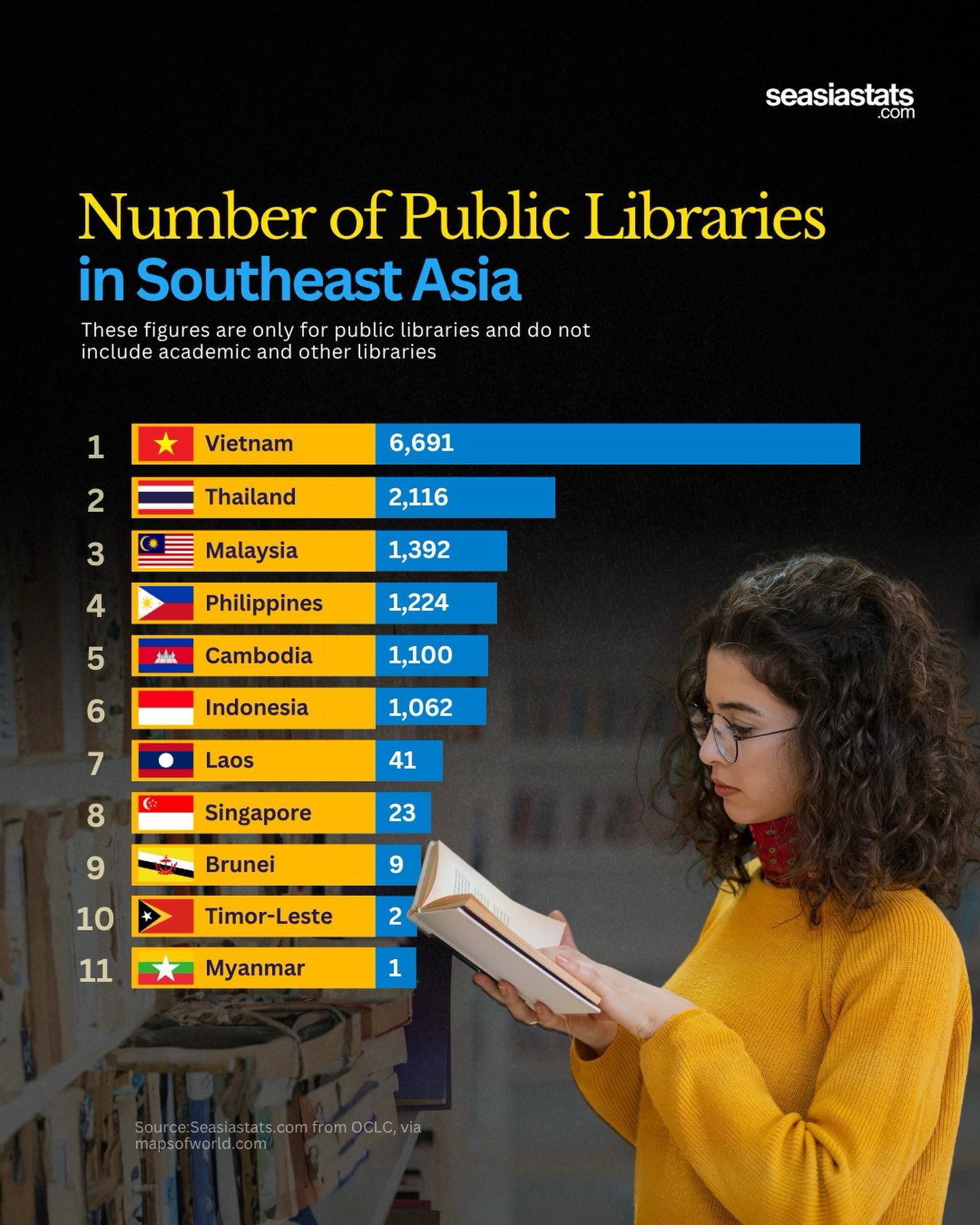
Vietnam leads Southeast Asia in public libraries with 6,691, far ahead of the rest in the region.

Public libraries play an important role in promoting education, literacy, access to information, and lifelong learning. Across Southeast Asia, however, the number of public libraries varies considerably from country to country.
Data attributed to the Online Computer Library Center (OCLC) show a striking difference between countries with large public-library networks and those with much smaller systems. The figures cover public libraries specifically and do not include academic or other types of libraries.
Vietnam has the largest number of public libraries in Southeast Asia, with 6,691. This places the country far ahead of the rest of the region. Thailand ranks second with 2,116 public libraries, followed by Malaysia, which has 1,392. Together, these three countries account for a substantial share of the public-library network represented in the data.
The Philippines ranks fourth with 1,224 public libraries, while Cambodia follows closely with 1,100.
Indonesia, despite being one of the world's most populous countries and the largest country in Southeast Asia by population, ranks sixth with 1,062 public libraries in this dataset. These figures demonstrate that population size alone does not determine the number of public libraries a country operates.
The numbers decline sharply among several smaller countries. Laos has 41 public libraries, while Singapore has 23.
Although Singapore's total is relatively small, its library system is known for modern facilities and digital services, illustrating why the number of libraries alone does not necessarily measure the quality or accessibility of a country's library services. Brunei has 9 public libraries, followed by Timor-Leste with only 2. Myanmar ranks last in the dataset, with 1 public library recorded.
Overall, the figures reveal significant disparities in public-library infrastructure across Southeast Asia. Countries with larger networks may have greater physical reach for communities seeking books, educational resources, and information.
At the same time, smaller countries can use technology and centralized services to expand access beyond the limitations of physical library numbers. As the region continues to develop, strengthening libraries, both physical and digital, could help improve literacy, education, and equal access to knowledge.