

Southeast Asia's QR Payment Systems and Schemes
ASEAN has different QR payment systems and schemes from all of its countries.

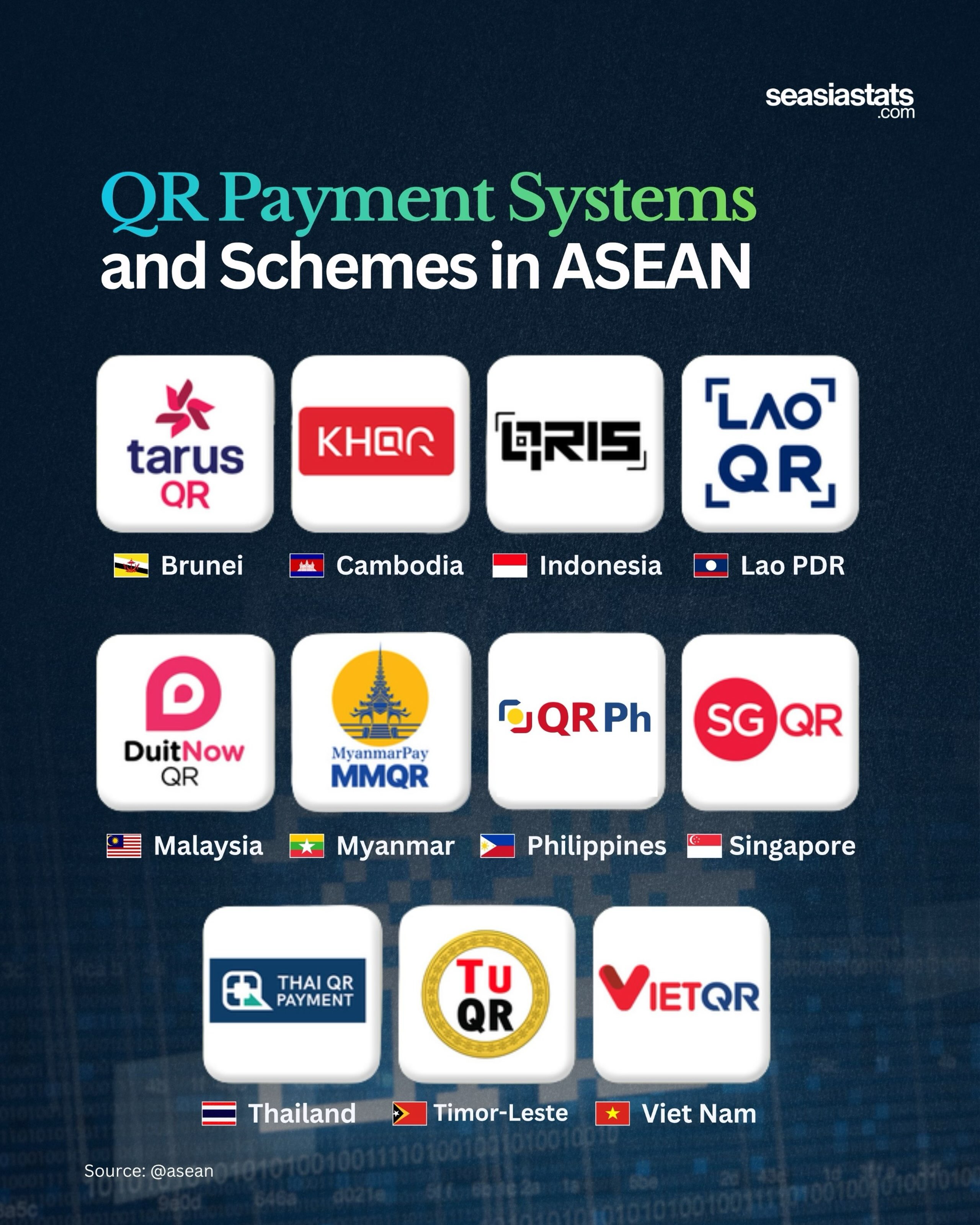
Southeast Asia has become one of the world’s leading regions for digital payments, with nearly every country introducing a national QR code payment standard. These systems allow consumers to make cashless transactions using mobile banking apps and e-wallets while giving merchants a single QR code that can be accepted by multiple financial institutions.
Most of these platforms are based on the EMVCo standard, ensuring interoperability and paving the way for cross-border payments across the region.
Brunei has introduced Taurus QR (tarusQR) as its national QR payment standard. It enables interoperable payments between participating banks and e-wallets, providing secure and instant transactions for consumers and businesses.
Cambodia operates KHQR, developed by the National Bank of Cambodia as part of the Bakong payment ecosystem. KHQR has played a significant role in promoting digital payments and cross-border QR transactions with neighboring countries.
Indonesia’s QRIS (Quick Response Code Indonesian Standard) unifies payments across banks and e-wallets, allowing merchants to display a single QR code. Since its launch in 2019, QRIS has become one of the region’s most widely adopted QR payment systems.
Laos uses Lao QR, introduced by the Bank of the Lao PDR to standardize QR payments nationwide and support regional payment connectivity.
Malaysia’s DuitNow QR enables seamless payments between banks and e-wallet providers through a unified QR code. It is also connected with several neighboring countries for cross-border transactions.
Myanmar has implemented MyanmarPay MMQR, a standardized QR payment system regulated by the Central Bank of Myanmar to improve interoperability among banks and digital wallets.
The Philippines adopted QRPh, which standardizes QR payments across banks and electronic wallets, making digital transactions more convenient for merchants and consumers.
Singapore’s SGQR combines multiple payment schemes into a single QR code, reducing clutter at merchant locations while supporting interoperable digital payments.
Thailand’s Thai QR Payment, commonly associated with PromptPay, has become one of the region’s most mature QR payment systems and is a key participant in ASEAN’s cross-border payment initiatives.
Timor-Leste is developing TuQR as its national QR payment standard to strengthen its digital payment infrastructure and align with regional interoperability efforts.
Vietnam’s VietQR provides a unified QR payment standard that enables instant transfers between participating banks and supports the country’s growing digital economy.
Together, these national QR payment systems are accelerating financial inclusion, simplifying everyday transactions, and strengthening cross-border payment connectivity across Southeast Asia, making the region a global leader in digital payment innovation.