

Southeast Asia's Top 10 Manufacturing Hubs
As one of the most dynamic regions in manufacturing, Southeast Asia have several top manufacturing hubs that stand out.

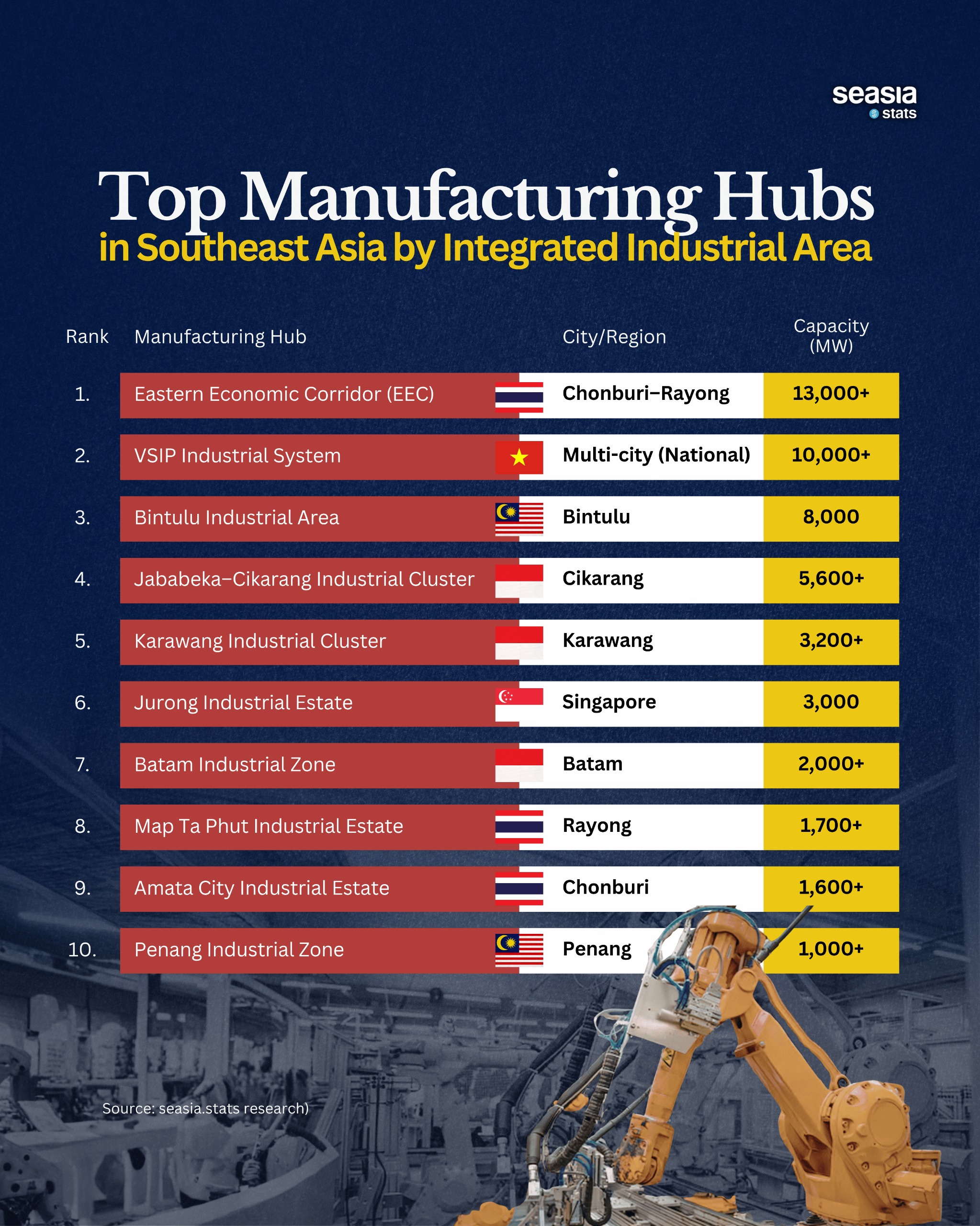
Southeast Asia has emerged as one of the world’s most dynamic manufacturing regions, supported by large-scale integrated industrial areas that combine infrastructure, logistics, and energy capacity. These hubs play a critical role in attracting foreign investment and supporting global supply chains across electronics, automotive, petrochemicals, and heavy industries.
At the forefront is Thailand’s Eastern Economic Corridor, boasting more than 13,000 MW of capacity. This flagship development anchors Thailand’s industrial strategy, connecting ports, airports, and high-speed rail to create a powerful manufacturing ecosystem.
Also in Thailand, Map Ta Phut Industrial Estate (1,700+ MW) and Amata City Industrial Estate (1,600+ MW) reinforce the country’s strength in petrochemicals and automotive production.
Viet Nam has rapidly risen through the VSIP Industrial System, which spans multiple cities and delivers over 10,000 MW in capacity. These integrated parks are known for attracting multinational manufacturers, particularly in electronics and consumer goods.
Malaysia’s industrial presence is highlighted by the Bintulu Industrial Area with more than 8,000 MW, driven largely by energy-intensive industries such as liquefied natural gas and heavy manufacturing.
Meanwhile, the Penang Industrial Zone (1,000+ MW) has become a major hub for semiconductor and electronics production, often referred to as the “Silicon Valley of the East.”
Indonesia features prominently with several major clusters. The Jababeka-Cikarang Industrial Cluster leads with 5,600+ MW, hosting hundreds of multinational companies.
Nearby, the Karawang Industrial Cluster (3,200+ MW) is a key center for automotive manufacturing. The Batam Industrial Zone (2,000+ MW) adds to Indonesia’s appeal with its proximity to Singapore and strong export orientation.
Singapore’s Jurong Industrial Estate, with around 3,000 MW, stands out for its advanced infrastructure and focus on high-value industries such as pharmaceuticals, petrochemicals, and precision engineering. Despite its smaller land area, Singapore remains a critical node in regional manufacturing networks.
Together, these ten industrial hubs illustrate Southeast Asia’s growing importance in global manufacturing. Their high energy capacities, integrated planning, and strategic locations make them attractive to multinational corporations seeking diversification beyond traditional production bases.
As supply chains continue to evolve, these industrial areas are expected to play an even larger role in shaping the future of global industry.