

The Biggest Population Booms from 1930 to 2026
The world's population has been growing exponentially compared to the 1930s.

Population growth has been one of the defining demographic trends of the past century. Advances in medicine, sanitation, nutrition, and economic development have dramatically reduced mortality rates while extending life expectancy across much of the world.
Comparing national populations between 1930 and 2026 illustrates how countries have experienced remarkably different rates of demographic expansion.
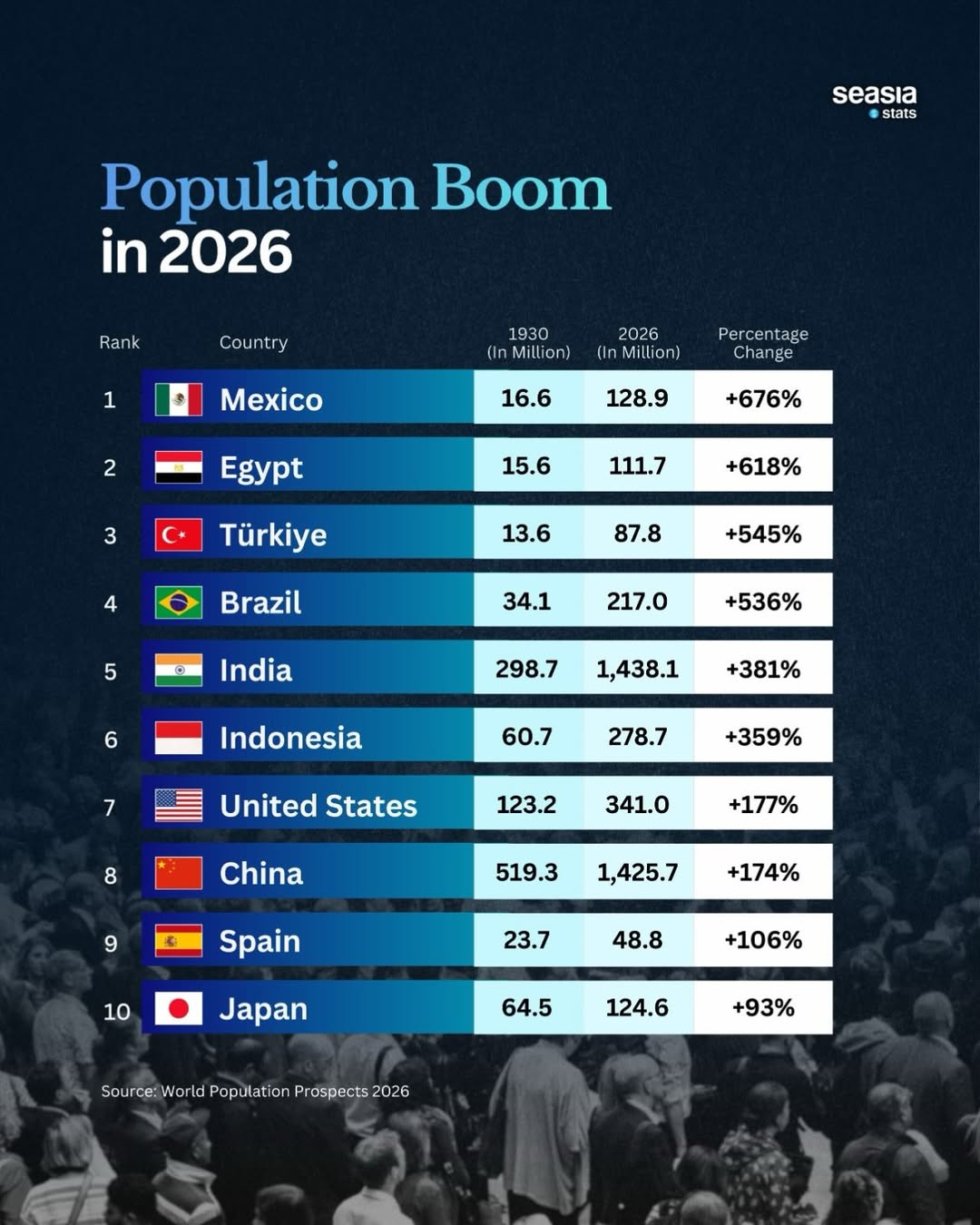
Among the countries compared, Mexico records the highest percentage increase in population. Its population grew from 16.6 million in 1930 to approximately 128.9 million in 2026, representing an increase of about 676 percent.
Egypt follows closely, expanding from 15.6 million to 111.7 million people, or a remarkable 618 percent increase. Turkey ranks third, growing from 13.6 million to 87.8 million, equivalent to a 545 percent rise over the same period.
Brazil also experienced extraordinary demographic growth, increasing from 34.1 million inhabitants in 1930 to approximately 217.0 million in 2026. This represents a 536 percent increase and reflects decades of rapid population expansion accompanied by urbanization and economic development.
India, now one of the world's two most populous countries, grew from 298.7 million to approximately 1.438 billion people, an increase of 381 percent. Although its percentage growth is lower than several smaller countries, India added more than 1.1 billion people in absolute terms, the largest numerical increase among the countries listed.
Indonesia's population expanded from 60.7 million to approximately 278.7 million, representing a 359 percent increase. As Southeast Asia's most populous nation, Indonesia experienced sustained population growth alongside significant improvements in healthcare, education, and economic development.
The United States grew from 123.2 million to around 341.0 million people, an increase of 177 percent, driven by both natural population growth and immigration. China expanded from 519.3 million to approximately 1.425 billion people, recording a 174 percent increase despite experiencing slower growth in recent decades.
Among developed nations, Spain and Japan recorded more modest demographic changes. Spain's population increased from 23.7 million to 48.8 million, representing a 106 percent increase.
Japan experienced the slowest growth among the countries listed, rising from 64.5 million to 124.6 million people, or about 93 percent. In recent years, Japan has faced population decline due to low birth rates and an aging population.
Overall, these figures demonstrate how demographic change has reshaped the modern world. While many developing countries experienced rapid population booms during the twentieth century, several developed economies have entered an era of slower growth or population decline.
These contrasting trends will continue to influence economic development, labor markets, urban planning, resource demand, and public policy throughout the twenty-first century.