

The Busiest International Airline Routes in 2026
As of June this year, these international airline routes are the busiest.

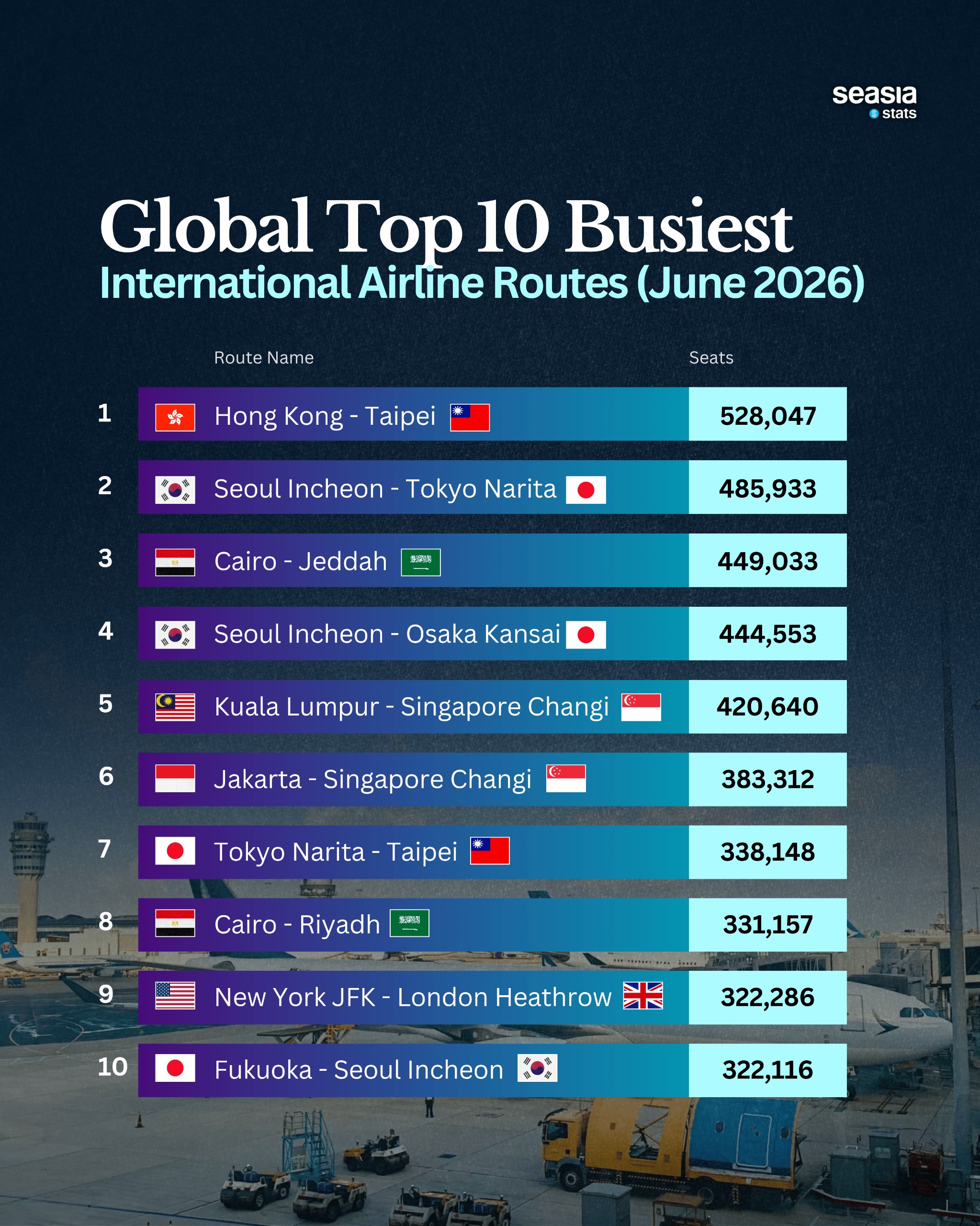
International air travel continued to expand in 2026 as passenger demand remained strong across business, tourism, and family travel markets. One of the best indicators of aviation activity is the number of airline seats available on individual routes.
Based on seat capacity in June 2026, the world's busiest international airline routes highlight the dominance of major travel hubs in Asia, the Middle East, Europe, and North America.
The busiest international route in June 2026 connected Hong Kong and Taipei, offering 528,047 seats during the month.
The route has long been one of Asia's busiest because of its short flight time, extensive business connections, tourism, and strong cultural and family ties. Multiple airlines operate frequent daily services, making it one of the world's most competitive aviation markets.
Second place belongs to the Seoul Incheon–Tokyo Narita route with 485,933 seats. Air travel between South Korea and Japan has rebounded strongly, driven by tourism, business travel, and cultural exchanges.
Another important Japan–South Korea connection, Seoul Incheon–Osaka Kansai, ranks fourth with 444,553 seats, while the Fukuoka–Seoul Incheon route rounds out the top ten with 322,116 seats, demonstrating the high level of connectivity between the two neighboring countries.
The Middle East also features prominently in the rankings. Cairo–Jeddah is the third busiest international route with 449,033 seats, reflecting strong demand from religious pilgrims, expatriate workers, and business travelers. Cairo–Riyadh ranks eighth with 331,157 seats, further highlighting the importance of air links between Egypt and Saudi Arabia.
Southeast Asia remains one of the world's fastest-growing aviation markets. Kuala Lumpur–Singapore Changi ranks fifth with 420,640 seats, serving one of the busiest short-haul corridors globally.
Jakarta–Singapore Changi follows closely in sixth place with 383,312 seats, supported by extensive economic ties, tourism, and Singapore's role as a major international hub. Tokyo Narita–Taipei ranks seventh with 338,148 seats, underscoring the continued importance of travel between Japan and Taiwan.
The only transatlantic route in the top ten is New York John F. Kennedy–London Heathrow, which ranks ninth with 322,286 seats. As one of the world's premier long-haul business corridors, it connects two of the most influential financial and commercial centers.
Overall, the June 2026 rankings demonstrate that Asia dominates global international aviation in terms of seat capacity.
Short-haul regional routes account for most of the world's busiest international air corridors because they combine high travel frequency with strong demand from business travelers, tourists, and visiting friends and relatives. These routes illustrate the continuing recovery and expansion of global aviation, particularly across the Asia-Pacific region.