

The Deepest Lakes in the World
These ten great lakes scattered around the world have astonishing depths.

Lakes are among the most fascinating natural features on Earth, serving as important sources of freshwater, biodiversity, and scientific discovery. While many lakes are known for their size, some are remarkable for their extraordinary depth.
The deepest lakes often formed through tectonic activity, volcanic processes, or glacial erosion over millions of years. Their immense depths create unique ecosystems and provide valuable insights into Earth’s geological history.
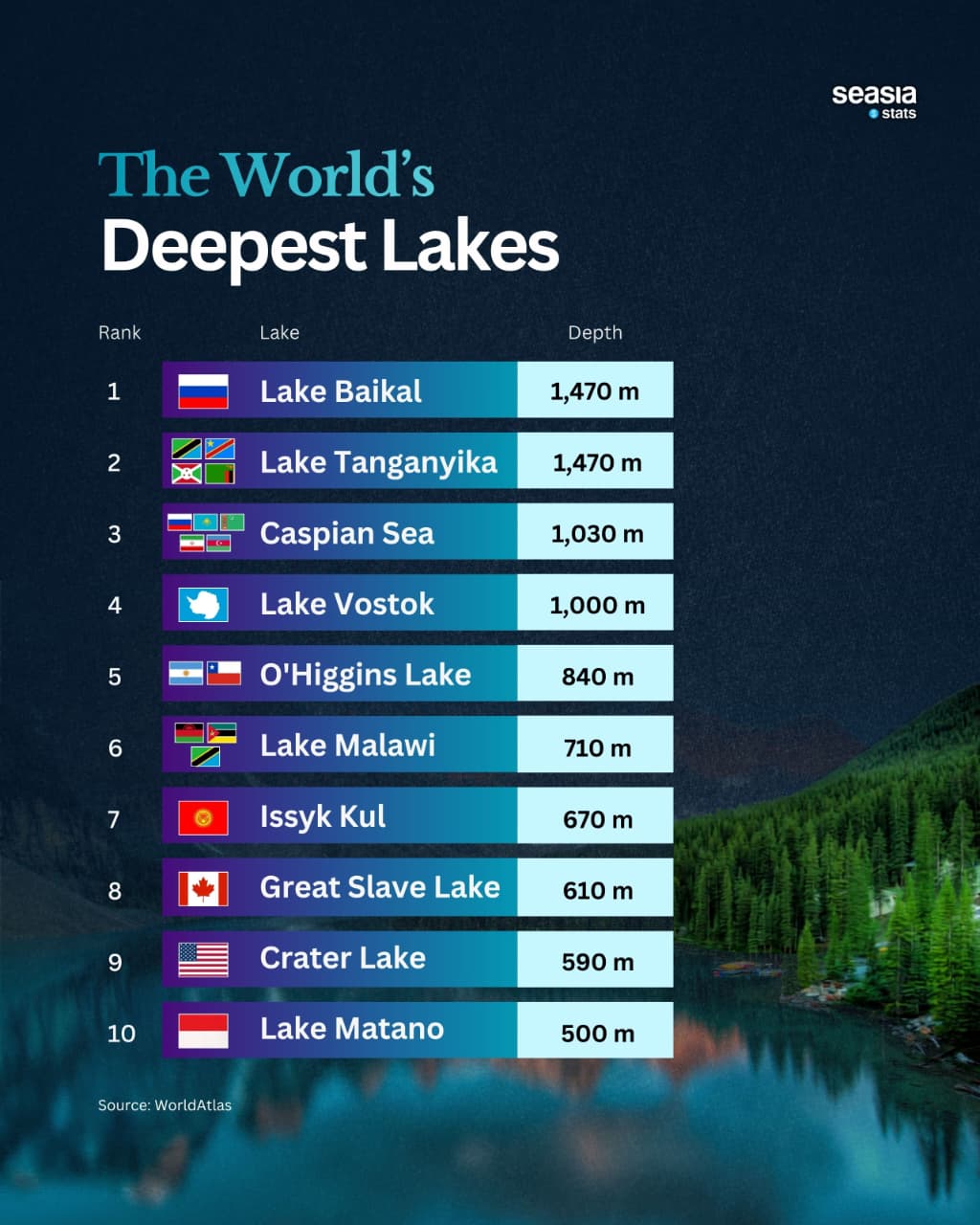
At the top of the list is Lake Baikal in Russia, the world’s deepest freshwater lake, reaching an impressive depth of 1,470 meters. Often called the “Galápagos of Russia,” Lake Baikal contains about one-fifth of the world’s unfrozen freshwater and is home to thousands of unique species found nowhere else on Earth.
Sharing the same listed depth of 1,470 meters is Lake Tanganyika, located in East Africa and bordered by several countries including Tanzania, the Democratic Republic of the Congo, Burundi, and Zambia. It is not only one of the deepest lakes but also among the oldest, supporting an exceptionally diverse aquatic ecosystem.
The Caspian Sea ranks third with a maximum depth of 1,030 meters. Although called a sea, it is technically the world’s largest enclosed inland body of water and possesses many characteristics of a lake.
In Antarctica, Lake Vostok reaches approximately 1,000 meters in depth. Hidden beneath thick ice sheets, it remains one of the most mysterious lakes on Earth and is of great interest to scientists studying extreme environments.
South America’s O’Higgins Lake, shared by Chile and Argentina, reaches about 840 meters deep. Its striking blue waters are fed by glaciers from the Andes Mountains. Africa’s Lake Malawi follows with a depth of 710 meters, making it one of the continent’s deepest and most biologically diverse lakes.
Central Asia’s Issyk Kul in Kyrgyzstan reaches 670 meters, while Canada’s Great Slave Lake extends to around 610 meters. Both are significant regional water bodies and important ecological habitats.
The ninth-deepest lake is Crater Lake in the United States, with a depth of 590 meters. Formed within a collapsed volcanic caldera, it is famous for its exceptionally clear blue water and dramatic scenery.
Completing the top ten is Lake Matano in Indonesia, which reaches approximately 500 meters deep. Located on Sulawesi Island, it is the deepest lake in Southeast Asia and hosts several endemic species that have evolved in isolation.
These remarkable lakes demonstrate the incredible diversity of Earth’s landscapes. From frozen Antarctic waters to tropical Indonesian ecosystems, the world’s deepest lakes continue to captivate scientists, explorers, and nature enthusiasts alike.