

The Distribution of Southeast Asia's Largest Ethnic Groups
This is how the largest ethnic groups in Southeast Asia are distributed throughout history.

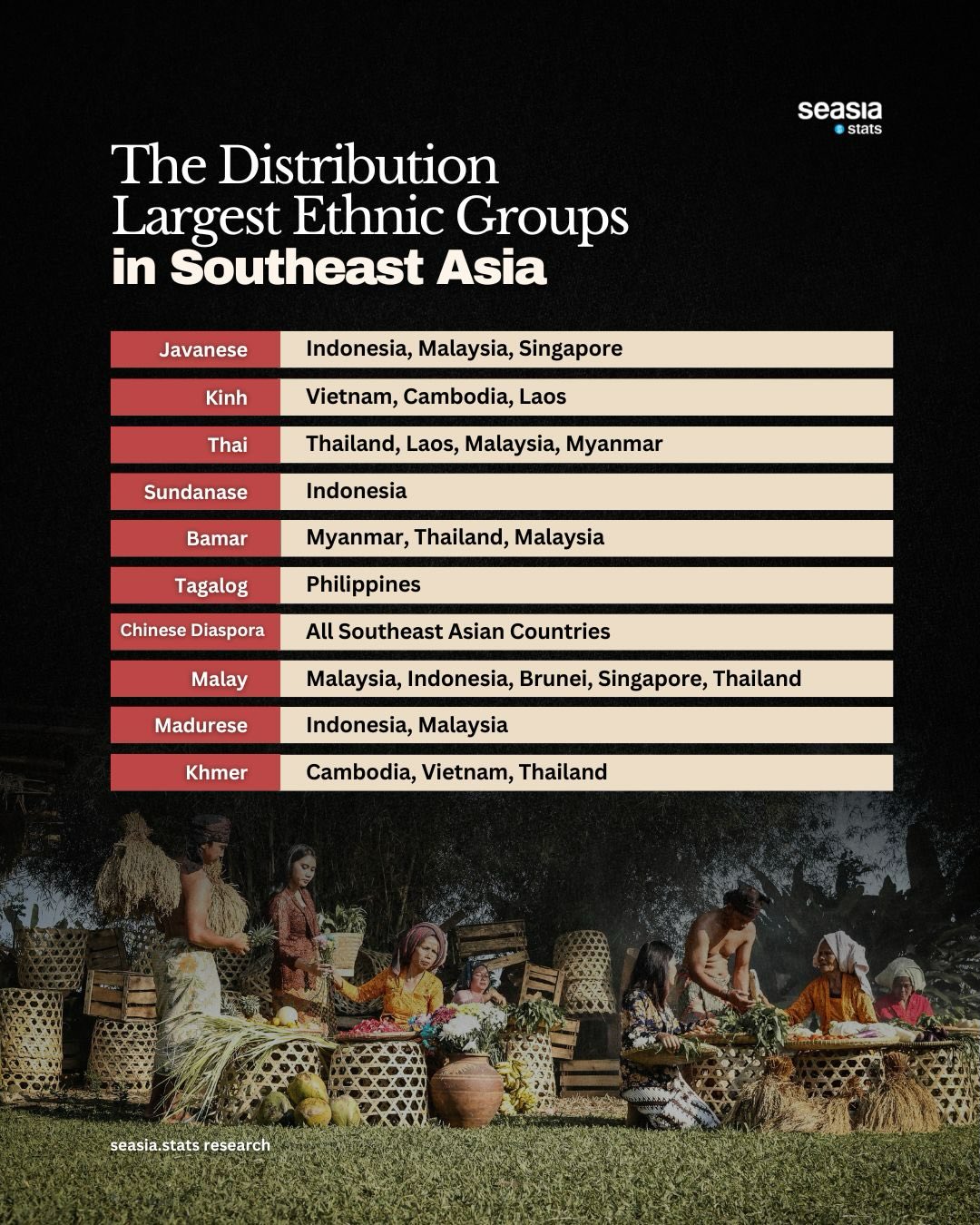
Southeast Asia is one of the most ethnically diverse regions in the world, shaped by centuries of migration, trade, colonization, and cultural exchange.
Among the region’s largest ethnic groups are the Javanese, Kinh, Thai, Sundanese, Bamar, Tagalog, Chinese diaspora communities, Malays, Madurese, and Khmer peoples, each with significant populations spread across multiple countries.
The Javanese are the largest ethnic group in Indonesia, mainly concentrated on the island of Java. Due to migration and economic opportunities, Javanese communities are also found in Malaysia and Singapore, where they have contributed to local culture and labor sectors.
Similarly, the Sundanese, originating from West Java, are another major Indonesian ethnic group, although their population remains more concentrated within Indonesia itself.
In mainland Southeast Asia, the Kinh people form the dominant ethnic group in Vietnam. Smaller Kinh communities also reside in neighboring Cambodia and Laos, often as traders, migrants, or descendants of earlier settlements.
The Thai people are the majority ethnic group in Thailand, but related Thai-speaking communities can also be found in Laos, northern Malaysia, and parts of Myanmar due to historical kingdoms and migration patterns.
The Bamar are the principal ethnic group of Myanmar and dominate the country’s political and cultural life. Bamar migrant communities are also present in Thailand and Malaysia, especially among workers seeking employment abroad.
Likewise, the Khmer people are centered in Cambodia but also maintain substantial populations in southern Vietnam and eastern Thailand, reflecting the historical extent of the Khmer Empire.
In the maritime region, the Tagalog people are one of the largest ethnic groups in the Philippines and form the cultural core of the Filipino national identity, especially because the national language, Filipino, is largely based on Tagalog.
The Malay people are widely distributed across Malaysia, Indonesia, Brunei, Singapore, and southern Thailand. Shared language, religion, and historical maritime trade networks have connected Malay communities for centuries, making them one of Southeast Asia’s most influential cultural groups.
The Madurese, originally from Madura Island in Indonesia, have also established communities in Malaysia through labor migration.
Another significant population throughout Southeast Asia is the Chinese diaspora. Ethnic Chinese communities are present in every Southeast Asian country, particularly in Singapore, Malaysia, Thailand, Indonesia, Vietnam, and the Philippines.
These communities have historically played important roles in commerce, finance, and urban development while also blending local and Chinese cultural traditions.
Together, these ethnic groups demonstrate the rich cultural complexity and interconnected history of Southeast Asia.