

The Evolution of GDP from 10 Largest Economies in the World
Japan is the only one out of ten with a decrease of GDP from a decade ago.

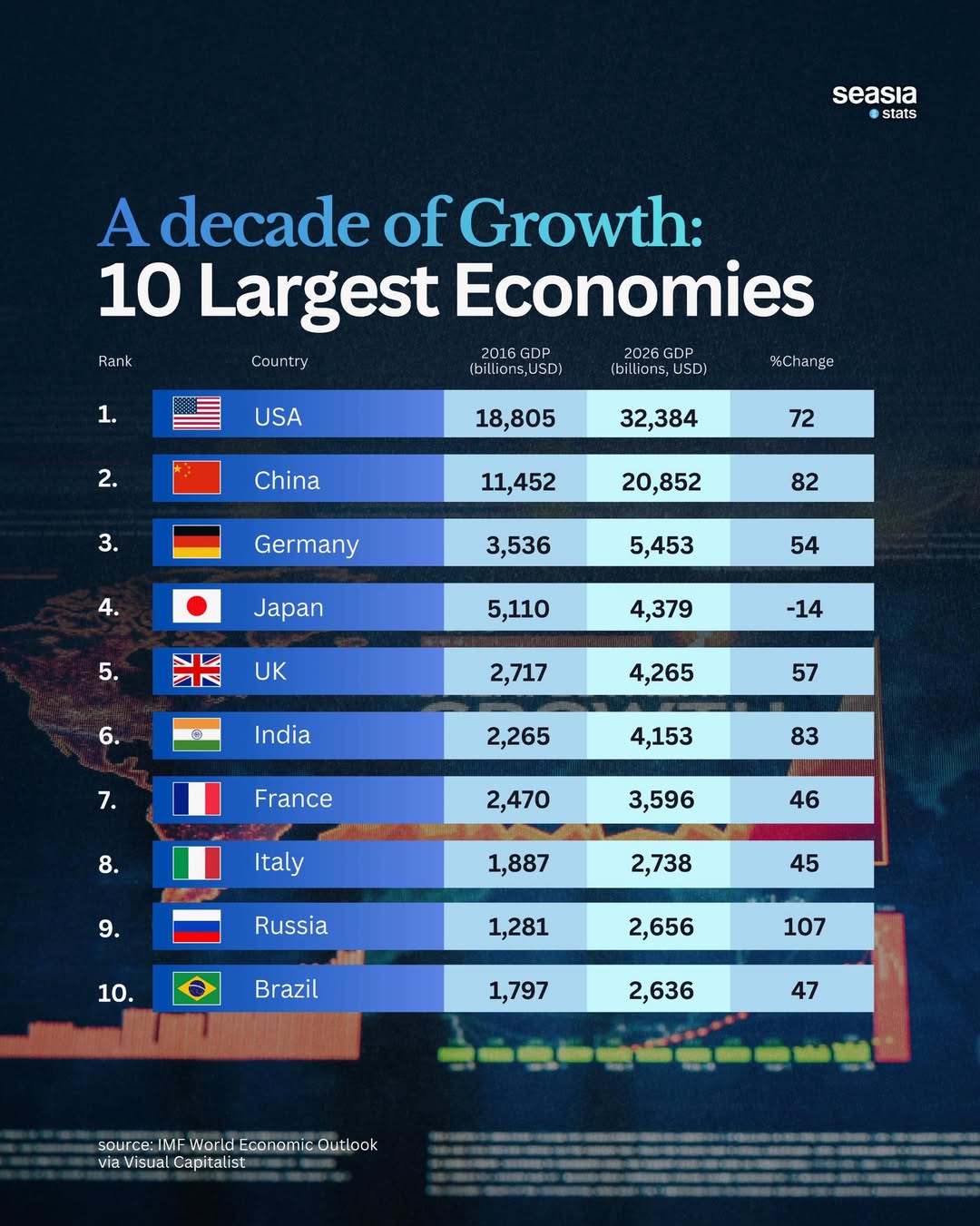
Between 2016 and 2026, the world’s largest economies experienced significant changes in the size of their gross domestic products (GDP), reflecting differing rates of economic growth, demographic trends, technological development, and geopolitical factors.
Measured in current U.S. dollars, most of the top ten economies expanded substantially over the decade, although growth rates varied considerably.
The United States maintained its position as the world’s largest economy throughout the period. Its GDP increased from $18.8 trillion in 2016 to $32.4 trillion in 2026, representing growth of 72 percent. Strong consumer spending, technological innovation, and a dynamic business environment helped sustain this expansion.
China remained the second-largest economy and recorded one of the strongest increases among major economies. Its GDP rose from $11.5 trillion to $20.9 trillion, an increase of 82 percent.
Despite a gradual slowdown from the rapid growth rates of earlier decades, China continued to benefit from industrial development, urbanization, and rising domestic consumption.
Among European economies, Germany expanded from $3.5 trillion to $5.5 trillion, a gain of 54 percent, while the United Kingdom grew from $2.7 trillion to $4.3 trillion, an increase of 57 percent. France and Italy also posted solid growth, with GDP rising by 46 percent and 45 percent respectively.
India emerged as one of the decade’s fastest-growing major economies. Its GDP increased from $2.3 trillion in 2016 to $4.2 trillion in 2026, representing growth of 83 percent. Rapid population growth, expanding domestic markets, and continued economic modernization contributed to this impressive performance.
Russia recorded the largest percentage increase among the top ten economies. Its GDP more than doubled from $1.3 trillion to $2.7 trillion, corresponding to growth of 107 percent. This expansion reflects a combination of economic recovery, commodity exports, and nominal GDP growth over the decade.
Brazil’s economy also expanded significantly, rising from $1.8 trillion to $2.6 trillion, an increase of 47 percent. Although growth was more moderate than in some other emerging economies, Brazil maintained its place among the world’s largest economic powers.
Japan was the only economy among the top ten to experience a decline. Its GDP fell from $5.1 trillion in 2016 to $4.4 trillion in 2026, a decrease of 14 percent. Factors such as demographic aging, low inflation, and slower economic growth contributed to this contraction.
Overall, the decade from 2016 to 2026 was characterized by substantial global economic expansion, with emerging economies such as India and Russia growing particularly rapidly while established economies continued to increase their economic output.