

The Evolution of the World's Tallest Towers, from United States of America to United Arab Emirates
The US used to have the tallest towers in the worlds for decades, until Malaysia, Taiwan, and the UAE beat them.

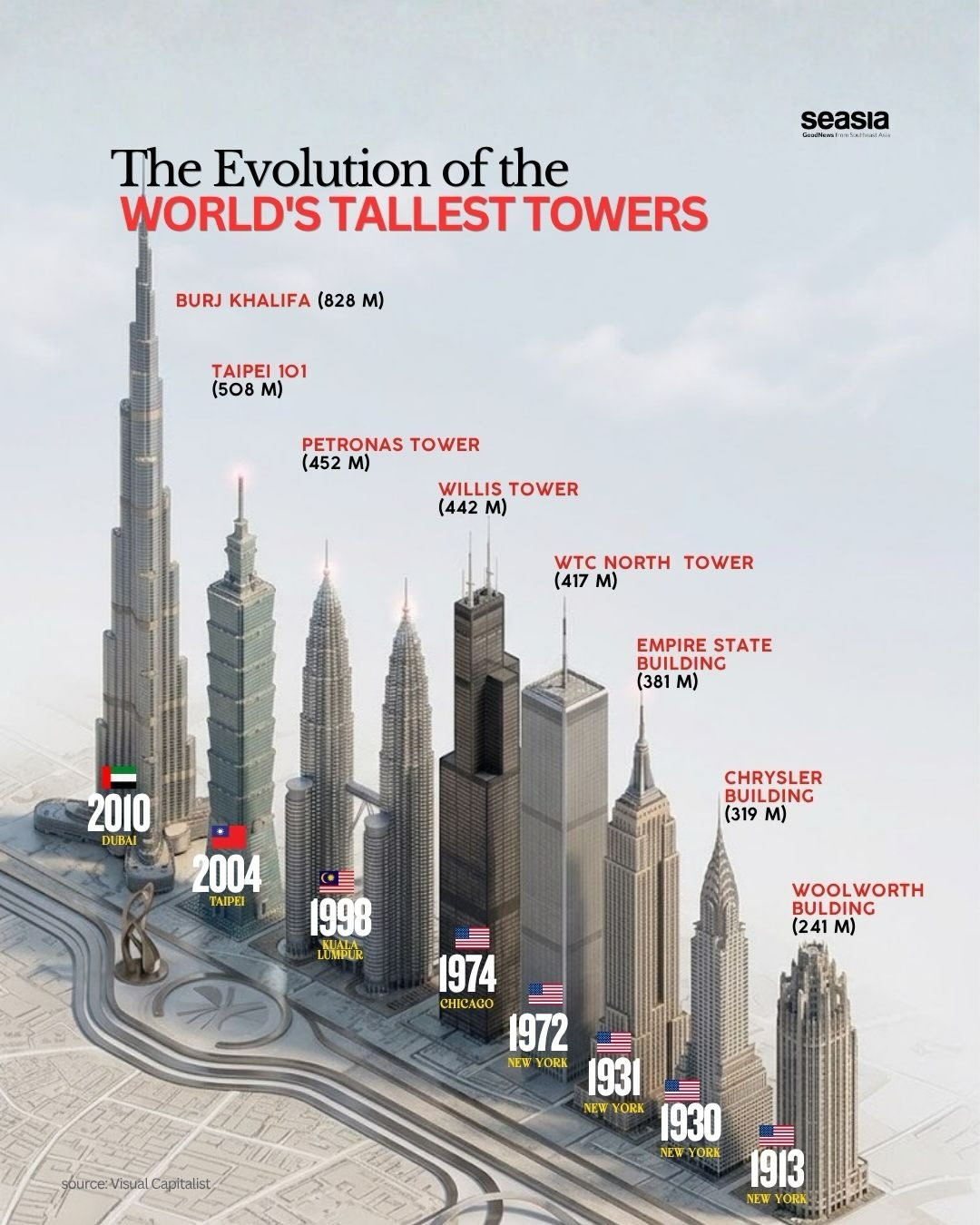
The history of the world’s tallest towers reflects humanity’s ambition, technological progress, and changing centers of economic power. Throughout the twentieth and early twenty-first centuries, the title of the world’s tallest building passed from one iconic structure to another, each representing the spirit and engineering achievements of its era.
The journey began in the United States with the Woolworth Building, completed in 1913. Rising to 241 meters, the neo-Gothic skyscraper symbolized America’s rapid industrial growth and the emergence of modern urban architecture.
Designed by architect Cass Gilbert, the building was nicknamed the “Cathedral of Commerce” because of its elegant design and its importance as a business center in New York City.
In 1930, the Chrysler Building surpassed the Woolworth Building with a height of 319 meters. Built during a fierce competition to construct the world’s tallest building, the Chrysler Building became famous for its Art Deco style and stainless-steel spire. However, its reign lasted only one year.
The following year, in 1931, the Empire State Building claimed the record at 381 meters. Completed during the Great Depression, it demonstrated remarkable engineering efficiency, as construction took only about thirteen months. For decades, the Empire State Building stood as a global symbol of American innovation and economic strength.
The race for height continued in the 1970s. In 1972, the World Trade Center North Tower reached 417 meters, briefly becoming the tallest building in the world.
Two years later, in 1974, Chicago’s Willis Tower, formerly known as the Sears Tower, exceeded it with a height of 442 meters. Its innovative bundled-tube structural system allowed unprecedented height and stability.
For many decades, the United States dominated skyscraper construction, but the center of architectural ambition gradually shifted to Asia. In 1998, Malaysia’s Petronas Twin Towers became the tallest buildings in the world at 452 meters. Their striking Islamic-inspired design represented Malaysia’s rapid modernization and economic growth.
In 2004, Taiwan introduced Taipei 101, which rose to 508 meters. The tower combined advanced engineering with traditional Asian design elements and was built to withstand earthquakes and typhoons.
Finally, in 2010, the Burj Khalifa redefined skyscraper construction by soaring to an astonishing 828 meters. As the tallest building ever constructed, it symbolizes the global era of mega-structures and the continuing human desire to reach new heights.