

The Fastest Growing Industries in Southeast Asia
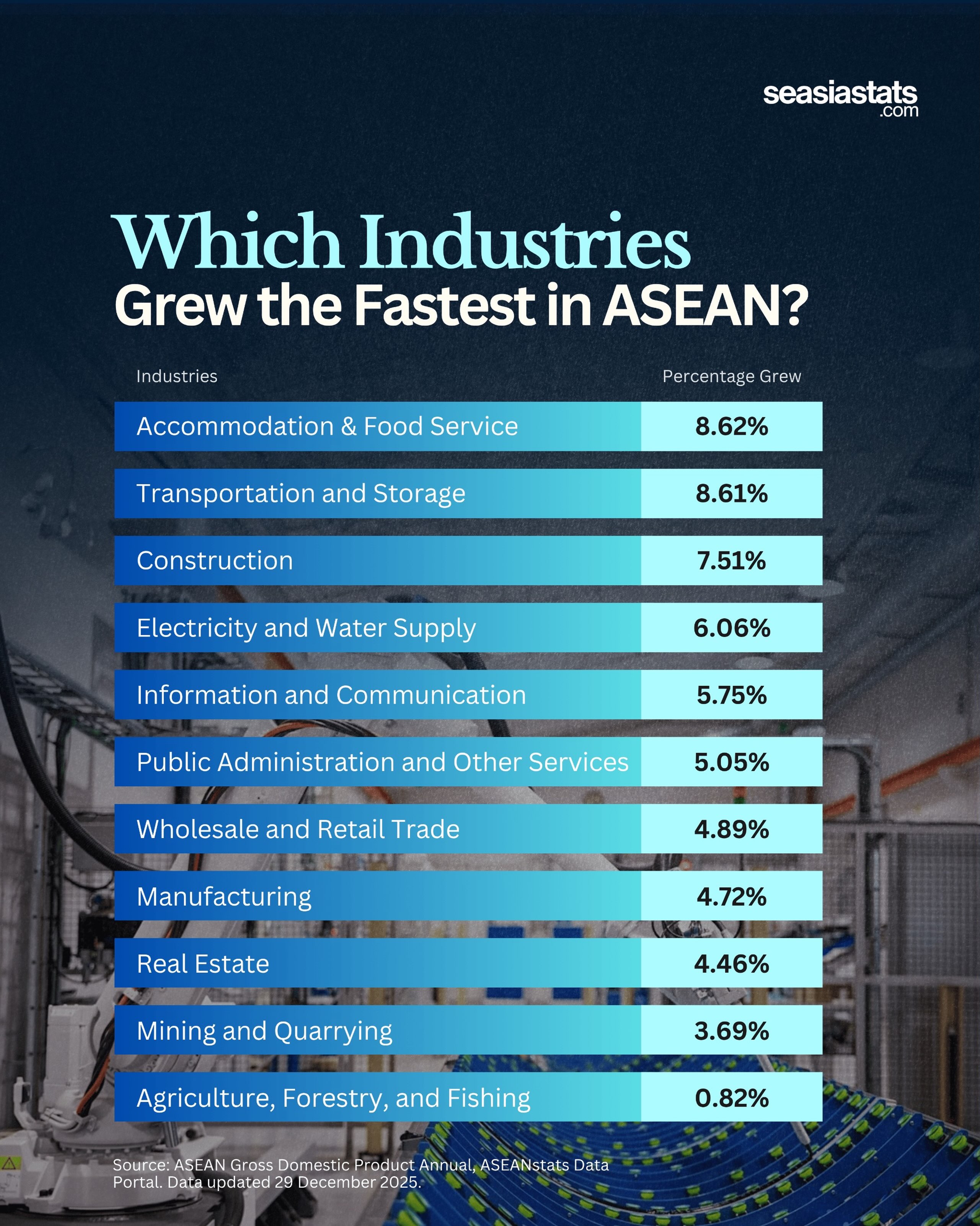
In Southeast Asia, accommodation and food service is the fastest growing industry.

Southeast Asia continues to strengthen its position as one of the world's most dynamic economic regions.
According to the ASEAN Gross Domestic Product Annual growth figures, several industries have demonstrated remarkable expansion, reflecting changing consumer demands, increasing investment, and rapid technological advancement. These sectors are playing a vital role in driving economic development across ASEAN member states.
The fastest-growing industry is accommodation and food service, which recorded an impressive growth rate of 8.62%. This strong performance has been fueled by the recovery of tourism, rising domestic travel, and increased consumer spending on hospitality and dining services.
Closely following is transportation and storage, with 8.61% growth, supported by expanding trade activities, logistics services, and the growing demand for efficient supply chains across the region.
The construction sector ranked third, growing by 7.51%. Increased public infrastructure projects, urban development, and private investments have contributed significantly to this expansion.
Meanwhile, electricity and water supply achieved 6.06% growth, highlighting the region's ongoing investments in utilities and sustainable infrastructure to meet rising population and industrial demands.
The information and communication sector recorded a solid 5.75% growth rate, reflecting Southeast Asia's accelerating digital transformation.
The widespread adoption of internet services, e-commerce, cloud computing, and digital communication platforms has made this sector an important engine of economic progress. Similarly, public administration and other services expanded by 5.05%, driven by improved government services and the recovery of various service-related industries.
Trade remains a cornerstone of the ASEAN economy, with wholesale and retail trade growing by 4.89%. This growth reflects strong consumer demand and the continued expansion of both traditional and online retail markets.
Manufacturing followed closely at 4.72%, supported by export-oriented production, foreign direct investment, and the diversification of regional supply chains.
Other sectors also contributed positively to economic growth. Real estate increased by 4.46%, benefiting from urbanization and property development. Mining and quarrying grew by 3.69%, supported by demand for natural resources despite market fluctuations.
In contrast, agriculture, forestry, and fishing recorded the slowest growth at 0.82%, reflecting challenges such as climate change, limited productivity improvements, and fluctuating commodity prices.
Overall, these growth rates illustrate the diverse drivers of Southeast Asia's economy. While service industries and infrastructure-related sectors are expanding rapidly, traditional industries continue to provide essential support. Together, these sectors demonstrate ASEAN's resilience and its growing importance in the global economy.