

The First Countries to Send Humans into Space
These ten countries have amazing marks in history, the first to send humans into space.

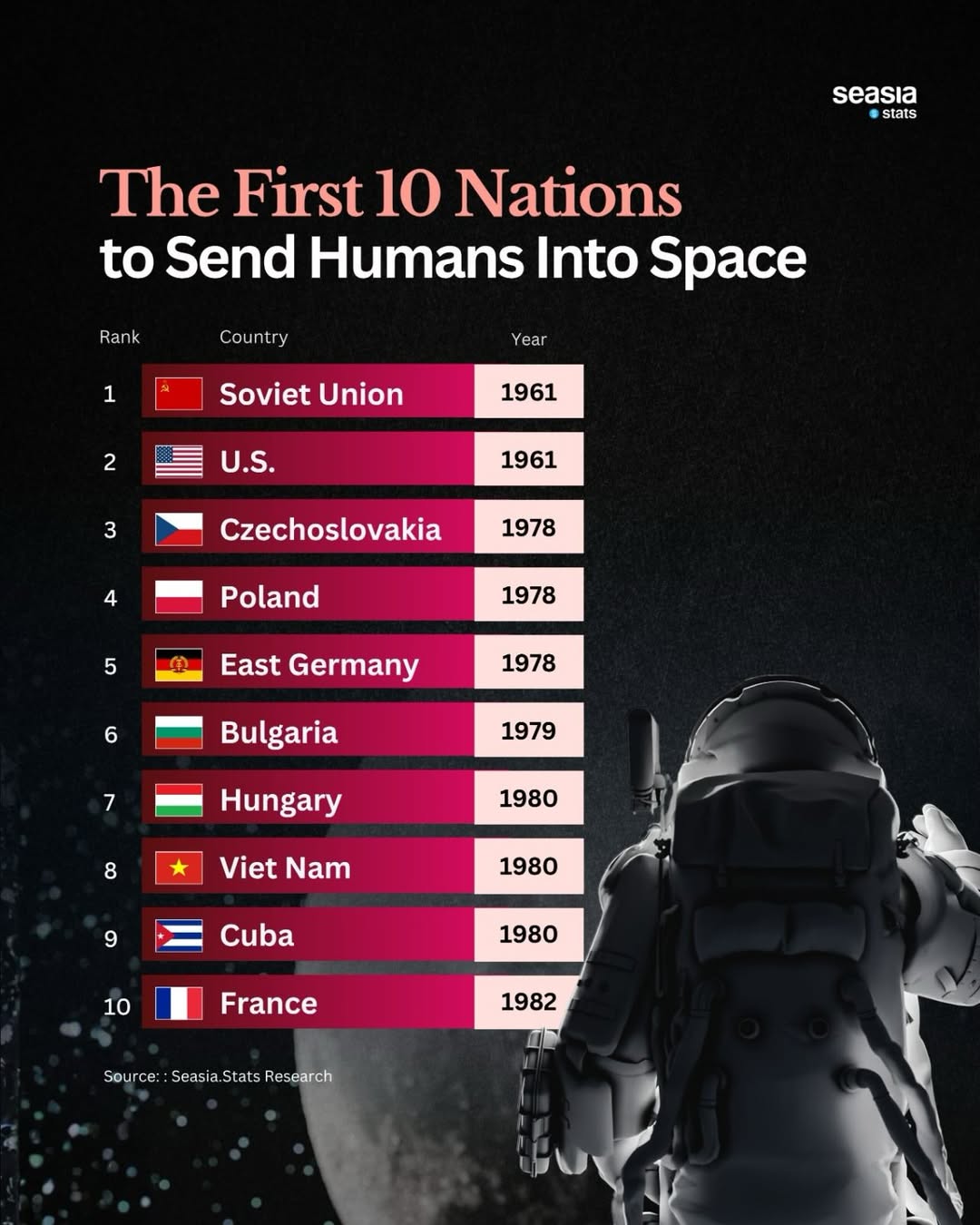
The exploration of space is one of humanity's greatest achievements, and several nations have earned a place in history by sending their citizens beyond Earth's atmosphere. Between 1961 and 1982, ten countries joined the exclusive group of nations whose people traveled into space, reflecting both technological progress and international cooperation.
The Soviet Union was the first country to send a human into space when Yuri Gagarin completed a single orbit around Earth aboard Vostok 1 on April 12, 1961. This historic mission marked the beginning of human spaceflight and established the Soviet Union as an early leader in the Space Race.
Less than a month later, on May 5, 1961, the United States became the second country to send a human into space. Astronaut Alan Shepard flew aboard Freedom 7 in a suborbital mission, paving the way for the American space program that would eventually land humans on the Moon.
After more than a decade dominated by the two superpowers, additional nations gained representation in space through the Soviet-led Interkosmos program. In 1978, Czechoslovakia became the third country represented in space when Vladimír Remek flew aboard Soyuz 28. His mission made him the first astronaut who was neither Soviet nor American.
Later that same year, Poland joined the list when Mirosław Hermaszewski flew on Soyuz 30, while East Germany followed with Sigmund Jähn aboard Soyuz 31. Their missions demonstrated the growing international participation in space exploration.
In 1979, Bulgaria became the sixth country represented in space through the flight of Georgi Ivanov aboard Soyuz 33. Although technical problems shortened the mission, it remained a significant milestone for Bulgaria.
The year 1980 saw three more nations enter the history books. Hungary's Bertalan Farkas flew on Soyuz 36, becoming the first Hungarian in space. Vietnam followed when Phạm Tuân flew aboard Soyuz 37, becoming not only the first Vietnamese but also the first Asian astronaut from a developing nation.
Later that year, Cuba's Arnaldo Tamayo Méndez flew on Soyuz 38, becoming the first Cuban, the first Latin American, and the first person of African descent in space.
Finally, France became the tenth country to send one of its citizens into space when Jean-Loup Chrétien flew aboard Soyuz T-6 in 1982. His mission marked an important step in European participation in human spaceflight.
Together, these pioneering nations expanded humanity's presence in space and demonstrated that space exploration could become an international endeavor rather than the achievement of only a few superpowers.