

The GDP per Capita of Southeast Asian Countries
Singapore leads GPD per capita in Southeast Asia by a landslide with almost US$100,000.

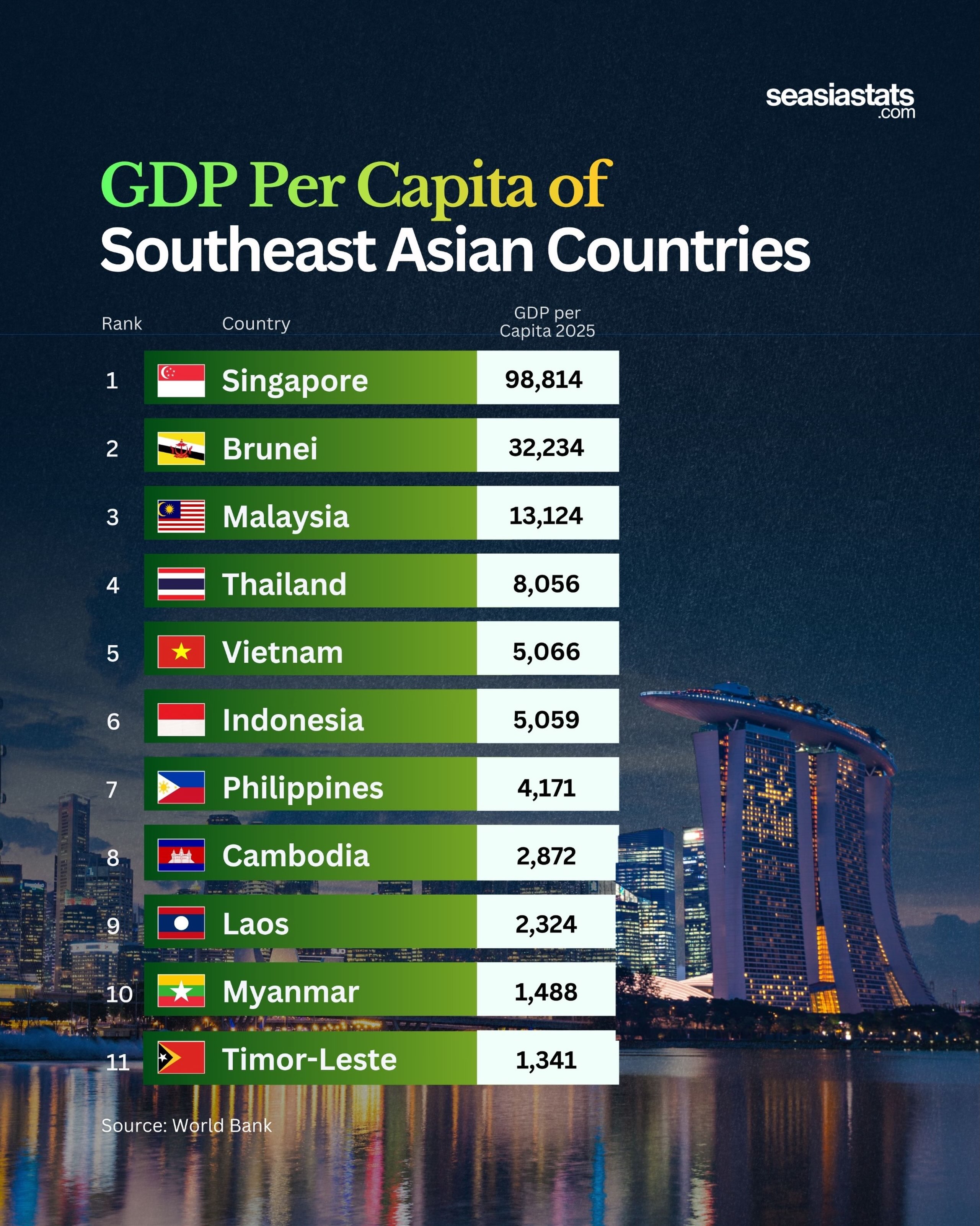
Gross Domestic Product (GDP) per capita is one of the most widely used indicators of a country's economic performance and average standard of living. Measured in U.S. dollars, it estimates the value of goods and services produced per person in a year.
According to the World Bank, Southeast Asia displays a wide range of GDP per capita levels, reflecting differences in economic development, industrialization, and natural resources.
Singapore leads the region by a significant margin with a GDP per capita of US$98,814. As a global financial hub and one of the world's most advanced economies, Singapore benefits from strong trade, high-value manufacturing, and a thriving services sector.
Brunei ranks second at US$32,234. The country's wealth is largely driven by its abundant oil and natural gas reserves, making it one of the richest nations in Southeast Asia despite its relatively small population.
Malaysia follows with US$13,124, supported by a diversified economy that includes manufacturing, electronics, palm oil, tourism, and financial services. It remains one of the region's upper-middle-income economies.
Thailand records a GDP per capita of US$8,056. The country's economy is powered by automotive manufacturing, agriculture, exports, and a well-established tourism industry.
Vietnam stands at US$5,066, narrowly ahead of Indonesia, which records US$5,059. Vietnam's rapid industrial growth and export-oriented manufacturing have fueled impressive economic expansion, while Indonesia, the region's largest economy by population, continues to benefit from its vast domestic market and abundant natural resources.
The Philippines has a GDP per capita of US$4,171. Its economy is supported by a growing services sector, overseas remittances, business process outsourcing, and increasing domestic consumption.
Among the developing economies, Cambodia reaches US$2,872, followed by Laos at US$2,324. Both countries have experienced steady economic growth in recent decades through manufacturing, agriculture, hydropower, and infrastructure development.
At the lower end of the ranking are Myanmar with US$1,488 and Timor-Leste with US$1,341. Both nations continue to face economic challenges that have affected income growth and long-term development.
Overall, the World Bank's GDP per capita figures highlight the remarkable economic diversity across Southeast Asia. From Singapore's high-income economy to the developing nations of mainland Southeast Asia, the region continues to offer significant opportunities for growth, investment, and economic transformation in the years ahead.