

The Giants of the Region: Southeast Asia's Mightiest Rivers
Southeast Asia’s geography is shaped and sustained by its rivers

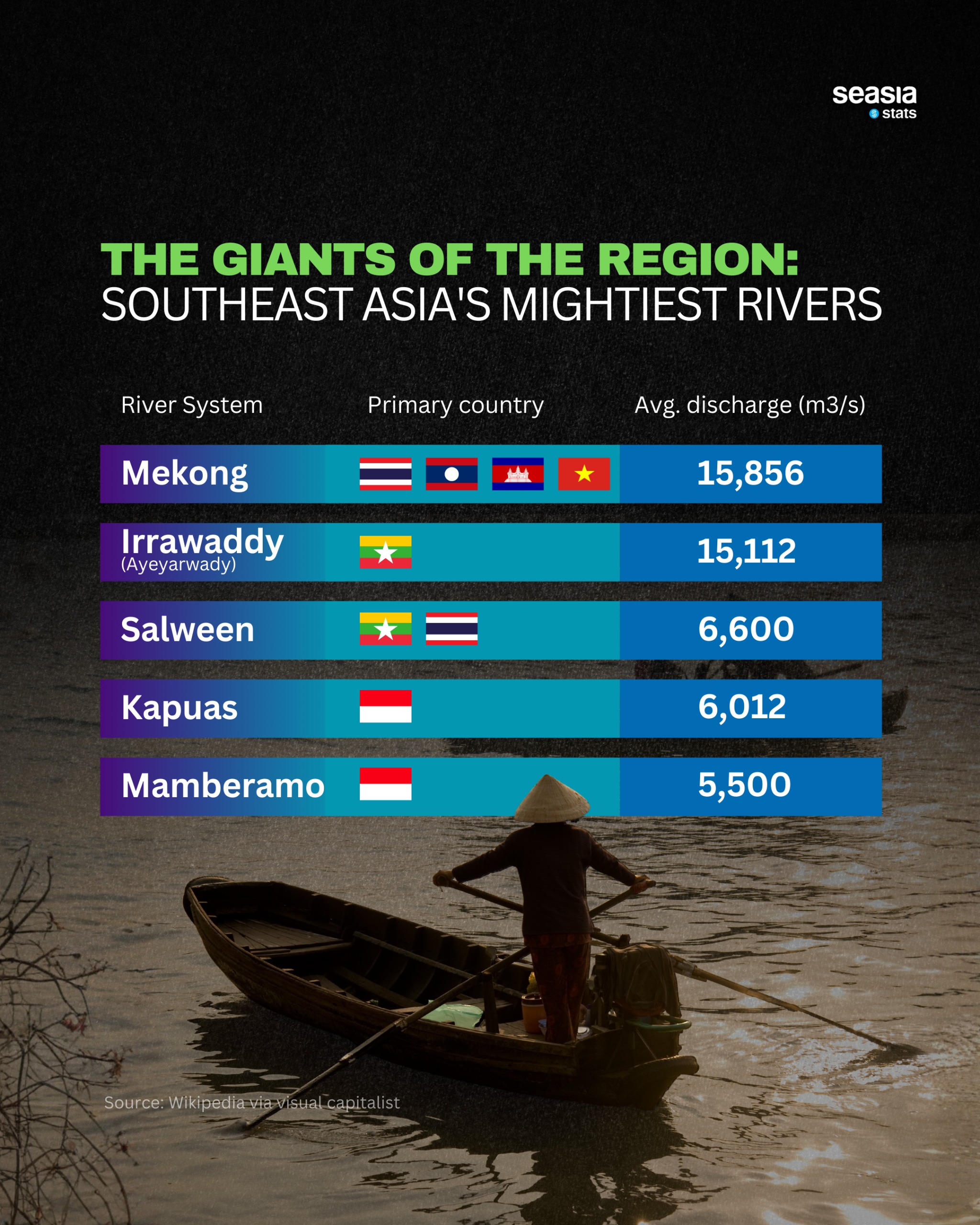
Southeast Asia’s geography is shaped and sustained by its rivers—vast, life-giving waterways that nourish ecosystems, feed millions, and anchor centuries-old civilizations. Known as the “giants of the region,” a handful of major river systems dominate the landscape through their immense water discharge and geographic reach. These rivers are more than natural features—they are cultural lifelines, economic corridors, and environmental powerhouses that define Southeast Asia’s identity.
The Mekong: Southeast Asia’s Lifeline
At the heart of the region flows the Mekong River, the most powerful river system in Southeast Asia with an average discharge of 15,856 cubic meters per second. Originating in the Tibetan Plateau, the Mekong winds through China, Myanmar, Laos, Thailand, Cambodia, and Vietnam before emptying into the South China Sea.
Its importance cannot be overstated. The Mekong Basin supports over 60 million people, providing irrigation for agriculture, fisheries that feed entire communities, and vital trade routes. Cities such as Phnom Penh and Ho Chi Minh City owe much of their economic vitality to the river’s presence, while Vietnam’s Mekong Delta remains one of the world’s most productive rice-growing regions.
Myanmar’s River Arteries
Myanmar is home to two of the region’s most powerful river systems: the Irrawaddy (Ayeyarwady) and the Salween (Thanlwin).
The Irrawaddy, with an average discharge of 15,112 m³/s, serves as Myanmar’s main economic artery. Flowing from the Himalayas down to the Andaman Sea, it links key cities such as Mandalay and Yangon and supports agriculture, trade, and transportation.
The Salween River, ranking third in Southeast Asia with 6,600 m³/s, is one of the last major free-flowing rivers in the region. It flows through China, Myanmar, and Thailand, forming part of the Thai-Myanmar border. Unlike many major rivers globally, the Salween remains largely undammed, making it ecologically invaluable and a focus of conservation efforts.
Indonesia’s Island Giants
Indonesia contributes two major rivers to the top five—demonstrating the archipelago’s vast hydrological diversity.
The Kapuas River in West Kalimantan is Southeast Asia’s fourth largest by discharge at 6,012 m³/s and is the longest river on the island of Borneo. It supports transportation and livelihoods across inland communities and plays a crucial role in sustaining the island’s peatland ecosystems.
Meanwhile, the Mamberamo River in Papua, with a discharge of 5,500 m³/s, is often called the “Amazon of Papua” due to its immense drainage basin and untouched wilderness. It flows through some of Indonesia’s most remote and biodiverse landscapes, supporting rare wildlife and indigenous communities.
Rivers Beyond the Top Five
Beyond these giants, Southeast Asia hosts many other vital river systems. Thailand’s Chao Phraya River powers the agricultural heartland around Bangkok, while Vietnam’s Red River supports the densely populated northern plains. In Malaysia, the Rajang River in Sarawak is the country’s longest and remains central to transport and trade. The Philippines’ Cagayan River and Mindanao’s Pulangi River also play essential roles in regional economies and food security.
A Future Shaped by Water
These rivers remain essential to Southeast Asia’s future—but they also face growing challenges. Climate change, dam construction, deforestation, and urbanization are altering water flows and threatening fragile ecosystems.
Protecting these river systems is not just about preserving nature—it is about safeguarding food security, energy, and livelihoods for millions across the region. As Southeast Asia continues to develop, the stewardship of its “giant rivers” will remain one of its most critical environmental and economic priorities.