

The Greenest Capital Cities in Southeast Asia
Myanmar's capital Naypyidaw stands as the greenest capital city in Southeast Asia.

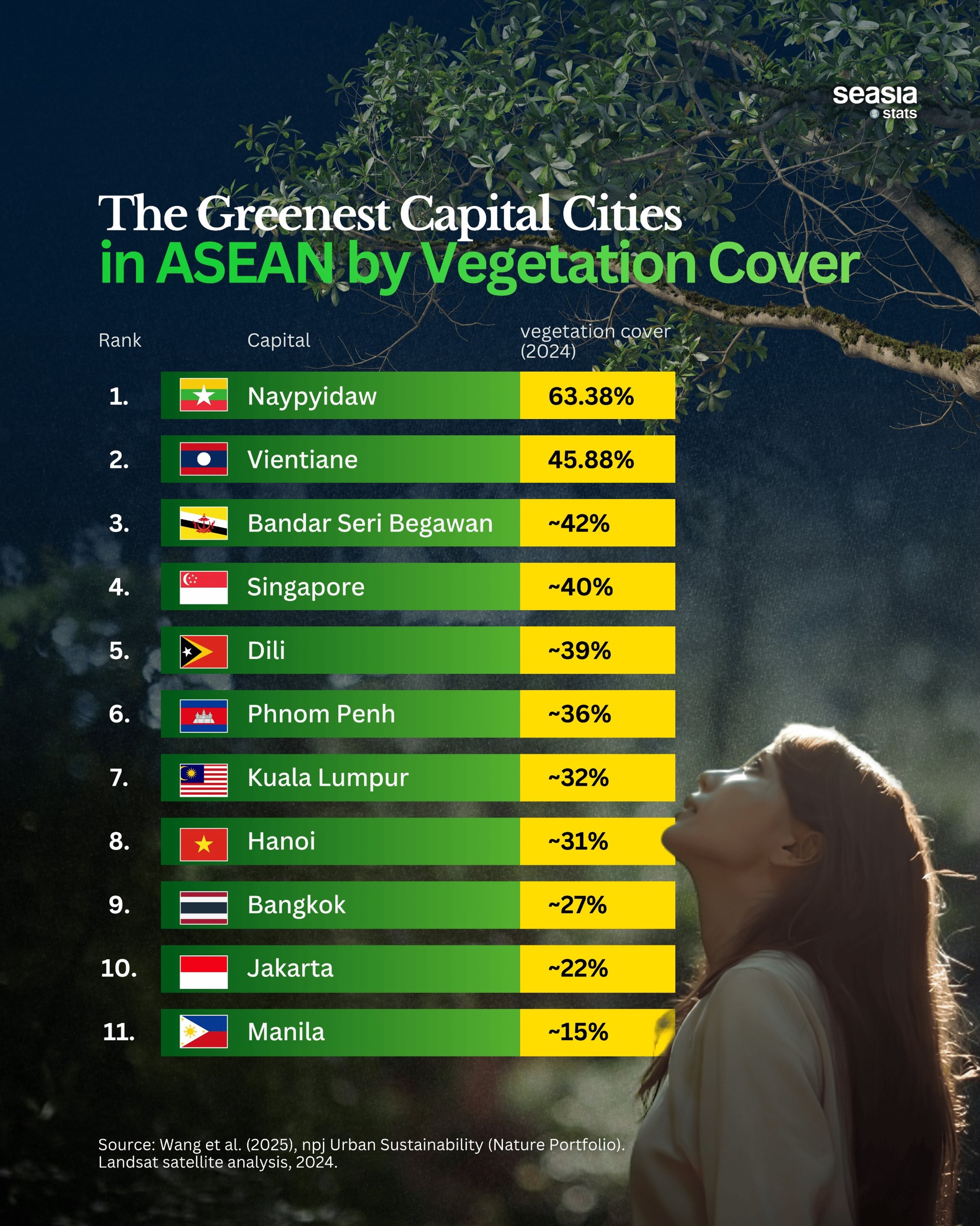
As Southeast Asia continues to urbanize, the presence of trees, parks, forests, and other green spaces has become increasingly important for environmental sustainability and public well-being.
Vegetation coverage is a useful indicator of how much natural greenery remains within a city's boundaries, helping reduce urban heat, improve air quality, and provide habitats for wildlife. Among the capitals of Southeast Asia, several cities stand out for their remarkable levels of vegetation.
Leading the region is Naypyidaw, the capital of Myanmar, with an impressive 63.38% vegetation coverage. Designed as a planned capital with wide boulevards, extensive parks, and preserved natural areas, Naypyidaw is by far the greenest capital city in Southeast Asia.
Second is Vientiane, the capital of Laos, where 45.88% of the city's area is covered by vegetation. Its relatively low population density, riverside landscapes, and abundant trees contribute to its lush urban environment.
Bandar Seri Begawan, the capital of Brunei, ranks third with around 42% vegetation coverage. Surrounded by tropical rainforest and supported by Brunei's strong environmental conservation policies, the city maintains a significant amount of natural greenery.
Closely following is Singapore, with around 40% vegetation coverage. Despite being one of the world's most densely populated cities, Singapore has earned its reputation as a "City in Nature" through extensive urban greening, roadside trees, vertical gardens, and carefully planned parks.
Dili, the capital of Timor-Leste, comes next with around 39% vegetation coverage, followed by Phnom Penh, Cambodia, at around 36%. Both capitals continue to retain substantial green spaces while experiencing urban development.
Kuala Lumpur, Malaysia's capital, records around 32% vegetation coverage, while Hanoi, Vietnam's capital, follows closely with around 31%. Both cities combine modern urban districts with numerous parks, lakes, and tree-lined neighborhoods.
Lower in the rankings is Bangkok, Thailand, with around 27% vegetation coverage. Although known for its dense urban landscape, Bangkok continues expanding public parks and green infrastructure to improve livability.
Jakarta, Indonesia's capital, has around 22% vegetation coverage. Rapid population growth and extensive urban expansion have placed increasing pressure on green spaces, making urban forestry initiatives an important priority.
Finally, Manila, the capital of the Philippines, ranks last among Southeast Asian capitals with around 15% vegetation coverage. Its highly urbanized environment and limited available land present ongoing challenges for increasing green areas.
These rankings demonstrate the importance of balancing urban growth with environmental conservation. Expanding vegetation coverage not only enhances a city's appearance but also strengthens climate resilience, improves public health, and creates more sustainable urban environments for future generations.