

The Hottest Capital Cities in the World
These capital cities are the hottest in the world, based on annual average temperature.

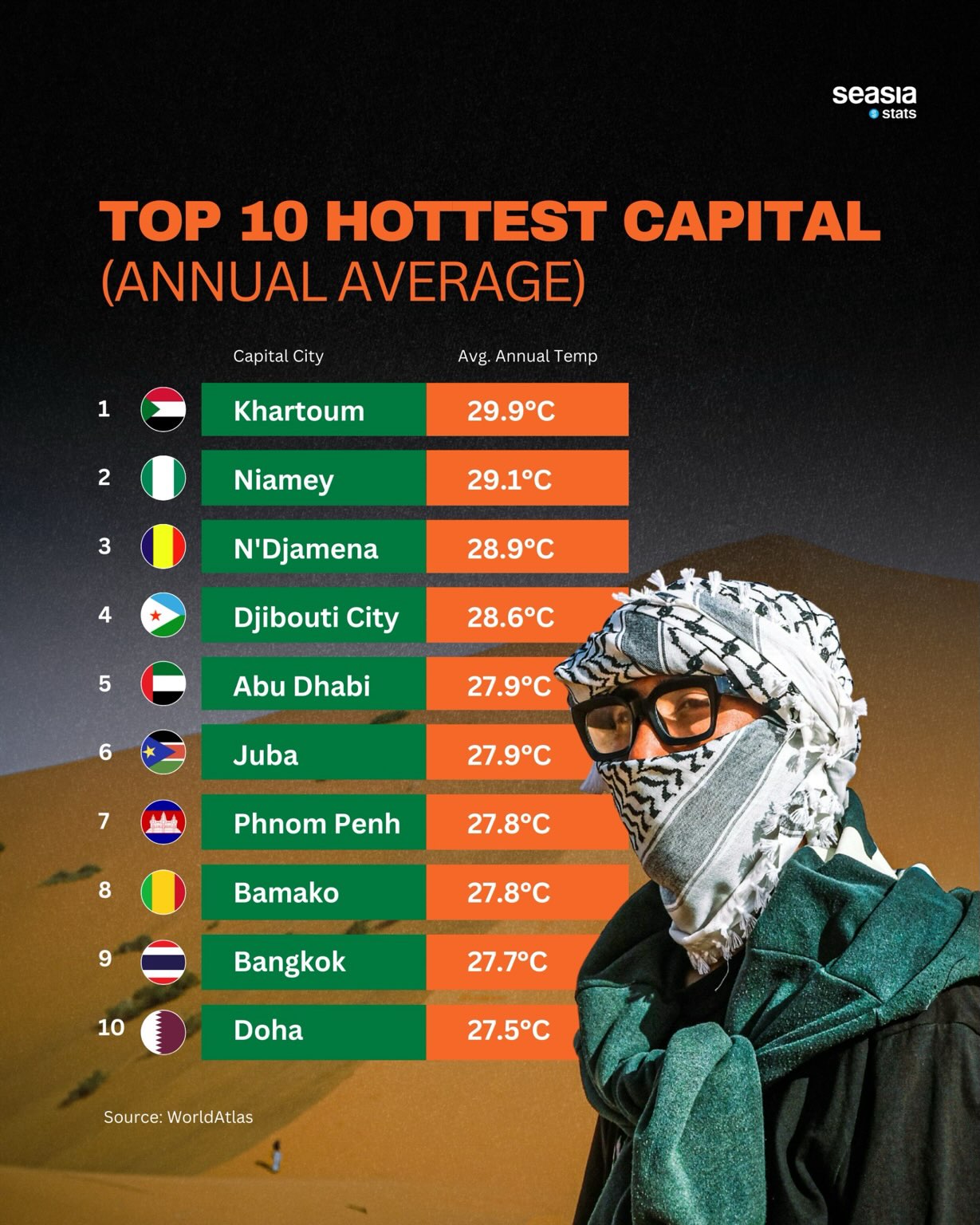
According to WorldAtlas, the world's hottest capital cities are those that experience exceptionally high average temperatures throughout the entire year. Unlike rankings based on record-breaking heat, this list reflects annual average temperatures, highlighting cities where warm and often scorching conditions are a constant part of daily life.
Leading the ranking is Khartoum, the capital of Sudan, with an annual average temperature of 29.9°C. Located near the confluence of the Blue Nile and White Nile, Khartoum experiences long, intensely hot summers and very little rainfall, making it the hottest capital city in the world by average temperature.
In second place is Niamey, the capital of Niger, averaging 29.1°C annually. Situated on the edge of the Sahara Desert, Niamey endures prolonged periods of extreme heat, particularly during the dry season.
Close behind is N'Djamena, the capital of Chad, with an average temperature of 28.9°C, where hot desert winds and limited precipitation contribute to consistently high temperatures throughout the year.
Djibouti City ranks fourth with an annual average of 28.6°C. Its coastal location along the Gulf of Aden combines high temperatures with significant humidity, creating a persistently hot climate.
Sharing fifth place are Abu Dhabi, the capital of the United Arab Emirates, and Juba, the capital of South Sudan, both recording an average annual temperature of 27.9°C. While Abu Dhabi experiences an arid desert climate, Juba's tropical environment remains warm year-round despite seasonal rainfall.
In Southeast Asia, Phnom Penh, the capital of Cambodia, averages 27.8°C, tying with Bamako, the capital of Mali. Phnom Penh's tropical monsoon climate brings consistently warm weather, while Bamako's inland location results in long, hot dry seasons.
Bangkok, Thailand's capital, ranks ninth with an annual average temperature of 27.7°C. High humidity, urban development, and a tropical climate keep temperatures elevated throughout the year.
Completing the top ten is Doha, the capital of Qatar, with an average temperature of 27.5°C. Its desert climate features extremely hot summers and mild winters, contributing to its high annual average.
These rankings illustrate how geography, latitude, desert environments, and tropical climates influence year-round temperatures. Many of the world's hottest capitals are located in Africa, the Middle East, and Southeast Asia, where intense sunshine and limited seasonal variation maintain consistently warm conditions.
Despite their challenging climates, these cities continue to serve as important political, economic, and cultural centers, demonstrating how human societies adapt and thrive in some of the hottest environments on Earth.