

The Languages with the Most Speakers in Southeast Asia
Indonesian has the largest number of speakers in all of Southeast Asia.

Southeast Asia is one of the most linguistically diverse regions in the world. With hundreds of languages spoken across its countries and communities, language is an important part of cultural identity, history, education, and everyday communication.
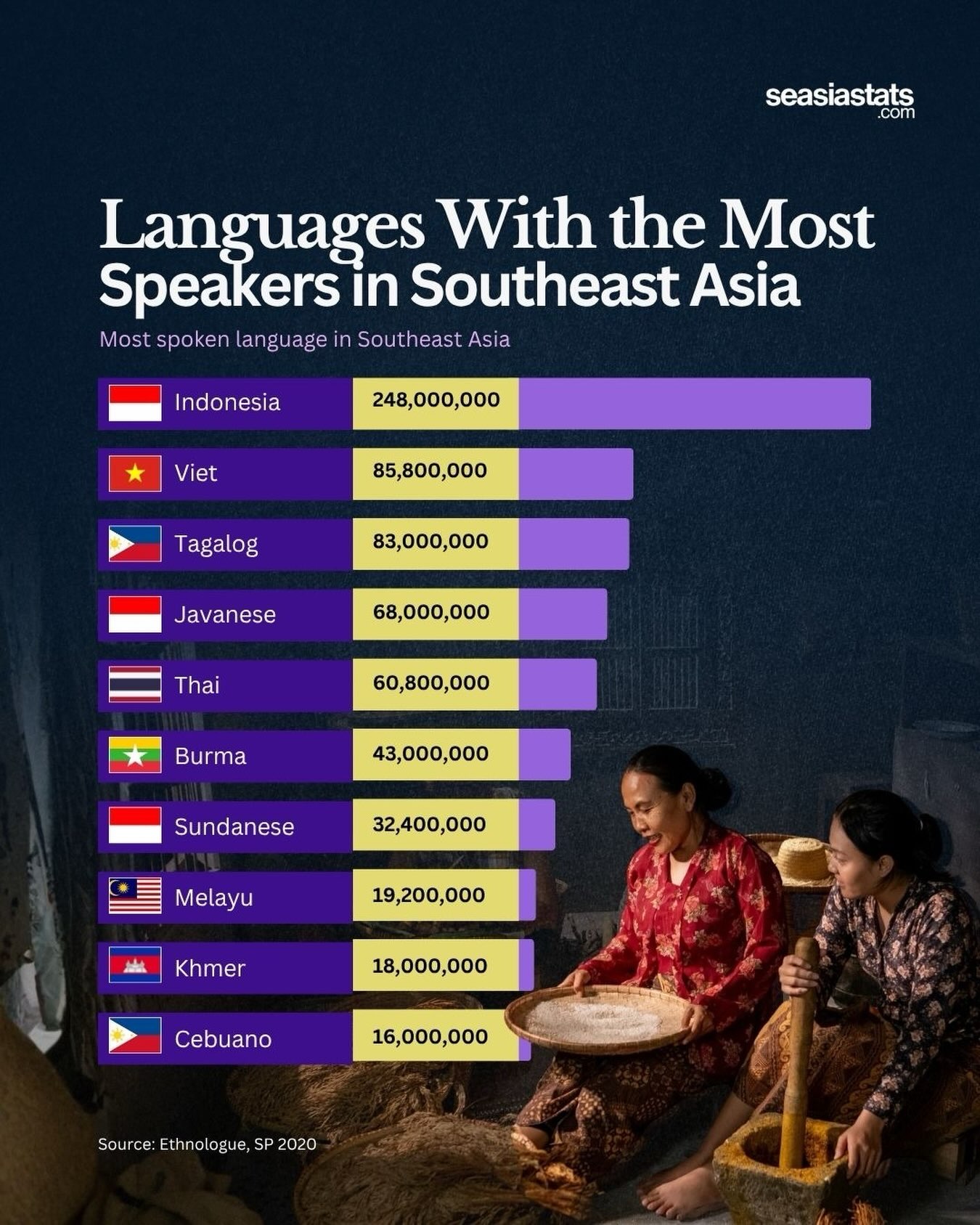
Among these languages, ten stand out because of their particularly large numbers of speakers. The figures below are based on the set of estimates you provided and are also reported in recent summaries using Ethnologue SP 2020 data.
The most widely spoken language on the list is Indonesian, with approximately 248 million speakers. As the official language of Indonesia, Indonesian serves as a common language among the country's many ethnic groups and islands.
Following Indonesian is Vietnamese, with around 85.8 million speakers. It is the national language of Vietnam and is widely used in government, education, business, and daily life.
In third place is Tagalog, with approximately 83 million speakers. Tagalog is particularly important in the Philippines and forms the basis of Filipino, the country's national language. Javanese, spoken by about 68 million people, comes next. It is concentrated mainly on the Indonesian island of Java and is one of the world's major regional languages.
Thai has approximately 60.8 million speakers and is the principal language of Thailand. It is central to the country's education, government, media, and cultural life. Burmese, with about 43 million speakers, is the official language of Myanmar and also functions as an important means of communication among different ethnic communities.
Indonesia appears again with Sundanese, which has approximately 32.4 million speakers, particularly in West Java. Malay, spoken by around 19.2 million people according to this ranking, is an important language across Malaysia, Brunei, Singapore, and parts of Indonesia.
Khmer, with about 18 million speakers, is Cambodia's national language and has a long literary and historical tradition. Finally, Cebuano, spoken by approximately 16 million people, is a major language in the central and southern Philippines.
Together, these languages demonstrate the remarkable diversity of Southeast Asia. They are more than methods of communication: they carry traditions, histories, literature, values, and identities from one generation to the next.
The large number of speakers also shows how population, migration, history, and national development have shaped the region's linguistic landscape. Learning about these languages provides a valuable way to understand the people and cultures of Southeast Asia.