

The Largest Economies in Asia & Oceania
Asia and Oceania have several massive economies with China fiercely competing with the U.S.

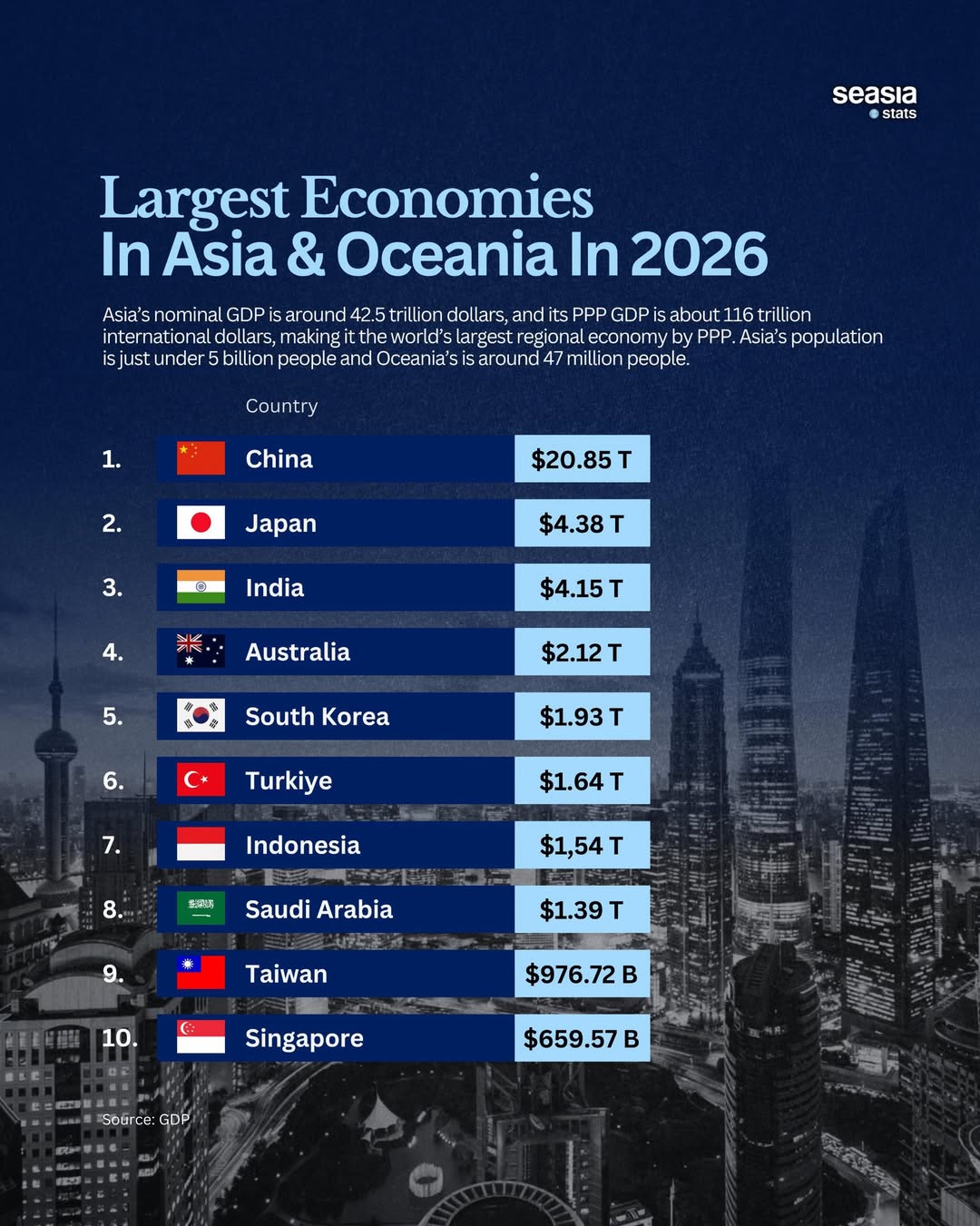
The economic landscape of Asia and Oceania in 2026 highlights a mix of long-established powerhouses and rapidly growing emerging markets. At the forefront is China, with a massive GDP of $20.85 trillion, firmly maintaining its position as the largest economy in the region.
Its strength lies in manufacturing, exports, and an expanding technology sector, which continues to drive both domestic growth and global trade influence.
Following China is Japan, with $4.38 trillion. Despite decades of slow growth, Japan remains a key economic force due to its advanced technology, automotive industry, and strong global brands. Close behind is India at $4.15 trillion, reflecting its rapid expansion fueled by a young population, digitalization, and increasing foreign investment.
In Oceania, Australia stands out with a GDP of $2.12 trillion. Its economy benefits from natural resources, strong trade ties with Asia, and a stable financial system. Meanwhile, South Korea, with $1.93 trillion, continues to excel in electronics, shipbuilding, and innovation-driven industries led by major global corporations.
Another significant player is Turkey, with $1.64 trillion, serving as a strategic bridge between Europe and Asia. Its diversified economy includes manufacturing, agriculture, and a growing services sector.
Indonesia follows with $1.54 trillion, making it the largest economy in Southeast Asia. Its growth is driven by domestic consumption, infrastructure development, and a large, youthful workforce.
In the Middle East, Saudi Arabia contributes $1.39 trillion, largely supported by oil exports, though ongoing reforms aim to diversify the economy under long-term development plans. Taiwan, with $976.72 billion, plays a critical role in the global technology supply chain, particularly in semiconductor manufacturing.
Finally, Singapore, with $659.57 billion, stands as a global financial hub despite its small size. Its strategic location, efficient governance, and openness to trade make it one of the most competitive economies in the world.
Overall, the region’s largest economies demonstrate a balance between scale, innovation, and resource wealth.
While giants like China, Japan, and India dominate in size, smaller economies such as Singapore and Taiwan show how specialization and strategic positioning can yield significant global influence. Together, these countries shape the economic trajectory of Asia and Oceania in 2026.