

The Largest Island Nations, Ranked by Area
Indonesia is the largest island nation in the world by area, tripled the size of Madagascar on second place.

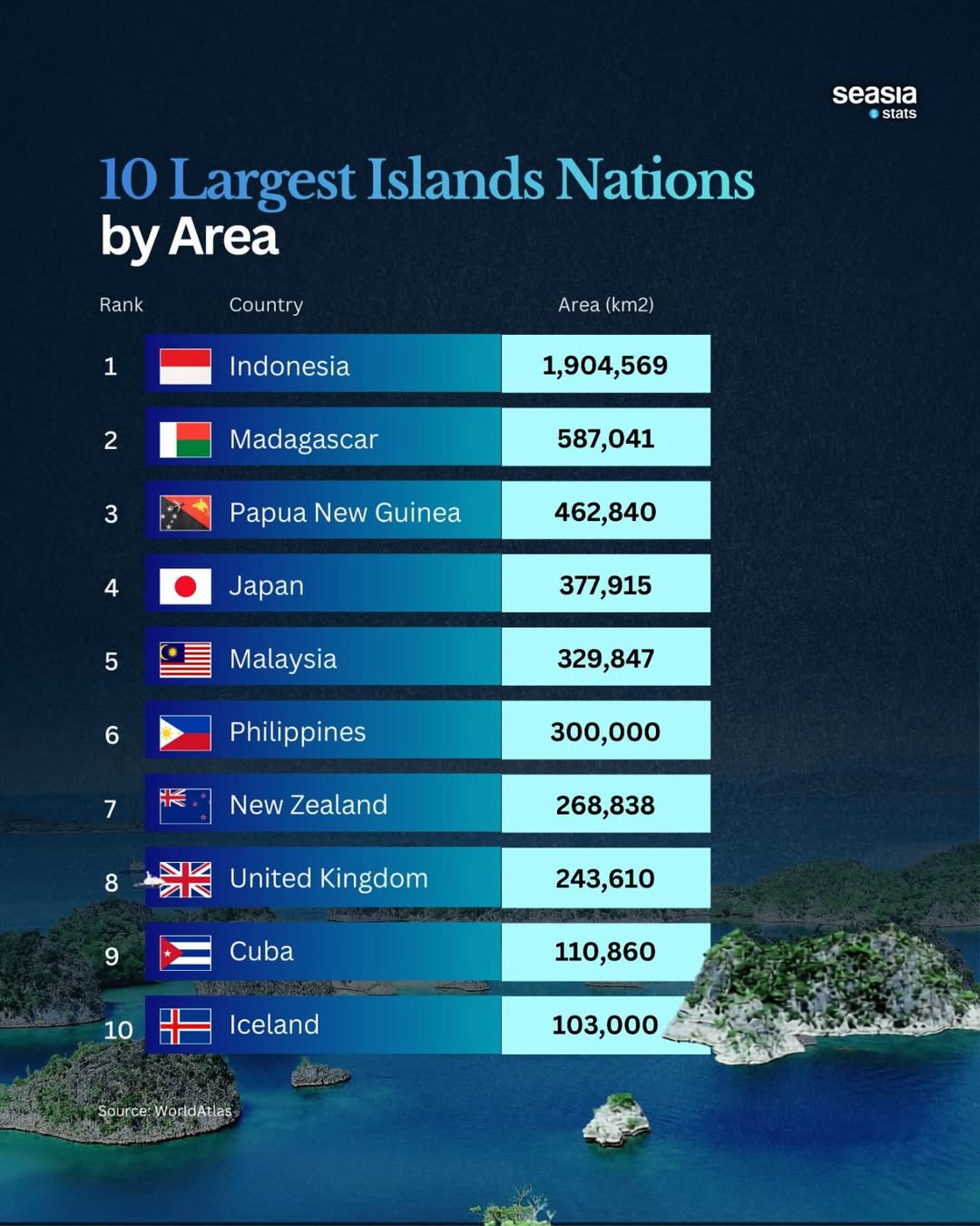
Island nations are countries whose territories are located entirely on one or more islands. These nations often possess unique cultures, ecosystems, and geographic characteristics shaped by their separation from continental landmasses. Among them, several stand out for their impressive size.
The largest island nation in the world is Indonesia, covering approximately 1,904,569 square kilometers. Consisting of more than 17,000 islands, Indonesia stretches across Southeast Asia and Oceania.
Its vast territory includes major islands such as Java, Sumatra, Kalimantan, Sulawesi, and parts of New Guinea. Indonesia is also one of the world's most populous countries and is renowned for its extraordinary biodiversity.
The second-largest island nation is Madagascar, with an area of 587,041 square kilometers. Located off the southeastern coast of Africa, Madagascar is famous for its unique wildlife, including lemurs and countless plant species found nowhere else on Earth.
Papua New Guinea ranks third, encompassing 462,840 square kilometers. Occupying the eastern half of the island of New Guinea and numerous surrounding islands, the country is known for its rugged landscapes and remarkable cultural diversity, with hundreds of distinct languages spoken across its territory.
Japan, covering 377,915 square kilometers, is the fourth-largest island nation. Composed of four main islands and many smaller ones, Japan combines advanced urban development with rich cultural traditions and dramatic natural scenery.
Malaysia follows with 329,847 square kilometers. Its territory is divided between Peninsular Malaysia and East Malaysia on the island of Borneo, giving the country a unique geographic structure and diverse ecosystems.
The Philippines, with an area of 300,000 square kilometers, consists of more than 7,000 islands. The nation is known for its extensive coastline, tropical climate, and rich marine biodiversity.
New Zealand covers 268,838 square kilometers and is located in the southwestern Pacific Ocean. Its spectacular mountains, forests, and coastlines have made it a global destination for tourism and outdoor recreation.
The United Kingdom, occupying 243,610 square kilometers, is situated primarily on the island of Great Britain along with part of the island of Ireland and numerous smaller islands. It has played a major role in global history, politics, and culture.
Rounding out the top ten are Cuba with 110,860 square kilometers and Iceland with 103,000 square kilometers. Both nations possess distinctive landscapes, from Cuba's tropical environment to Iceland's volcanoes, glaciers, and geothermal features.
Together, these island nations showcase the remarkable geographic diversity found across the world's islands.