

The Largest National Parks in Southeast Asia
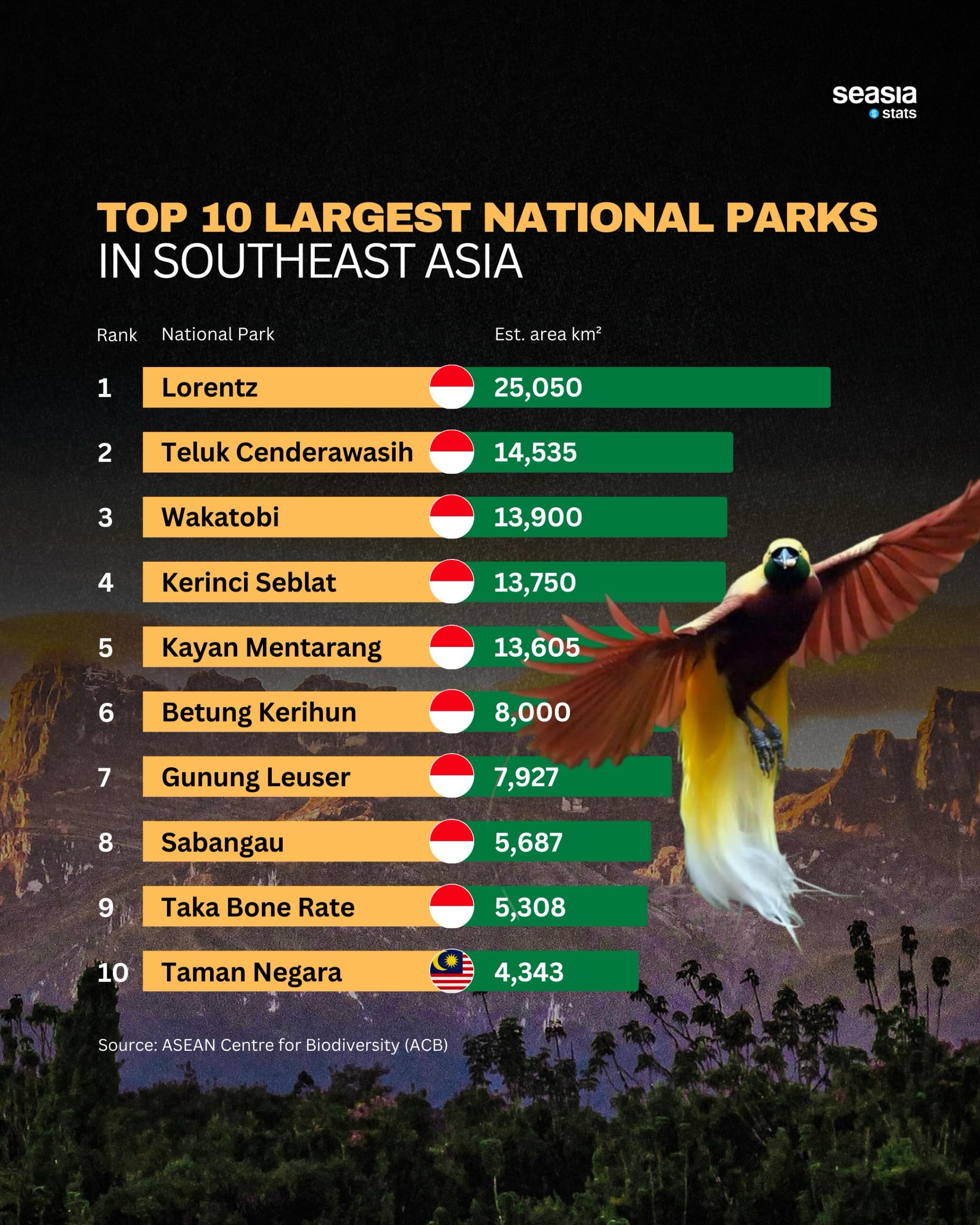
Nine out of ten largest national parks in Southeast Asia are located in Indonesia.

Southeast Asia is home to some of the world's most spectacular protected landscapes, preserving tropical rainforests, coral reefs, wetlands, mountains, and extraordinary biodiversity.
According to the ASEAN Centre for Biodiversity, the region's largest national parks play a vital role in conserving endangered species and maintaining ecological balance while supporting sustainable tourism and scientific research.
Topping the list is Lorentz National Park in Indonesia, covering an impressive 25,050 square kilometers. Recognized as a UNESCO World Heritage Site, Lorentz spans ecosystems ranging from tropical marine environments to glaciers, making it one of the most diverse protected areas on Earth.
Second is Teluk Cendrawasih National Park, also in Indonesia, with an area of 14,535 square kilometers. The park is renowned for its rich marine biodiversity, coral reefs, and opportunities to encounter whale sharks in their natural habitat.
The third-largest protected area is Wakatobi National Park, encompassing 13,900 square kilometers. Located in Southeast Sulawesi, Wakatobi is internationally recognized as one of the world's premier diving destinations, featuring vibrant coral reefs and thousands of marine species.
Indonesia also dominates the next several positions. Kerinci Seblat National Park covers 13,750 square kilometers and protects the longest mountain range in Sumatra, providing habitat for critically endangered species including the Sumatran tiger and rhinoceros.
Kayan Mentarang National Park, spanning 13,605 square kilometers, safeguards one of Borneo's largest remaining tropical rainforest ecosystems.
Completing the upper half of the ranking is Betung Kerihun National Park, with 8,000 square kilometers, followed by Gunung Leuser National Park, covering 7,927 square kilometers. Gunung Leuser is globally important as one of the last places where orangutans, tigers, elephants, and rhinoceroses coexist in the wild.
The remaining parks further highlight Southeast Asia's remarkable natural diversity. Sabangau National Park occupies 5,687 square kilometers and protects extensive peat swamp forests that are essential carbon stores and orangutan habitats.
Taka Bone Rate National Park, measuring 5,308 square kilometers, contains one of the world's largest atoll systems and supports exceptional marine biodiversity.
Rounding out the top ten is the only national park outside Indonesia which is Taman Negara National Park in Malaysia, covering 4,343 square kilometers. Estimated to contain one of the world's oldest tropical rainforests, the park attracts visitors with its ancient forest, wildlife, and canopy walkways.
Together, these ten national parks represent Southeast Asia's commitment to conserving irreplaceable ecosystems. Their immense size and ecological significance make them invaluable for biodiversity conservation, climate resilience, scientific research, and sustainable tourism, ensuring that the region's extraordinary natural heritage can be enjoyed by future generations.